Showing posts with label microorganisms. Show all posts

January 20, 2007

Celunol produces Ethanol from Wood using Bacteria

Celunol Corporation out of Dedham, Massachusetts is making good on its commitment to help open commercial-scale cellulosic ethanol facilities this year using their proprietary wet biomass conversion technology.

The technology

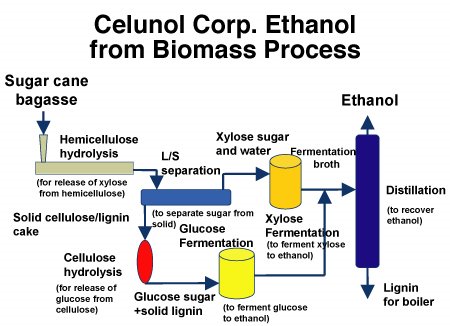
The sugar in cellulosic biomass is locked up in the form of cellulose and hemicellulose. Cellulose contains glucose, the same type of sugar—a six-carbon (C6) sugar—that is found in cornstarch and that can be fermented to ethanol using conventional yeasts.  However, hemicellulose contains mainly non-glucose sugars—five-carbon (C5) sugars.  Conventional yeasts cannot ferment most non-glucose sugars to ethanol with commercially acceptable yields.

Celunol’s technology enables almost complete conversion of all the sugars found in cellulosic biomass.  This efficiency advantage, combined with the low input cost of cellulosic biomass, results in superior economics in the production of ethanol.

(Its) groundbreaking technology is based on the metabolic engineering of microorganisms. Its key element is a set of genetically engineered strains of Escherichia coli bacteria that are capable of fermenting into ethanol essentially all of the sugars released from many types of cellulosic biomass. This trait enables Celunol to achieve the required efficiency to make the process commercially feasible.

----------------
BioEthanol Japan Begins Production of Cellulosic Ethanol from Wood Scraps; Uses Celunol Technology

BioEthanol Japan on Tuesday became the world’s first company to produce cellulosic ethanol from wood construction waste on a commercial basis.

The plant in Osaka Prefecture has an annual capacity of 1.4 million liters (about 370,000 gallons US). In 2008, it plans to boost production to 4 million liters (1 million gallons).

BioEthanol Japan was established in 2004 by five companies, including construction firm Taisei Corp., major trading house Marubeni Corp., Daiei Inter Nature System, and beermaker Sapporo Breweries Ltd.

Marubeni is supplying the process technology, which it has licensed from US-based Celunol (earlier post), to BioEthanol Japan. Marubeni is also supplying the same technology for a wood ethanol project in Asia, and is also involved in a bioethanol project using sugar cane in Thailand run by the New Energy and Industrial Technology Development Organization (NEDO).

Celunol is a privately held company headquartered in Dedham, Massachusetts moving rapidly to commercialize its proprietary technology for producing ethanol from a wide array of cellulosic biomass feedstocks, including bagasse, agricultural waste, wood products and dedicated energy crops.


technorati , , , , ,

November 22, 2006

Greenhouse Gases as Feedstock?

Will bacteria play THE major role in the production of biofuels and sequestering of carbon dioxide? Patents already exist for strains of bacteria that can convert syngas into ethanol.

New research being funded by the U.S. Department of Energy to study new roles for bacteria. The challenge is to sequence the DNA of certain cyanobacteria that can extract greenhouse gases from the air and, using sunlight, convert them into "thick mats of green biomass, from which liquid ethanol can be extracted." Sounds similar to the idea of using algae as a "breath mint" for smokestacks - but much more refined.

Here are excerpts form an article that appeared in "Washington University in St. Louis News & Information":

---------------------
Sequencing The DNA Of Six Photosynthetic Bacteria To Make Biofuel To Warm Homes And Run Cars
by Tony Fitzpatrick

The United States Department of Energy (DOE) has devoted $1.6 million to sequencing the DNA of six photosynthetic bacteria that Washington University in St. Louis biologists will examine for their potential as one of the next great sources of biofuel that can run our cars and warm our houses.

That's a lot of power potential from microscopic cyanobacteria (blue-green algae) that capture sunlight and then do a variety of biochemical processes. One potential process, the clean production of ethanol, is a high priority for DOE.

A natural at fermentation

"The Department of Energy is very interested in the production of ethanol or hydrogen and other kinds of chemicals through biological processes," said Pakrasi, who also is director of the University's Bioenergy Initiative. "Cyanobacteria have a distinct advantage over biomass, such as corn or other grasses, in producing ethanol, because they use carbon dioxide as their primary cellular carbon source and emit no carbons and they naturally do fermentation. In biomass, yeast needs to be added for fermentation, which leads to the production of ethanol. Cyanobacteria can offer a simpler, cleaner approach to ethanol production." Pakrasi heads a group of nearly two dozen researchers who will do a lengthy, painstaking manual annotation of the gene sets of each organism to figure out what each gene of each strain does.

"The diversity in those sequences will give us the breadth of what these organisms do, and then we can pick and choose and make a designer microbe that will do what we want it to do," Pakrasi said. "We want to tap into the life history of these organisms to find the golden nuggets."

One possible way to produce ethanol using Cyanothece strains is a hybrid combination of the microbe and plant matter where the cyanobacteria coexist with plants and enable fermentation. The model exists in nature where cyanobacteria form associations with plants and convert nitrogen into a useful form so that plants can use the nitrogen product.

Extracting ethanol

At Washington University, Pakrasi and his collaborators have designed a photobioreactor to watch Cyanothece convert available sunlight into thick mats of green biomass, from which liquid ethanol can be extracted.

Pakrasi led the sequencing of Cyanothece 54112 as the focus of a Department of Energy "grand challenge project" that resulted in the sequencing and annotation of a cyanobacterium gene that could yield clues to how environmental conditions influence key carbon fixation processes at the gene-mRNA-protein levels in an organism.

technorati , , , , , ,

LOUISIANA: Cellulosic Feedstock Conversion Deployments

The process of converting sugar cane into either sugar or ethanol results in a biomass waste product called bagasse. Many research efforts have tried to find a renewable fuel use for bagasse. An obvious use is to burn it, as they do in Brazil, but the carbon dioxide emissions offsets the benefit of any heat or electricity that would be co-generated during the process.

Recently there have been two press releases for new biorefineries in Lousiana that intend to convert corn and sugar cane (using sugar fermentation) and the bagasse (using catalysts or enzymes) into ethanol and other renewable products.

--------------------------

Jennings Project using Celunol Technology

Celunol Corp. is developing a 55-million gallon ethanol production facility in Jennings, Louisiana.

By working with the University of Florida and acquiring other technology, Celunol has developed a unique technology to release the sugar potential of cellulosic biomass.

Celunol's landmark technology is based on the metabolic engineering of microorganisms. The key element of Celunol’s technology is genetically engineered strains of Escherichia coli bacteria that are capable of fermenting into ethanol essentially all of the sugars released from all types of cellulosic biomass. This enables Celunol to achieve the required efficiency to make the process commercially feasible.

Feedstocks That Can Be Used With Celunol Technology

Celunol expects that its technology will be able to convert almost any type of cellulosic biomass material to ethanol. Examples of these feedstocks are:

Agricultural Residues
Rice straw
Corn stover
Wheat straw

Agricultural Wastes
Sugarcane bagasse
Rice hulls
Corn fiber
Sugar beet pulp
Citrus pulp
Citrus peels

Forestry Wastes
Hardwood and softwood thinnings
Hardwood and softwood residues from timber operations

Wood Wastes
Saw mill waste
Pulp mill waste

Urban Wastes
Paper fraction of municipal solid waste
Urban wood waste
Urban green waste

Dedicated Crops
Switchgrass
Hybrid poplar wood

-------------------------

BioEnergy International Commences Site Work on 108 Million Gallon Ethanol Project

BioEnergy International, LLC ("BioEnergy"), a company developing proprietary technologies to produce ethanol and specialty chemicals from traditional feedstocks as well as lignocellulosics, announced today that it has commenced site work on its first biorefinery, a 108 million gallon per year ethanol plant located on land leased from the Lake Providence Port Commission in East Carroll Parish, Louisiana.

Initially the plant will produce ethanol from corn using conventional technology designed by Delta-T Corporation, a leading, innovative designer of alcohol plants, systems and technology. BioEnergy intends to rapidly introduce its proprietary technology to produce fuels and specialty chemicals using organic wastes such as bagasse, rice hulls and wood in addition to corn. BioEnergy has a pipeline of projects in various stages of development representing over 400 million gallons of annual ethanol production.


technorati , , , , ,