Showing posts with label wildlife. Show all posts

August 22, 2011

Increased global forest density necessitates more forest management

Environmental Research Web published a report last month based on U.S. and European research concluding that global "Forest Density is Increasing." This substantiates the argument that Indirect Land Use Change is a speculative theory because increased forest density can mitigate the impacts of deforestation - particularly in large forests like Brazil's. If we can sustainably grow and manage forests that have increased density or develop best practices that improve the health and yield of forests (just as we can with food and energy crops) then minor variations in the use of acres becomes a meaningless concern.

Unfortunately, many in the North American environmental community will conclude that the study results prove something else. They believe that, by obstructing forest industry development and enforcing a more laissez-faire attitude toward forests, that forests will cure themselves of the "exploitive invasion" by the forest products industry.

Almost everyone agrees that that an end to active fire suppression decades ago in North America has resulted in more forest density. However, the challenge and responsibility of maintaining forest health is more important now than ever before. Is it safe to have unmanaged forests with 400-600 trees per acre when, properly thinned, it is much healthier and fire resistant at 100?

What is the value of a carbon sink if it (and its diverse habitats) can be lost to megafires and beetle kill? These disasters have grown substantially since 2000 in North America - in acreage and intensity. One can believe that "natural conditions" will fix forests but if that same person believes that 39% more carbon in the atmosphere compared to the pre-Industrial era compromises natural conditions then a laissez-faire attitude toward forest health is pure negligence.

Increased density of our forests makes it imperative that we exercise more forest management. The academics (UC/Berkeley), agencies (USDA/Forest Service and the Woody Biomass Utilization Group), and associations I belong to (TAPPI, SAF, ACORE) all tell me that the key to improving forest management is building more "infrastructure." They define infrastructure to mean forest products facilities, including biopower plants and biorefineries, that can convert forest thinnings into products, power, and fuels.

These products that have the added carbon cycle benefit of reducing greenhouse gases from combusting coal and oil distillates. More infrastructure will also provide important disaster response alternatives for managing forest salvage from hurricanes, tornadoes, floods, and droughts - all anticipated to rise with global climate change.

I wrote about a 2008 study of 4 wildfires in California and the carbon consequences of active vs. inactive forest management as carried out by private vs. federal managers (see Links between California Wildfires and GHG emissions). The data analysis from this study raises some important questions relevant to our perception of the best way to manage forests before and after high density fuelwood accumulation.

----------------

technorati , , ,

September 4, 2008

Woody Biomass Removal Case Studies


Here are a series of publicly accessible case studies that point to the conscientious work being performed and meticulously documented by forest managers and academia "so that managers, land- owners, business entrepreneurs, communities, and industry partners can easily access information to help them remove and utilize woody biomass from forests in an efficient and ecologically responsible manner."

Who is the Forest Guild?

We are a professional organization of forest stewards and affiliates who are passionate about sustaining and restoring the integrity of our forests while meeting the needs of the communities that rely on them. Our members’ work provides tangible examples of “excellent forestry”—forestry that is ecologically, economically, and socially responsible.

Anyone can access the fruits of this study by simply inserting a search keyword (a species of animal, for instance) or by choosing from multiple options for each of several fields of information (see screen shot below).

------------------------
Woody Biomass Removal Case Studies
Lessons Learned and Strategies for Success

Forest managers remove woody biomass from forests for many reasons, including: reducing hazardous fuels, increasing fire safety in the wildland-urban interface, restoring ecosystems, improving wildlife habitat, conducting forest stand improvement, and providing products from poles to pellets. Managers across the country on public, tribal, conservation, and private lands have utilized a wide variety of strategies for removing biomass. To help share these strategies, the Joint Fire Sciences Program initiated two coordinated analyses of themes, strategies, and lessons learned from an examination of over 40 biomass removal case studies.

Two research teams, one led by the Forest Guild and another by the University of Minnesota, have collected and analyzed the case studies presented here so that managers, land- owners, business entrepreneurs, communities, and industry partners can easily access information to help them remove and utilize woody biomass from forests in an efficient and ecologically responsible manner.
Search the case studies
Case studies index
Project summary – University of Minnesota
Project summary – Forest Guild
Links to woody biomass resources and information

----------------
technorati ,

August 25, 2008

The Forest Service and Climate Change

The Forest Service has put together a 12 minute video titled The Forest Service and Climate Change that encapsulates some of the mounting concern for the impact of global warming on the health of our forests, the ability of forests to counteract its progress, and how the Forest Service plans to deal with it.
----------------
technorati ,

August 11, 2008

Authority returned to the Forest Service

I am convinced that one of the hardest jobs in the government is to work in the USDA Forest Service. It is not that it is dangerous work... it's that it must be so frustrating.

Here is an organization entrusted with a gargantuan challenge, with what should be a more than adequate budget, and more responsibility than should be expected of any governmental agency - safeguarding the health of one of our biggest assets, our federal forests. The job should be the most fulfilling in government - "gardeners" of our rich forest legacy and its wildlife. The people I've met are dedicated and top-notch - steeped in decades of education and experience studying the fine machinations of our forest ecology.

So why is it so frustrating? It is because the management lacks any real authority. They cannot control their own much less our forests' destiny.

What is ironic is that the people that challenge them the most - the non-governmental organizations (NGOs) that frequently take them to court - insist on turning more private lands into their care. Do they receive commensurate budgetary increases to manage the additional lands? No. Are the forests going to be taken care of better by a federal bureaucracy than by private timberland owners - no. Why? Well, the private owners had authority to tend to their assets. The Forest Service has very little control over these same lands. It must be great sport taking the FS to court but it certainly isn't resulting in healthier forests based on better science.

Which is why it is heartening to see the Ninth Circuit Court of Appeals come out and unanimously overrule a decision that judges should not be making scientific decisions in lieu of Forest Service expertise. The August 2008 issue of the Society of American Forestry (SAF) reports on this encouraging turnaround.

Incredibly, many court challenges barring forest management projects are based on the specious argument that the Forest Service violates the National Environmental Policy Act (NEPA) because it doesn't "adequately address all of the uncertainties in its proposed treatments." The lower courts often take the view that "the public interest in preserving nature and avoiding irreparable environmental injury outweighs economic concerns." In short, neither money nor time matters if there is any possibility that their actions might be detrimental to some special concern or another. The appeals court's ruling counters that this policy gives the lower court too much authority over scientific matters outside its jurisdiction.

In its July 2 ruling on Lands Council v. McNair (or Lands Council I) the panel wrote that, “In essence, Lands Council asks this court to act as a panel of scientists that instructs the Forest Service how to validate its hypotheses regarding wildlife viability, chooses among scientific studies in determining whether the Forest Service has complied with the underlying Forest Plan, and orders the agency to explain every possible scientific uncertainty. As we will explain, this is not a proper role for a federal appellate court.”"

Such a ruling couldn't come too soon. As explained elsewhere in this blog, our forests suffer from too little forest management stalled interminably by litigation - particularly in view of the unnatural conditions of smoke and greenhouse gas emissions from wildfires which continue to distort the historic profile of our forests.

--------------------
Ninth Circuit: Improper for Judges to Act as Scientists
11-Judge Panel Says Courts Must Defer to Agency Expertise

In a landmark case, an 11-judge panel of the US Circuit Court of Appeals for the Ninth Circuit unanimously ruled last month that courts must defer to US Forest Service expertise when it cannot be shown that the agency acted in scientific uncertainty in complying with the National Environmental Policy Act (NEPA), and that the agency could choose the scientific methods it uses in meeting the requirements of the National Forest Management Act (NFMA).

Undersecretary of Agriculture Mark Rey praised the decision.
“We think this is a fairly significant decision—maybe the most significant Forest Service environmental case of the past two decades,” he said. “The panel was reacting to the Ninth Circuit getting deeper and deeper into a posture of second-guessing agency expertise or its use of expert scientific information. In several instances, the panel reversed what they believed was a drift in Ninth Circuit jurisprudence away from the standards of review used by other circuits.”

Rey added that the panel said that it was not necessary for the Forest Service to prove its methods to a level of scientific certainty.
“The panel said that wildlife viability is not the only consideration that the agency has to take into account and that we are not required to use on-the-ground analysis in all cases,” Rey said. “They said that it is not the court’s role to conduct an assessment of the methodology the Forest Service uses, that the Forest Service has discretion to determine what scientific studies are important, and that we’re not required to address every possible uncertainty in our decisionmaking.”

----------------
technorati , ,

January 9, 2008

Logging trees to save forests from development


One of my favorite forest industry resource sites is the Smallwood Utilization Network operated by Craig Rawlings and Nora McDougall of Missoula, Montana. I find a timely piece of information whenever I read one of their monthly newsletters (you can subscribe for free here).


This month's nugget is an editorial published in the Seattle Times about the retrenchment of various conservancy groups who are suddenly realizing that the forest products industry is good for forests and is a bulwark against the plagues of bugs, fires, and real estate developers that are ruining these precious resources.

The author of the article is Brian J. Boyle was Washington's commissioner of public lands from 1981 to 1993 and is the leader of the Northwest Environmental Forum. The University of Washington's College of Forest Resources has brought together a broad spectrum of stakeholders to apply scientific and policy information to address critical environmental and natural resource management issues. Potential users will include resource and environmental agencies; energy, forest, agriculture, and real estate interests; and land conservancies, environmental groups, tribes, and NGOs.

Here is the text of his article in its entirety...

----------------
Save Northwest forests for conifers, not condos
By Brian J. Boyle

The Nature Conservancy announced this past summer that it plans to log trees on 161,000 acres in the Adirondack forest in New York to preserve the forest. The conservancy says that the logging will help pay off the debt incurred buying the land from a private owner, pay taxes, supply logs to a local sawmill and protect "a unique jewel of nature from fragmentation and development."

In Washington, the Cascade Land Conservancy has acquired 140,000 acres of "working forests" with a similar goal — to prevent development. The land conservancy also has plans to log sustainably, in keeping with the idea that the forest "works" when it provides logs and jobs — and income for the conservancy to manage the forest.

One might ask, how did the conservationists become tree-cutters?

Twenty years ago, environmental activists chained themselves to trees to save them from cutting, and the forest industry was often branded a threat to the environment. Yet, today, sustainable logging may be the salvation, because in the words of one conservationist, it's a choice between conifers and condos.

When you fly over Western Washington and some areas east of the Cascades in the daylight, you see unbroken swaths of trees. A forest? you ask. But try flying over at night — in Eastern King, Snohomish, Okanagan or Lewis counties — and what you will see are lights, thousands of them, from houses on rural subdivisions split into one- to five-acre parcels. This isn't a forest, it's "rural residential." This forest doesn't have spotted owls or murrelets, and the dominant bird species may be the crow. Once-timbered slopes now have serpentine driveways leading up to rural mansions.

Working forests, on the other hand, include areas actively managed for timber and for environmental services, such as fresh water, wildlife habitat and climate protection. Washington's working forests include 8 million acres of private and tribal forests and more than 2 million acres of state forestland.

Protecting the forests from development has turned conservation leaders into working-forest proponents. They've teamed up with old enemies and other strange bedfellows to keep sustainable timber operations in business, and they're stopping forests from being converted to subdivisions the old-fashioned way, by buying the land.

The forest industry isn't the same one your grandparents knew. The so-called industrial forest is disappearing. Weyerhaeuser is the last big corporate owner in the Northwest and its future is uncertain. Other former industrial forests are now owned by pension funds and investors and valued as financial investments, not for their tree values, and are swapped from landowner to landowner to rebalance portfolios.

Family forest owners eke out a living while fending off pressures from neighbors who live in subdivisions that used to be forests. Any forest landowner may find it expedient to sell as Washington's urban areas grow and subdivisions are permitted. The money from a developer fattens a retirement portfolio faster than the money from trees that can't be harvested for 30 years. But, a forest thick with houses ceases being a working forest, a shelter for wildlife and a protector of streams.

Conservation groups, local land trusts, and timber industry, government and tribal representatives, at a series of dialogues convened as the Northwest Environmental Forum, agreed that to sustain the forest environment, they need to help keep the timber industry in business through incentives for landowners. Here is what this diverse group thinks the Legislature should do:

• Create conservation markets, by putting a price on fish-and-wildlife habitat and carbon capture, so landowners can realize profits from more than just timber;

• Help nonprofits and others acquire and trade easements and development rights to protect critical forest watersheds;

• Remove wood from overstocked and overstressed forests to reduce wildfire risks, protect wildlife habitat and save state forest-fire-suppression funds;

• Help investors produce bioenergy from wood cellulose;

• Provide tax incentives so developers permanently protect forestland in exchange for higher-density development elsewhere.

Many say the Puget Sound-area population will double by 2050. That's a lot of potential condos, unless we can find ways for the forests to be saved and to support this new image of the industry.

Copyright © 2008 The Seattle Times Company
----------------

October 5, 2007

Ending Obstructive Environmental Lawsuits

An oft heard frustration of the USDA Forestry Service is the frequency of challenges mounted in opposition to their planned forest management programs. In June of last year, the Society of American Foresters published a comprehensive study of the legal challenges filed in federal court from 1989-2002 - all 729 of them!

Dr. Robert Malmsheimer, lead researcher and Associate Professor of Forest Policy and Law at State University of New York's College of Environmental Science and Forestry (SUNY ESF) expressed the good news/bad news verdict of the study:

“The Forest Service enjoys an excellent success rate – winning 57% of all cases and 73% of the cases decided by a judge or panel of judges – especially when one considers that the Forest Service is the defendant in all of these cases and the plaintiffs get to choose the basis and venues for their lawsuits.

“It’s interesting to note however, that the Forest Service settles more than one in every six cases – almost as many land management cases as it loses. Clearly both the Forest Service and litigants view settlements as an important dispute-resolution tool.”

The study’s authors also note that plaintiffs win less than one of every four cases. This suggests that plaintiffs may receive indirect benefits from litigation, such as publicity, delay of action, and the chance of establishing new legal precedents. These benefits may be as important to some litigants as the direct benefits of winning lawsuits.

Delays are costly to the environment. Forest Service programs are designed to either prevent a health problem for a forest or remediate an unhealthful condition that could result in fires, decay, or infestations. It has been determined that a decaying forest emits 300% more greenhouse gases than a fire ravaging the same tree. The Forest Foundation reports that "Nearly four years after fires burned more than 133,000 acres of national forest land in California, less than one percent of those acres have been replanted.” As Forest Service resources are squandered fighting litigation and forest fires, is it any wonder that more remedial programs are shelved until more resources are available?

On the bright side, Michael Moore of The Missoulian reports that environmentalists and government leaders have found a way to reach consensus on forest programs without resorting to legal redress. See excerpts below:

----------------------
Forest Parties Reach Consensus on Restoration Principles
by MICHAEL MOORE of the Missoulian, September 28, 2007

For months, a diverse group of conservationists, timber industry officials, forest users and government leaders met in an effort designed to stem the tide of lawsuits filed against forest restoration projects.

Finally, on Thursday, the group announced a set of 13 principles that might guide future restoration work on the Bitterroot and Lolo national forests.

And because those principles are the result of a time-consuming consensus process, the hope is that restoration projects will move ahead more quickly, be less likely to spawn litigation and, most important, be good for the ecosystems they're designed to restore.

The effort started in the frustrating wake of a post-fire restoration project in the southern Bitterroot Valley. The project became embroiled in litigation, and prompted many on both sides of the debate to wonder if there wasn't a better way to approach such projects.

Not long after that, a group of about 35 gathered at the Lubrecht Experimental Forest for a meeting that eventually evolved into the Montana Forest Restoration Working Group.

The group drew representatives from industry and the conservation community, but also from forest user groups like snowmobilers, horsemen and outfitters.

Over the next months, they worked to find what they characterized as a zone of agreement, a place where everyone could accept what a successful restoration project ought to look like.

The zone eventually grew into a preamble and set of principles. That preamble notes the importance of scientifically sound, ecologically appropriate restoration work, but it also factors in the importance such work can have on surrounding rural communities.

The principles include:

- Restore functioning ecosystems by enhancing ecological processes.
- Re-establish fire as a natural process on the landscape.
- Consider social constraints and seek public support for reintroducing fire.
- Engage community members and interested parties in the restoration process.
- Improve terrestrial and aquatic habitat and connectivity.
- Establish and maintain a safe road and trail system that is ecologically sustainable.
- Integrate restoration with socioeconomic well-being.

Now that the principles are in place, the committee will begin work on two pilot projects on the Lolo National Forest and one on the Bitterroot. Those projects are still under consideration and were not announced on Thursday.

On a project-to-project basis, committee membership will vary depending on where the project is, with an eye toward bringing stakeholders and those with the most knowledge of the area to the table, Ekey said.

Pyramid's Gordy Sanders said the end result should be a restoration process that works for both the land and communities.

The Full Restoration Guidelnes Can be viewed and Down loaded at www.montanarestoration.org.

------------------

Finally, in a recent article in the NY Times titled As Logging Fades, Rich Carve Up Open Land in West environmentalist see another ominous threat that is a consequence of the demise of the forest products industry - the rise of timberland sales to real estate developers.
In ways that would have been unthinkable only a few years ago, environmentalists and representatives of the timber industry are reaching across the table, drafting plans that would get loggers back into the national forests in exchange for agreements that would set aside certain areas for protection.

Both groups are feeling under siege: timber executives because of the decline in logging, and environmentalists because of the explosion of growth on the margins of the public lands.

technorati , ,

September 29, 2007

Woody Biomass: Fuel for Wildfires


This article contains the text and some images from the first half of a speech I presented at the Energy from Biomass and Waste conference in Pittsburgh, PA on September 27. It leads into the second half of the presentation titled Woody Biomass: Feedstock for BioEnergy which describes the existing and emerging technologies that can utilize woody biomass for the production of bioenergy - heat, steam, electricity, and biofuels. Many of the statistics and photos come from an excellent Forest Foundation publication titled Protecting Communities and Saving Forests.

-----------------
Woody Biomass: Fuel for Wildfires

I believe that the conversion of biomass to energy represents not only a sustainable, clean alternative to fossil fuel energy but that implementing these emerging technologies can help us solve environmental and ecological challenges of the new millennium.

This presentation will focus on just one environmental challenge - wildfires in the continental U.S. - and how a robust woody biomass conversion industry can provide tools to lessen the threat to our forests.

There are over 10 million private forest owners in the U.S. Although you could say that the country experienced “deforestation” during its early development, the acreage of forests have not diminished at all during the last 100 years. Forests have provided fuel and created great industries for furniture, construction, and paper - industries that sequester carbon.

Unfortunately, these industries that are now stagnating and, in some cases, staggering under the multiple pressures of cheap imports, crusades against forest use, and timberland sell-offs due to skyrocketing real estate prices.

Added to these pressures is the appropriation of more lands to public ownership shifting responsibility to management by the USDA Forest Service.

Some groups seek to preserve forests, biodiversity, and wildlife habitats by severely limiting access by the forest product industries and, through litigation, micromanaging the public forest services charged with insuring forest health.
I contend that it is simply not economically feasible or sustainable for public agencies to take proper care of forests under these conditions.

Forest health has suffered greatly from wildfires and bug infestations.

Wildfires and Greenhouse Gas Emissions
We all know that healthy forests are capable of sequestering vast amounts of greenhouse gases which is a leading cause of global warming.
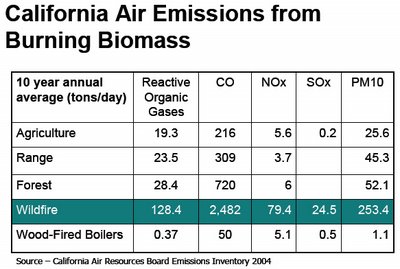
But we are just starting to recognize that forests can emit vast amounts of GHG through burning and decaying. Here are some numbers pulled together by the California Air Resources Board comparing the average emissions of major geographic sectors. Notice that wildfire emissions dwarf the volume from the other sources combined!

Satellite photographs taken during the last four years of wildfire’s devastating impacts on public lands provide clear evidence of the extent of this travesty.

In Congressional testimony Senator Pete Domenici of New Mexico testified that when the Hayman Fire burned in Colorado in 2002, NASA scientists estimated that the fire was emitting more carbon dioxide in one day than all the vehicles in the United States emitted in a week. It lasted 14 days.

Since 2002 mega-fires have gotten worse.

In 2003 the San Diego Cedar Fire (click to enlarge) was the largest in California history lasting 8 days and consuming an area half the size of Rhode Island. Here is a satellite photo of the emissions - so dense that air traffic control towers in L.A. and San Diego were closed for a period of time.


Simultaneously, a fire was burning in the San Bernardino Mountains, just east of L.A. It lasted two weeks and destroyed more than 1,000 other homes. Fortunately it stopped before reaching resort towns near Lake Arrowhead and Big Bear, shown in the upper right corner. If it had it would have decimated evergreen trees that were already sick, dead, or dying from bark beetle infestations - which, incidentally, is what happened in Big Bear two weeks ago. The lakeside community of Fawnskin had to be evacuated by the 15,000 acre fire. The smoke plume from this fire reached far north into Nevada.

Here is what a burned forest looks like (click to enlarge) - charred remains stripped of its leaves and pine needles and in active decay. According to the Forest Foundation the impact of wildfires does not end with the smoke. During decay trees emit about 300% more greenhouse gases than what was emitted during the fire.

Most of the charred remains need to be removed and the lands replanted. Unfortunately, “Nearly four years after fires burned more than 133,000 acres of national forest land in California, less than one percent of those acres have been replanted.”

Just Monday, Senator Craig of Idaho gave testimony in Congress stating that over $2 Billion has been spent this year fighting forest fires while less than $600 million has been spent on preventing them.

Indeed, 2007 has seen a startling upsurge in mega-fires. The Angora Fire, a 3,100 acre blaze in South Lake Tahoe, was responsible for emitting the equivalent of 143,000 cars for an entire year. A blaze 15 times that size devastated Montana.

On July 4th a fire broke out in the Santa Barbara mountains. A week later in Yosemite a satellite photo series was posted throughout the park warning hikers of the health impacts caused by the fire 180 miles away. Driving south through Bakersfield the sun was blotted out by the smoke. The fire lasted another two weeks.

The point is that MORE greenhouse gases are emitted each year from wildfires than we are likely to save in a decade of reduced vehicle greenhouse gas emissions. We can do much better.

Wildfire Impact on Wildlife
They say the road to hell - in this case wildfires - is paved with good intentions. Activists mount crusades and file litigation to protect endangered species which frustrate attempts to fix forest health problems that lead to wildfires.

It is impossible to estimate the impact of wildfires on wildlife but even if the species escape, it leads to overcrowding in surrounding ecologies. But not even mobile animals are immune from the quick moving fires. Like the victims of Pompei most animals die from asphyxiation. Fires can boil streams which kill the fish. The U.S. Fish and Wildlife Department reports that Georgia’s largest fire ever that started in the Okefenokee Swamp this year was also the most expensive ever for the agency.

The problem of forest density
According to Texas A&M professor Dr. Tom Bonnicksen, a founder of the Forest Foundation, the problem is one of forest density. Our forests have 4 to 10 times as many trees per acre as they used to have. People used to be able to gallop through forests - now it is hard to walk through them or fight fires within them.

Excess forest biomass in the form of small diameter trees, and underbrush create a kindling “ladder of fuel” that helps surface fires spiral up to the crowns of trees. Once there, a fire storm can evolve whipped by winds to spread rapidly in all directions.

Public agencies waste precious funds to fight the wildfires - the symptoms of unhealthy forests - rather than invest it in efforts to restore and manage forest health through thinning. When asked what the biggest hurdle is to deploying thinning programs that are important to restoring forest health, field Forest Service planners say "infrastructure." Without forest product industries to convert the woody biomass to carbon sequestering products and bioenergy, there is no where to store the collected woody biomass and no economically sustainable way to help pay for the program.

To restore forests to a healthy condition, Dr. Bonnicksen recommends a three step, economically sustainable solution that involves private industry who would restore and maintain forest stewardship as part of their operating overhead.
1. First they would harvest decaying biomass
2. Then reforest to a historic model specific to the forest, and
3. Third mechanically thin vulnerable forests of woody biomass as part of their stewardship.

The USDA Forest Service could provide oversight of the program.

-----------------
The followup presentation is titled Woody Biomass: Feedstock for BioEnergy

----------------
technorati , ,

August 27, 2007

California wildlife threatened by mega fires

The Forest Foundation has made a field guide available to help forest enthusiasts appreciate and identify the variety of wildlife that populate various geographical portions of California's 15 million acres of private forestlands. The guide categorizes the wildlife by forest type - generally the age and type of vegetation - with geographic state maps that display where these species are located.

There is also an identification guide that depicts the prevalent types of trees that grow on California forestlands. Not only are the shape profiles provided, but also the leaf and needle designs.

In the first ten pages of the guide are several essays by an esteemed slate of forestry experts. Many point out the severe risks to wildlife and wildlife diversity that are posed by the poor health of our forests. The main causes? Excessive forest tree density (four to ten times historic norms) leading to wildfires and bug infestations. Here are some excerpts:

----------------
A Guide to California's Wildlife on Private Forestlands

Enhancing Biodiversity by John Stuart Ph.D

On California’s private forestland, foresters strive to create a mosaic of forest types to support diverse wildlife – just like patches of old and young, dense and open forests that historically covered the West were shaped by seasonal lightning fires and fires set by Native Americans. Harvesting and replanting are carefully planned because everybody needs a home.

California's Historic Forests and Wildlife by Thomas Bonnicksen, Ph.D
Overcrowded forests can fuel catastrophic wildfires and have detrimental effects on wildlife. The plants and animals that need sunny openings get crowded out and are disappearing. Streams are drying up as thickets of trees use all the water. Insect infestation and tree mortality are reaching epic proportions. Catastrophic fire can alter wildlife habitat for centuries.

Habitat in Decline by George Gruell
Wildlife habitat in unmanaged forest ecosystems is collapsing across the West. Overly dense forests block sunlight and intercept precipitation that once reached the forest floor. That begins the collapse. Herbaceous plants and flowering shrubs, denied moisture, sunlight and nutrients, die out and get replaced by litter and coniferous debris. When you lose the grasses and shrubs, you lose critical habitat and wildlife populations suffer. The cumulative effect of hands-off forest management has been less biodiversity and more catastrophic fire. We must actively manage the landscape if we are to sustain the biodiversity we claim to cherish.

Forestry Education Must Prevail by Douglas Pitrio
Some people equate caring for forests with leaving them alone. Doing so ignores the dangerous fuel accumulations that now plague our forests and fails to consider that today’s overgrown forest conditions negatively affect biodiversity. It also dooms California to a cycle of severe fires, deadly mudslides, and devastated communities.

There is no doubt that many of California’s public forests are overcrowded, nor that overcrowding can lead to horrific forest health and fire hazards. Conditions similar to those in Southern California’s forests before they succumbed to beetles and flames in 2003 are increasingly appearing throughout the Sierra Nevada and Lake Tahoe Basin.

Leaving forests alone doesn’t work. Southern California’s firestorm makes clear what professional foresters have known for years: forests need management to be safe and productive.

technorati , ,