July 16, 2007

Food cost studies compare impact of corn vs. energy price increases

There sure is alot of hang-wringing about biofuels these days. The lastest issue involves concern that the demand for corn will cause food prices to increase - disproportionately affecting the nation's poor and, by extension, the underdeveloped countries in the world.

Good news - the price of corn has dropped! According to recent data, corn prices haven't been this low since the end of 2006 (see chart below courtesy of a recent article at GoG2G Blog).

It is always dangerous to extrapolate trends based on short duration spikes or valleys - particularly in something as variable as corn futures.

But that isn't even what is so interesting about the public outcry. What seems to have gone unnoticed in the press is that the price of gasoline going up has also had an impact on food prices. Compared to the relatively isolated corn price impacts, the energy price increases have a pandemic effect that impacts all food prices for two reasons - most crops are cultivated with petroleum-based fertilizers and all food is transported multiple times between the source and consumer.

BioPact has unearthed two studies that detail findings that support this argument:

John M. Urbanchuk, The Relative Impact of Corn and Energy Prices in the Grocery Aisle [*.pdf], June 14, 2007

The Renewable Fuels Association: Energy Prices, Not Corn, Chief Reason for Rising Food Prices, Study Finds - June 14, 2007.

In short, concern about the plight of underdeveloped nations and the world's poor is a reason to support fuel diversification and decentralization efforts, not hamstring them.

technorati , ,

July 8, 2007

Southern utilities lobby against federal RPS legislation

Major Southeastern utilities including the Tennessee Valley Authority, Southern Company, and Duke Energy are lobbying hard against Energy Bill provisions that would establish a federal Renewable Portfolio Standard (RPS). The RPS would mandate that the all U.S. utilities replace 15% of their fossil fuel power generation with renewable alternatives by the year 2020. The utilities are crying foul insisting that their region does not have the same wind and solar power potential of other states and that it is unfair to their consumers to levy extra surcharges for their inability to meet the new standard.

Of course, there are ample woody biomass resources available for conversion to renewable energy (biofuels and electricity) but these assets are, according to the utilities' position, not projected to supply enough electricity to meet RPS goals. In California, its RPS creates high demand resulting in strong investment incentives to develop new renewable generation capacity.

As reported by Carl Levesque of the American Wind Energy Association,in his article featured on Renewable Energy Access titled Slimmed-Down U.S. Energy Bills Raise Major Questions:

High expectations and disappointments have characterized early action on energy legislation. Last month, the U.S. Senate produced an energy bill that includes no tax title -- and, therefore, no production tax credit extension -- and that has no renewable portfolio standard (RPS). In fact, Senate advocates of renewable energy found themselves in a procedural morass that did not even allow for a vote on the RPS issue.

Joe Romm, author of a new book on global water and politics titled Hell and High Water and Climate Progress blogger for the Center for American Progress Action Fund placed the blame on Southern utilities:
In brief, last week the Senate tried to require power companies to generate 15% of their electricity from renewable energy by 2020. That modest renewable portfolio standard (RPS) was killed by the combined efforts of utilities like the Tennessee Valley Authority, Southern Company, and Duke Energy.

Romm cited an article written by Daniel Cusick for Greenwire...

----------------
Who Killed the Senate RPS?

Southern utilities played key roles in the effort to undermine plans in the Senate last week to require power companies to generate at least 15 percent of their electricity from renewable energy.

The fingerprints of the Tennessee Valley Authority and those of the Tennessee Valley Power Providers Association, whose members distribute TVA power to nearly 9 million customers in the South, were all over the successful effort to keep the so-called renewable portfolio standard (RPS) out of the sweeping Senate energy bill.

So too were those of other major Southeastern utilities, including Southern Co. here and Duke Energy Corp. of Charlotte, N.C., both of whom pressed the message to lawmakers that a nationwide renewables mandate would undermine the South’s stable electricity market by forcing utilities to draw more power from wind, biomass, geothermal and other forms of energy.

Their message became a mantra for mostly Republican senators from the South. “Forcing Tennesseans to either build 40-story wind turbines on our pristine mountaintops or to pay billions in penalty taxes to the federal government amounts to a judge giving a defendant the choice to be hanged or shot,” warned Sen. Lamar Alexander (R-Tenn.).

Tennessee’s junior senator, Republican Bob Corker, labeled the RPS proposal as a “transfer of wealth” from the Southeast to other regions of the country where wind and solar power are more viable.

Alabama Sen. Jeff Sessions (R), in a June 14 floor speech, said it would not be feasible for utilities in the South to generate enough power from solar, wind or other renewable power sources to meet the RPS goal. He made his case using data provided by TVA, its power distributors in north Alabama, and the state’s other dominant utility, Southern Co.

“In my home state of Alabama, solar is not effective in our area,” Sessions said. Wind power, too, is a non-starter, he said, because the state lacks sufficient wind to drive large turbines.

“I just don’t like to see us require wind turbines where it is not going to work, or solar panels where it won’t work,” Sessions said.

‘Didn’t seem fair for us’
Proponents of the RPS proposal say the region’s lawmakers missed a prime opportunity to expand the South’s renewable energy base, which they say has far more potential than the utilities and their allies suggest.

“We think that’s very unfortunate,” said Stephen Smith of the Southern Alliance for Clean Energy (SACE), a Knoxville-based advocacy group. “And we are going to let the customers in TVA’s service area know that their energy providers were actively working against clean energy.”


The issue is not dead on Capitol Hill. Senate Majority Leader Harry Reid (D-Nev.) said last week he hopes to revive the proposal, and there could be an effort to add an RPS when the House assembles its energy bill next month.

Spokesmen for TVA in Knoxville insist the government-owned utility took no official position on the renewables measure. But its influence was clear in bleak economic projections it offered to lawmakers opposed to the measure. The authority said a 15 percent RPS would have cost the utility an additional $410 million per year by 2020, and most of that tab would have been passed on to consumers.

TVA spokesman Gil Francis said lawmakers requested the information as they sought to take positions on the renewables measure. “We did not take a formal position,” Francis said, “and we did not send a letter.”

Rather, the heavy lobbying came from the 158 distributors of TVA power who buy wholesale electricity from the utility and resell it under retail sale agreements with municipalities and cooperatives.

Jack Simmons, president and CEO of the Tennessee Valley Public Power Association, which represents TVA’s retail distributors, said his organization believes the RPS plan sponsored by Senate Energy and Natural Resources Committee Chairman Jeff Bingaman (D-N.M.) would impose an untenable mandate upon TVA retailers, forcing them to spend tens of millions of dollars to buy wind and solar power from outside sources.

Specifically, Simmons said, six of the valley’s largest power providers — in areas such as Nashville, Memphis, Knoxville and Chattanooga — have to buy additional renewable power from outside the region at a cost of 2 cents per kilowatt-hour to meet the standard. He and other critics of the proposal likened the mandate to an energy tax on the region’s homeowners and businesses, and a transfer of wealth from the South to other regions.

“Right off the bat, it didn’t seem fair for us to have to pay a 2-cent-per-kilowatt-hour tax when we didn’t have any control over whether we made green power or not,” Simmons said in a telephone interview last week.

Simmons insisted his group is not opposed to greater development of renewable energy resources in the Tennessee Valley. “We were opposing the way the legislation was crafted since it would tax our members without any relief,” he said.

In North and South Carolina, where Duke Energy provides electricity to much of the upstate region, and in portions of Alabama, Georgia, Mississippi and Florida where Southern Co. predominates, the message was much the same.

“A one-size-fits-all approach does not work for us,” said Duke spokesman Tom Williams.

Southern Co. officials said the measure would have driven up annual costs by as much as $745 million by 2020, and much of that increase would have been borne by its 4.32 million customers in Alabama, Florida, Georgia and Mississippi.

“We believe it would be very difficult to comply with a 15 percent RPS from resources here in the Southeast,” said Leonard Haynes, Southern’s executive vice president for supply technologies, renewables and demand side planning.

Call for research
But critics of the utilities’ position, like Smith of SACE, argue the challenges are not insurmountable. Moreover, they say that large power providers in the region will not make a sustained push on expanding renewables unless they are forced by a government mandate.

“The biggest casualty of this debate was the potential for renewables development in the Southeast, and the failure of our utilities to embrace that potential and instead to argue for the status quo,” Smith said.

Smith added that his group and others will work hard to restore a renewables provision through the House, hoping it will be brought back up during the final bill’s conference negotiations.

But George Sterzinger, executive director of the Washington, D.C.,-based Renewable Energy Policy Project, conceded that RPS foes who argued that the South would struggle to meet an RPS mandate have a point. “Using the current set of technologies,” he said, “that’s probably true.”

But, Sterzinger added, even if wind and solar power are not viable in the Southeast, the region has high potential to develop renewable energy resources from biomass such as forest products and switchgrass, a high-yield crop that grows well in the Southern climate.

Southern Co., for example, is already co-firing switchgrass as part of its voluntary “green power” purchase program in Alabama. But the program has failed to draw significant customer interest, in part because of the technological limitations of co-firing with switchgrass, but also because the utility has failed to aggressively market the program (Greenwire, Nov. 2, 2006).

And Southern subsidiary Georgia Power Co. included a biomass provision in its latest filings for additional power supply before the state public service commission.

Sterzinger said utilities wanting to get serious about biomass energy need to invest more heavily in research geared toward burning woody debris and grasses more efficiently, including processes that would gasify biomass materials.

Haynes, the Southern Co. executive, said such R&D efforts are part of the company’s longer-range priorities at its Power Systems Development Facility in Wilsonville, Ala. “Down the road, we think we may have an opportunity to either gasify biomass or introduce biomass along with coal in the gasification process,” he said.

According to Williams, wind power development in western North Carolina is a nonstarter because of restrictions on ridgeline development throughout the Appalachian mountains, which are important to the state’s tourism economy.

“We have potentially very good biomass potential in the Carolinas, but we don’t have the wind potential some others have,” he said.

technorati , , ,

Senator decries inertia on controlling wildfires

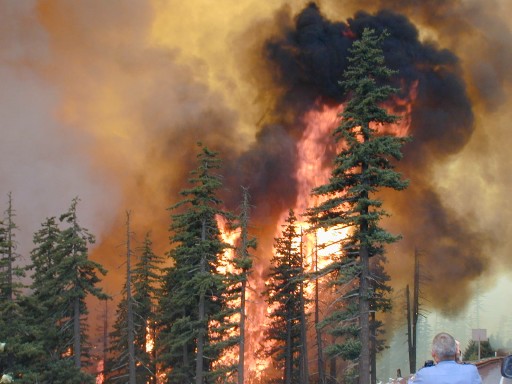
U.S. Senator Pete Domenici (R-NM), ranking member of the Senate Energy and Natural Resources Committee, is beginning to voice frustration with the inability of his colleagues to see the connection between underfunded forest management, forest fires, and climate change. It is an issue that is all too real in his state of New Mexico, but has much broader implications to the rest of North America as wildfire carbon emissions, bug infestations, and wildlife extinction become a spiraling problems both contributing to and suffering from global warming. As Domenici testified...

When the Hayman Fire burned in Colorado in 2002, NASA scientists estimated that the fire was emitting more carbon dioxide in one day than all the vehicles in the United States emitted in a week.

The implication is clear. Funding improved forest management and certification programs will reduce greenhouse gases at a level comparable to other renewable energy production programs.

Two benefits of congressional legislation that would support strong woody biomass biorefinery development could be better private-industry funded forest management programs and cleaner wood waste bioenergy processes.

Here is a press release from the Committee's website on June 26th...

----------------
Domenici: Forest Fires Are a Climate Change Issue, Too
Senator Expresses Frustration With Lack of Progress In Controlling Wildfires

WASHINGTON – U.S. Senator Pete Domenici, ranking member of the Senate Energy and Natural Resources Committee, today expressed frustration with the lack of progress made to control wildfires in America’s forests.

Domenici, a long-time advocate of forest thinning and an active approach to forest management, spoke today at an Energy Committee hearing to discuss fire preparedness. The Senator expressed frustration with the lack of progress being made to address wildfires, especially in light of the renewed focus on carbon emissions among lawmakers.
“I am growing tired of sitting here year after year after year and asking the same questions. I believe we are now throwing good money after bad on an unworkable model without addressing the underlying fundamental question: what is this Congress going to do to find a way to allow our agencies to change the fuels on-the-ground dynamic to avoid intense catastrophic fires?,” Domenici said.

“Wildfires are a climate change issue, too. When the Hayman Fire burned in Colorado in 2002, NASA scientists estimated that the fire was emitting more carbon dioxide in one day than all the vehicles in the United States emitted in a week. I would hope this committee would be as concerned about this source of carbon dioxide as it is with carbon from coal fired utilities or vehicles,” he continued.

“Federal researchers are now suggesting that it could be as long as 600 years before the area burning in the Hayman Fire fully recovers. If we can avoid these fires, or reduce their intensity, it is something this Congress should and must address,” Domenici said.

Domenici’s comments come after a fire season in which over 9 million acres were burned, and over $2 billion was spent fighting fires. Among the most notable was the Derby Fire, which consumed over 207,000 acres in Montana, and produced smoke columns estimated to be 60,000 feet tall—far taller than power plant emissions.

Defoliated forests are often susceptible to insect damage. The community of Cloudcroft, New Mexico, currently has 15,000-20,000 acres of defoliated forest that is being damaged by insects. This damage could lead to a catastrophic fire.

The Senator noted that recent clear cutting experiments netted positive results, clearing dangerous and dying brush while producing more water and vigorous young forests that are able to fight off insects.
“Like many others, I am worried about the Forest Service becoming an agency with no funds to manage anything other than fires. I believe that an ounce of prevention would be worth more than a pound of cure when it comes to our forests. We must take action to reduce the likelihood of intensity of fires rather than standing by as they destroy our forests, our soils, our water quality, our fish and wildlife populations, and our air quality while pumping millions of tons of carbon dioxide in the atmosphere year after year,” Domenici said.

technorati , , , ,

July 2, 2007

Range Fuels will break ground this summer

Being "firstest with the mostest" is extremely important when it comes to brand identification and capital marketability of any emerging technology. The significance of being awarded a construction permit out front of the other five D.O.E. grant cellulosic ethanol developers is a milestone that demonstrates corporate determination, operational integrity, local support, and negotiating skills. It will be interesting to see how soon the other developers begin breaking ground.

The thermochemical route to biomass conversion does appear to be more flexible in its acceptance of variable and blended feedstock. Using heat instead of enzymes to break molecular bonds not only saves the price of enzymes but dramatically reduces the need for water - not an insignificant issue, particularly in the face of mounting concern about global warming's impact on water resources.

Emissions control technologies have advanced greatly in the past two decades, particularly when attached to closed cycle pyrolytic or gasification systems. Their fundamental purpose is to use the bulk of the emissions (syngas) as a raw material for conversion to biofuels and green chemicals.

Below is the complete press release from Range Fuels today:

-----------------------
Range Fuels awarded permit to construct the nation’s first commercial cellulosic ethanol plant
Independence Day marks the start of our country’s independence from fossil fuels

Palo Alto, CA. and Broomfield, CO – July 2, 2007 –Range Fuels announced today that the company was awarded a construction permit from the state of Georgia to build the first commercial-scale cellulosic ethanol plant in the United States. Ground breaking will take place this summer in Treutlen County, Georgia for a 100-million-gallon-per-year cellulosic ethanol plant that will use wood waste from Georgia’s forests as its feedstock. Phase 1 of the plant is scheduled to complete construction in 2008 with a production capacity of 20 million gallons a year.

“We are thrilled to receive this permit and anticipate the construction of many plants throughout Georgia and the Southeast using wood waste to make ethanol,” said Mitch Mandich, CEO of Range Fuels. “With Independence Day on July 4, we are excited to begin the march toward independence from our country’s reliance on fossil fuel.”

“Cellulosic ethanol offers tremendous promise for not only the development of an alternative energy source, but also rural economic development for our state,” said Sonny Perdue, Governor of Georgia. “We look forward to the construction of this plant and are hopeful this is the first of many more to come.”

"The Department is pleased that the country is one step closer to making the widespread use of cellulosic ethanol a reality," U.S. Secretary of Energy Samuel W. Bodman said. "This furthers the President's goal of deploying clean, renewable energy into the marketplace, and we are eager for the results of Range Fuels’ work, and the work of the other biorefinery grant recipients, to help increase energy security and enhance economic growth."

Range Fuels is at the forefront of new proprietary technology for producing cellulosic ethanol. While most domestic ethanol production requires corn as a feedstock, Range Fuels' proprietary process does not. The country’s ability to make corn ethanol is limited by the agricultural land available to grow it. The latest estimates predict that corn ethanol can only produce up to 15 billion gallons per year. On the other hand, the U.S. Department of Energy, in their joint report with the USDA, has identified over one billion tons of biomass annually that could be converted to biofuels, like ethanol. Range Fuels’ technology can transform all of this biomass, including wood chips, agricultural wastes, grasses, and cornstalks as well as hog manure, municipal garbage, sawdust and paper pulp into ethanol. The company has already successfully tested close to 30 types of biomass for producing ethanol.

The company’s technology completely eliminates enzymes which have been an expensive component of cellulosic ethanol production. Range Fuels’ thermo-chemical conversion process, the K2 system, uses a two step process to convert the biomass to synthesis gas, and then converts the gas to ethanol. In addition to the ability to process a broad range of potential biomass feedstock, the K2 system benefits from a modular design. Depending upon the quantity and availability of feedstock, the K2 system can scale from entry level systems to large configurations. This range of system size allows placement of the K2 near the biomass source reducing transportation costs, and will allow the most appropriate size system to be deployed.

The company selected Georgia for its first plant based upon the abundance of forest refuse and the renewable and sustainable forest industry. The state has demonstrated great stewardship of its forest lands and environmental sensitivity. The forests of Georgia can support up to 2 billion gallons a year of cellulosic ethanol production.

Range Fuels, with Governor Perdue, announced plans to build the plant on February 7 of this year. The company was subsequently selected to negotiate for up to $76M in a grant from the Department of Energy on February 28. These negotiations are still underway.

technorati , , ,

June 21, 2007

Nexterra Gasifies Wood Residue-to-Fuel

In the latest issue of BIOMASS magazine there is an article titled Wood Residue-to-Fuel written by Michael Shirek. It concerns a Canadian company, Tolko Industries Ltd., that is currently reaping the benefits of using Nexterra technology to gasify its woody biomass to reduce its fossil fuel expenditures for steam, heat, and electricity. Based on the results of one year of operation, he writes about the ancillary benefits to the surrounding community:

While the improved bottom line for Tolko has been a positive result of the wood gasification project, the environmental impact is drawing attention outside of the accounting department. By replacing natural gas with an inside-the-fence fuel produced from biomass, Tolko and Nexterra say that the Heffley Creek mill cuts greenhouse gas emissions by 12,000 metric tons (13,200 tons) a year. The companies say this is equivalent to taking nearly 3,000 cars off the road. Tolko estimates that over the expected life of the energy system, the company will have reduced carbon dioxide emissions by 300,000 metric tons (330,000 tons).

Although it’s possible to simply burn the wood residue to produce heat for the mill’s operations, wood gasification has its advantages. Converting solid waste into gas allows the energy to be used as a replacement for, or a supplement to, current natural gas-powered operations. The emissions from combusted syngas are also less environmentally invasive than those from combusted wood.

Below is the Nexterra press release on the project which commenced opertion in May, 2006.

----------------
Tolko and Nexterra Complete Gasification Plant: Technology Fuels New Era of Clean, Low Cost Energy

Vernon and Vancouver, BC – July 25, 2006 - Tolko Industries Ltd. and Nexterra Energy Corp. announced today they have successfully completed their new gasification project at Tolko’s Heffley Creek plywood mill near Kamloops BC. The new “syngas” plant converts wood residue into low-cost, clean, thermal energy, replacing high-cost natural gas and moving this mill closer to energy self-sufficiency. The system will not only save the mill more than $1.5 million in annual fuel costs, but will also improve local air quality and reduce Tolko’s greenhouse gas emissions by 12,000 tonnes per year. This is equivalent to taking almost 3,000 cars off the road.

“This project underscores Tolko’s commitment to investing in technologies that make our mills more energy self-sufficient, and improves our environmental and bottom-line performance,” said Jim Baskerville, Tolko’s regional manager, veneer and plywood. “We are very pleased with the Nexterra gasifier system. It is user friendly, simple to operate, and we are working with Nexterra to identify opportunities where we can apply the technology at other Tolko mills.”
“This project is a great example of the innovative use of biomass for energy production – a concept we are addressing in the development of a new bioenergy strategy”, said Richard Neufeld, BC Minister of Energy, Mines and Petroleum Resources. “In the future, bioenergy will help meet our electricity needs, help create jobs and develop economic opportunities, while also helping to protect our health and environment.”

“This is tremendous news for the forest industry,” said Jim Dangerfield, vice-president, western region for Forintek, Canada’s Wood Products Research Institute. “Despite progress toward energy self-sufficiency, the industry still consumes billions of dollars of fossil fuel. Switching from natural gas to syngas using Nexterra's gasification technology has the potential for widespread application in the forest industry to reduce reliance on fossil fuels, cut costs and improve competitiveness."
“Tolko is a terrific partner and we will continue to support their goal of becoming energy self-sufficient,” said Jonathan Rhone, Nexterra’s president and CEO. “This project demonstrates how our technology can help customers regain control of their energy costs by switching to alternative fuels. This concept of an ‘inside-the-fence’ syngas utility has widespread application in the forest products and other industries as leading companies invest in fuel conversion technologies.”

About the Project – In 2005, Tolko partnered with Nexterra to develop the 38 MMBtu/hr gasification system that converts 13,000 bone dry tonnes per year of wood residue into a clean burning, renewable biofuel called syngas. The syngas generated will displace approximately 235,000 GJ (gigajoules) per year of natural gas previously used at the mill to dry veneer and to produce hot water for log conditioning. This is equivalent to the amount of natural gas required to heat approximately 1,900 residential homes in BC.

This project has received financial support and encouragement from the federal and provincial governments including Natural Resources Canada, TEAM (Technology Early Action Measures – a federal interdepartmental technology investment program) and Ethanol BC.

technorati , , ,

June 13, 2007

Salvaging wood from natural disasters

We've all heard the following bromides:
"When all you've got are lemons, make lemonade."
"Turning a silk purse out of sow's ear."

Somehow they don't quite measure up to what needs to be done with the devasting waste refuse of natural disasters. However, unless something is done with this unanticipated wealth of biomass, the decay may lead to further perpetuation of the emergency conditions: forest fires, disease, infestation, and the release of even more greenhouse gases.

An interdepartmental government task force called the Federal Woody Biomass Working Group and Partners (WBUG) has been formed to, among other things, draw up contingency plans to deal with the residual biomass of woody biomass related disasters - from floods, hurricanes, tornadoes, fires, and the like. What resources can be enlisted to collect the residuals? What processes can be employed to mitigate the harmful effects of the decay? What benefits can be derived from converting the biomass into bioenergy or biofuels?

A proposal has been drafted by the WBUG titled "Timber Recovery and Wood Utilization Response Plan." In the aftermath of Hurricane Katrina, its initial focus is on wind events and disturbances in the Eastern and Gulf Coast Regions. Here are some excerpts from their funding proposal to create the plan:

Executive Summary:
The Plan will assist in the short term response, but also provide opportunities for long term economic and environmental recovery. Many partners have been engaged in developing this proposal, and see high potential for coordinating a broad spectrum of federal, state, tribal and local government and industries in disaster debris and wood utilization.

Final Product:
A hands-on tool for planning for and responding to multiple-level wind disasters at local, state, regional, and national levels. It will also be a framework for better coordination among the various federal, state, tribal and local government agencies, and with partnering organizations within the forestry, arboricultural, disaster response, and wood utilization sectors.

Scope:
The scope of this project is to begin the process of (1) focusing on the recovery of downed or damaged woody biomass in the forest, both merchantable and non-merchantable material not currently being recovered, and (2) expanding and improving upon national, regional and local response to disaster debris disposition, including green waste and uncontaminated demolition wood.

Meanwhile, another natural disaster has befallen the Southeastern states of Georgia and Florida - a months long fire that resulted from acute drought followed by intense lightning from thunderstorms.

Here's another bromide - "An ounce of prevention is worth a pound of cure." It is time to enact and fund policies and procedures that will strengthen proper stewardship of the nation's forests. Sadly, not much can be done with the pitiful amount of biomass left after a major fire. It is a time to clear out the refuse and replant the forests.

----------------
Fires Rip through GA, FLA
Timber Harvesting Magazine
May/June 2007

Wildfire fighters from Georgia and surrounding states continued to struggle to put out a major forest fire that had scorched more than 100,000 acres in southeast Georgia, with major fires spreading into northeast Florida and popping up across the Florida Panhandle region.

The Sweat Farm Road/Big Turnaround Fire, burning mostly in Ware and Charlton counties south of Waycross and near the Okefenokee Swamp, is the biggest in Georgia history, covering more than 100 square miles. Georgia Gov. Sonny Perdue signed an Executive Order on May 2 declaring a state of emergency in 21 counties in southeast Georgia, citing severe drought conditions and extreme wildfire threat. Through the second week of May, the area had passed a record-setting 66 days without rain.

Yet a line of thunderstorms that provided a small amount of spotty rain the weekend of May 7 did more damage than good, with lightning strikes starting new fires. One, the Bugaboo Scrub Fire, started at the southern tip of the Okefenokee and quickly burned into Florida, scorching more than 30,000 acres in two days. Other wildfires have popped up across the Panhandle region, with a subdivision in Freeport losing 4 homes and having 13 others damaged.

As of May 8, Florida officials reported fires burning in 54 of the state’s 67 counties.

Extensive post-fire surveys and inventories have yet to be performed, but early observations are the fire has burned extremely hot across all age classes and in many cases stems are completely burned and unsalvageable. Salvage rate for merchantable-size timber may be as low as 15%, according to one early report, with poor markets making the salvage situation even tougher.

technorati , ,

June 8, 2007

Forest certification programs: FSC, SFI, and Tree Farm

Rightful concern about tropical "deforestation" should never be confused with controlled American logging of our natural wood resources as carried out under the watchful eye of national and international forest certification programs.

Right now it is estimated that volume of annual net timber growth in America is 36% greater than the volume of annual timber removals. This statistic comes from an excellent new report titled The State of America's Forests produced by the Society of American Foresters (available online) :

The Society of American Foresters has published a comprehensive, peer-reviewed report on the status of America’s forestland. This 68-page report outlines the latest facts and figures in easy to read graphs, charts, tables, and supporting commentary. The State of America’s Forests is the most definitive, one-source compilation of credible forestry facts touting more than 50 sources and peer-review by academia, non-governmental organizations, and the USDA Forest Service.

As pointed out in the report, trees not only define our landscape but they freshen the air we breath, purify the water we drink, provide habitat for wildlife, and nourish the ground we walk upon. Proper stewardship of our timberlands enable the forest products industry to provide the studs in our walls, the wood in our furniture, and the paper in our books, magazines, and newspapers. Wood has also been the primary renewable feedstock of our energy past, present, and future. 44% of American renewable energy comes from wood and wood residuals - more than any other source.

To confuse the desire for preservation of our forests with the need for conservation would be a huge mistake. According to Wikipedia The distinct difference between conservation and preservation, is that conservation allows for the sustainable development paradigm, whereas preservation is complete restriction. Some acres must be protected it is true, but untended forests grow at a phenomenal rate and their ecology inevitably changes with them.

While the area covered by forests has not changed in 100 years, "historical trends show that the standing inventory (the volume of growing stock) of hardwood and softwood tree species in U.S. forests has increased continually over the past five decades - by 49% between 1953 and 2006. In the same time period, the total annual net growth of growing stock (annual growth minus annual mortality) increased 75 percent."

The consequences of untended forests include overgrowth of underbrush leading to wildfires (which wipe out wildlife forest habitats and have a devastating impact on carbon balance of the atmosphere) as well as unstoppable insect infestations that spread faster through tree proximity.

There is a section in the report that depicts the current level of certification that is being practiced in the world. "Originally developed to address the issue of tropical deforestation", 87% of certification is actually taking place in "temperate and boreal regions in developed countries."

----------------
The State of America's Forests
The Society of American Foresters

There are three major certification schemes in place: the Sustainable Forestry Initiative (SFI), the Forest Stewardship Council© (FSC), and the American Tree Farm System. In the U.S. 107 million acres representing 14% of total U.S. forests are certified. 25% of private forestlands are certified.

Forest certification programs continue to develop and evolve. In 1999, the Programme for the Endorsement of Forest Certification schemes (PEFC) was founded as the global umbrella organization for the assessment of and mutual recognition of national and international certification schemes.

With 65 years of history, the American Tree Farm is the oldest voluntary, third-party forest management verification process in the country. It certifies the forestry practices of family-owned and other nonindustrial private landowners.

The American Tree Farm System® (ATFS), a program of the American Forest Foundation, is committed to sustaining forests, watershed and healthy habitats through the power of private stewardship.

Since 1941, ATFS has educated and recognized the commitment of private forest owners in the United States. Currently, ATFS has 27.5 million acres of privately owned forestland and 87,000 family forest owners who are committed to excellence in forest stewardship, in 46 states. Tree Farmers share a unique commitment to protect wildlife habitat and watersheds, to conserve soil and to provide recreation for their communities while producing wood for America. These individuals hold the key to the kinds of forests, forest activities and forest resources future generations of Americans will enjoy.

ATFS has established standards and guidelines for property owners to meet to become a certified Tree Farm. Under these standards and guidelines, private forest owners must develop a management plan based on strict environmental standards and pass an inspection by an ATFS volunteer forester every five years.


The Sustainable Forestry Initiative (SFI) program was developed by the American Forest and Paper Association in 1994 to document the commitment of member companies to sustainable forestry. In 2000, an independent 501(c)(3) multistakeholder organization, the Sustainable Forestry Board, was established to oversee SFI standards development and the certification process. SFI certifies companies in the United States and Canada. Thus far, SFI is the only U.S. scheme officially recognized by PEFC.

The SFI Standard spells out the requirements of compliance with the program. The SFIS is based on nine principles that address economic, environmental, cultural and legal issues, in addition to a commitment to continuously improve sustainable forest management.

The SFI program has a new standard valid from 2005 through 2009. The SFIS contains 13 objectives covering sustainable forest management, procurement of wood and fiber, public reporting, continuous improvement and mitigating illegal logging.

The Forest Stewardship Council (FSC), founded in 1993, is an international nonprofit organization whose members, from more than 70 countries, represent social, economic, and environmental interests centered on forests.
FSC sets forth principles, criteria, and standards that span economic, social, and environmental concerns. The FSC standards represent the world’s strongest system for guiding forest management toward sustainable outcomes. Like the forestry profession itself, the FSC system includes stakeholders with a diverse array of perspectives on what represents a well-managed and sustainable forest. While the discussion continues, the FSC standards for forest management have now been applied in over 57 countries around the world.


technorati , ,

May 31, 2007

May 2007 Digest

Tying Energy Efficiency to Renewable Energy

Lost in the rush to develop alternative energy technologies is the obvious value of making energy usage more efficient. As Amory Lovins of the Rocky Mountain Institute would say, "a watt saved is a watt earned." This can be applied to biofuel usage as well. It is far cheaper to save energy than it is to produce more of it, particularly when existing technologies are so wasteful.

In marked contrast to the oil crisis of the 70's when cars lined up on even or odd license number days to tank up on gasoline and speed limits were held to 55 MPH to conserve energy, there has been little preaching by this administration - or the states for that matter - to slow down and use less. Memorial Day weekend driving plans were little impacted by recent gas price spikes. Auto shows still promote performance over gas use efficiency.

It is highly unlikely that the laudable goals of the 25x'25 Initiative for reducing fossil fuel dependence will be reached if we persist in inefficient usage of our energy resources or, in fact, grow our demand beyond current expectations. Similarly, while developing renewable energy (RE) technologies, energy efficiency (EE) needs to be built into the systems.

In a joint report presented by the American Council on Renewable Energy (ACORE) and the American Council for an Energy-Efficency Economy (ACEEE) case studies are showcased that demonstrate the synergies available when RE and EE are developed together. For installations that have such long lifespans and high capital costs, it is important to address efficiency challenges during early planning.

Here are links to stories that were posted in the BioEnergy BlogRing during May, 2007:

BIOstock Blog--------------
• Clean Wood replaces Coal Power Plant in N.H.
• U.S. paper & pulp industry assesses its bioenergy future

BIOconversion Blog--------------
• Molecular visualization of the bioconversion process
• U.S. State Dept. to host 2008 Int'l Renewable Energy Conference
• IPCC 4th Assessment: Steps to mitigate climate change
• U.S. D.O.E./E.I.A. International Energy Outlook 2007

BIOoutput Blog--------------
• Tying Energy Efficiency to Renewable Energy
• California's electricity - Phasing out coal
• Amory Lovins - RMI and the Hypercar

Each month we provide a similar breakdown of article titles from our favorite "companion" site - Biopact Blog. This list is kept current and is accessible in the right hand column of each of the three blogs.

Please forward a link to this digest to anyone you know who would be interested in keeping track of change that will affect us all. They can add their name to the mailing list on the BioConversion Blog.

technorati , , , , , , , ,

May 14, 2007

U.S. paper & pulp industry assesses its bioenergy future

TAPPI, the leading association of the paper and pulp industry in America, held a special International Conference on Renewable Energy - 2007 on May 10-11, 2007 in Atlanta, Georgia. Led by conference chair, Jim Frederick of Georgia Tech's Institute of Paper Science and Technology, the association organized a sterling line-up of technologists and decision-makers who will be the key stakeholders in bioenergy implementations at paper & pulp mills throughout North America during the next two decades.

This is an important topic for America because, unknown to most Americans, the forestry products industries have been the foremost producers of renewable energy - some 44% of the total - beating hydroelectric, ethanol, wind, and solar. As the the most experienced producers of bioenergy in the country, they have the most to win from a successful implentation of cellulosic ethanol conversion technology. However, it is difficult for management to ignore the inherent risks.

To set the tone for the conference, the keynote was presented by two principals involved in the recently announced alliance between oil and paper industry giants - Richard Zalesky of Chevron, VP of Biofuels and Hydrogen Business, and Denny Hunter, Weyerhaeuser VP of Technology.

Zalesky acknowledged his company's perspective that energy demand is growing so fast it is necessary to develop alternative, renewable biofuels processed from a variety different feedstocks. One point he made was that the expense to deploy one exploratory well used to find a deep water deposit of oil would pay for the deployment of several biorefineries. He also said that, under current economic conditions, it is government regulations that drive the development of renewable energy technologies - particularly Executive Orders like California's Low Carbon Fuels Standard.

Forest Biomass Availability and Logistics
A major contributor of information to the Billion-Ton Report, Dr. Bryce Stokes of the USDA Forest Service substantiated the finding that the land resources of the U.S. are capable of producing a sustainable supply of biomass to displace 30% or more of the nation's present petroleum consumption. One quarter of the amount could come from woody biomass resources. He admitted that the forestry projections are "very conservative, only based on forest wastes and fairly low estimations of utilization. They did not include forest crops - the agricultural analysis did include woody perennial crops."

What is the potential for tree farming in the U.S. to help supply fast growing, perennial woody biomass for biorefineries? Nathan Ramsey of ArboGen and Brian Stanton of Greenwood Resources made separate presentations about genomics and hybrid poplar feedstocks (an approach in practice in Europe). ArboGen is developing trees with improved quality and productivity characteristics that include faster growth rates, freezing tolerance, and modifications to wood composition. Stanton talked about the advantages and benefits of hybrid poplar plantations and the methodologies his company is working on for improving production economics.

Citing the Southeastern region as the nation’s woodpile, Jim Gan of Texas A&M spoke glowingly about it woody bioenergy potential. He concluded that policy decisions should be based on consideration of the entire value chain - including environmental and socioeconomic co-benefits. Tom Belin from Potlatch gave a peek at his company’s "100 Mile Biomass Study", which is examining the economics of a proposed pilot gasification/catalysis biorefinery as compared to a commercial higher volume biorefinery utilizing a 100-mi. radius of woody biomass grown in southern Arkansas.

Overview of Liquid Biofuel Technologies
Eric Larson of the Princeton Environmental Insitute teamed up with Michael Pacheco, current Director of the NREL National Bioenergy Center (but soon to be Chief Technology Officer for Archer Daniel Midland at the end of May) to provide an overview of a “continuum of options” for the production of cellulosic ethanol – using both biochemical and thermochemical processes. Their analyses led to a projection of how biorefining might be technologically integrated in the modern pulp mill facility.

Larson contributed the following observation based on a comparison of effective fuel yields - "A biorefinery integrated with a pulp mill effectively requires much less biomass per unit of liquid fuel produced vs. 'stand-alone' biofuel production. The reason is that black liquor (and some biomass) are charged against services provided to the mill (chemical recovery, process steam and power) - not against liquid fuel."

His concluding comments focused on how the P&P industry could get started: 1) energy-industries and the government to help manage the risk and bring in energy-industry competencies, 2) woody biomass gasification for IGCC-electricity and/or liquid fuels would be the most plausible first step, and 3) black liquid gasification (Weyerhaeuser New Bern model) would be another early technology to pursue.

Peter Axegård of STFI-Packforsk, the
leading R&D center in Scandinavia for forest products, described many ongoing European wood-based biorefinery research projects. Progress of many pilot programs are in the demonstration stage with some co-located with existing paper mills. In Europe there is no question that the forest-based sector plays a key role in a sustainable society.

Technology Sessions
Three technology sessions followed the introduction by Pacheco, Axegård, and Larson. The first one focused on the conversion of sugars to transportation fuels using biochemical technologies. The speakers included Art Ragauskas of Georgia Tech, Andrew Richard from Mascoma, and Michael Rushton of Lignol.

Session 2 took an indepth look at progress being made pursuing a thermochemical route. Fast pyrolysis, pyrolysis, and low and high temperature gasification were compared for their features and benefits using a variety of feedstock for the production of a variety of bioproducts. Jim Patel of Carbona focused his talk on biomass gasification technologies under development, including Bubbling Fluidized Bed (BFB) and Circulating Fluidized Bed (CFB) applications. His company is developing expertise on feeding biomass into the gasifier as well a filtering for cleanup of solids.

Session 3 introduced information on current thermochemical project development. Thomas Meth is Executive VP of Sales & Marketing of Intrinergy, a company that builds, owns, and operates gasification equipment for industrial users. The company is commissioning its first woody biomass cold-gas facility in Ohio and building several more in Alabama.

Biomass Gas & Electric's Rick Jensen spoke about a 28MW gasification power project his company is developing for Georgia Power Company. It is located near a C&D landfill which provides primary fuel supplies. It also will utilize forest wood waste and road & land cleaning debris.

Where are we now?
Ben Thorp of the Biorefinery Deployment Collaborative gave a comprehensive overview of the many commerical biomass gasifiers in North America, a brief summary of the current pulp and paper biorefinery activities, and a side-by-side comparison of the six U.S. D.O.E. "Section 932" grant winners. He then made a persuasive appeal to the paper and pulp industry to begin now to capitalize biorefinery opportunites because they "may be the only way to avoid massive shutdown and loss of pulp and paper facilities in North America."

Making the Biorefinery a Reality
According to Richard Phillips of North Carolina State University there are five targets that must be met to achieve ethanol profitability:
1) The Ethanol Price> $2.50 per gallon,
2) The Capital Cost < $3 per Annual Gallon,
3) Wood Cost <$60 per bone dry ton (BDT),
4) Enzyme Cost <$.15 per gallon, and
5) ethanol yield> 75 gallons per BDT wood.

He echoed the conclusion of the Agenda 2020 Forest Products Industry Roadmap, "repurposing an existing kraft pulp mill as an initial approach has a greater chance of success (than a Greenfield plant)."

In short, the two day conference was well-conceived and well-executed. It is certainly time for the paper and pulp industry to take stock of its options and adjust to meet the demands of the future. The global leadership that it has lost in the production of pulp and paper could be recouped if it acts now to secure its position as a leader in bioenergy production. The key advantage it has is the current infrastructure and natural resources that already exist. Couple that with prudent investment in emerging technologies and government regulatory and incentive reform, and there is no reason why the roadmap laid out in the Agenda 2020 plan couldn't be a rebirth for American self-reliance as well.

technorati , , ,

May 5, 2007

Clean Wood replaces Coal Power Plant in N.H.

When it comes to producing electricity, it isn't necessary to convert the feedstock to ethanol or syngas or even invest in gasification or pyrolysis burners. Advanced wood boilers meet the EPA standards and provide a clean renewable alternative to dirty, carbon-positive coal boilers of the past.

Here is the press release from Public Service of New Hampshire (PSNH). It is New Hampshire's largest electric utility, generating and distributing clean electricity for more than 490,000 homes and businesses in an environmentally friendly manner. Each year, PSNH supports dozens of forest protection, energy conservation, and environmental organizations through both financial contributions and employee volunteerism.

There is a YouTube video of this project available online.

----------------
Officials Celebrate Northern Wood Power

One of the nation’s newest and largest renewable energy projects was officially recognized today as environmental, political and utility leaders celebrated the completion of Public Service of New Hampshire’s (PSNH) Northern Wood Power Project. The $75 million project includes a new 50 megawatt wood-burning boiler which replaced a coal-burning boiler of identical size.
The new PSNH boiler, capable of producing power for about 50-thousand typical homes, is expected to consume more than 450-thousand tons of clean wood chips annually, significantly reduce emissions at the Seacoast power plant, and contribute about $20 million a year to the regional economy.

“In completing this project, PSNH has demonstrated its ability to build and operate the state’s largest and cleanest biomass power plant,” said Chuck Shivery, president and chief executive officer of Northeast Utilities, PSNH’s parent corporation. “It achieved this accomplishment on time, under budget, and in a way that has kept electric rates low and stable for its customers.”

Northern Wood Power began official operations last December and has, since that time, received clean wood chips from licensed loggers and certified suppliers in New Hampshire, Maine and Massachusetts.

“A little over three years ago, Northern Wood Power was just an idea, a vision for the future that PSNH brought to state legislators with the promise of lower emissions, a stronger forestry industry, and low electric rates for New Hampshire homes and businesses,” said Gary Long, PSNH president and chief operating officer. “We’ve demonstrated that PSNH can be part of the solution in helping New Hampshire become the ‘greenest’ power-producing state in the nation while maintaining a significant price advantage for our 490,000 customers.”

Environmental Benefits
Northern Wood Power is reportedly the largest coal-to-wood repowering conversion in the nation. It is also one of the lowest-emitting power plants in New England today, not only meeting but exceeding all US Environmental Protection Agency emissions standards for new power plants. The plant achieves these results through a state-of-the-art, fluidized-bed boiler combustion system, an advanced combustion technology which burns fuel more completely and substantially limits the production of nitrogen oxide (NOx), sulfur dioxide (SO2) and Mercury (Hg) emissions. Northern Wood Power is also considered ‘carbon neutral,’ meaning that no additional net carbon (CO2) is released into the atmosphere by the burning of wood.

Economic Benefits
There are a number of substantial economic benefits associated with PSNH’s new wood-fired power plant. The plant produces power for PSNH customers at a lower cost when compared to the price of energy offered through the regional marketplace. Northern Wood Power also produces ‘Renewable Energy Certificates,’ which PSNH sells in a regional market to suppliers and utilities without sufficient renewable resources of their own. The proceeds of the sale of RECs is used to offset the project’s capital costs and keep PSNH customer rates low.

Further, the company’s switch to wood has eliminated the need to burn more than 130,000 tons of coal annually. The money paid for fuel now remains in New England, contributing an estimated $20 million annually to the area economy.

More Wood to Come?
PSNH’s Gary Long and NU’s Chuck Shivery both spoke of the need in New England for additional sources of new renewable energy and expressed their desire to invest in more regulated generation to help meet that need. Current state law prohibits PSNH and other regulated electric utilities from acquiring or building any new renewable sources of generation, but legislators are considering modifying the law to allow such a proposal to be made.

technorati , , ,

April 30, 2007

April 2007 Digest

Woody Biomass - Energizing a new generation

America is witnessing the balkanization of its renewable energy portfolio. The sun belt is home to solar energy. The corn belt is home to ethanol. Landfill bioenergy is focused in urban areas. The nation's woodpiles are in the Pacific Northwest and the Southeast. Each region will have to come to grips with the economic, technical, environmental, and cultural changes that will be necessary build, market, and sustain development in their communities. NIMBY-ism will be a constant, frustrating impediment to many grand schemes.

We have seen the impact that ethanol has played in the cornbelt. Its communities have embraced the technologies - not without some consternation from its livestock industry. Individual farmers have banded together to form cooperatives to build ethanol plants. Agricultural giants like ADM and Cargill are re-evaluating how they can realign their business units to capitalize on their waste and biomass assets. Politicians are displaying uncharacteristic bipartisanship on ag/energy issues.

Following this model, we are now witnessing an emerging focus in the southeastern U.S. - home to communities that are committed now and in future generations to forestry and wood-related companies. 44% of the existing renewable energy generated in the U.S. comes from and is used by this industry - mostly generated from woody waste accumulating at paper and pulp mills. Landowners are eying biorefinery plans for the region to see if it makes sense to form cooperatives. Moribund mills and chemical factories that have lost business to foreign competition are now viewed as possible sites for new bioenergy ventures since they already have supply and distribution infrastructure in place.

The best resource of the region is the character of the indigenous citizens. Unfailingly patriotic but often regarded as the underappreciated step-children of America, many communities of the Southeast are eager to finally have an opportunity to contribute their regional ingenuity, brawn, and industrial capacity to the national effort to end American addiction to foreign oil. It is, after all, the young, proud southern recruit that continues to carry the bulk of the national security burden caused by this addiction.

As a political footnote, presidential aspirants interested in a Southern strategy should remember that in 2000 Gore lost ALL the states in the region - including his home state of Tennessee which would have put him in the White House. A commitment to woody bioenergy development of the region would be well received. It is not clear that the same can be said of the Pacific Northwest.

Here are links to stories that were posted in the BioEnergy BlogRing during April, 2007:

BIOstock Blog--------------
• E3 Biofuels and Closed Loop Ethanol Plants
• The need for Public Outreach: a case study in China
• BIOstock 101: The BioTown Sourcebook
• Woody Biomass Utilization and the USDA Forest Service
• Development alliance builds between forest and energy giants
• Hybrid poplars reduce carbon emissions best
• Thinning trees to save ecology
• In-Woods Expo 2007 Harvests Energy

BIOconversion Blog--------------
• Industrial Symbiosis: Creating eco-industrial parks
• Latin America's Blueprint for Green Energy
• BIOconversion 101: The BioTown Sourcebook
• EPA releases comprehensive Renewable Fuel Standard (RFS) program
• Converting Biomass to Hydrogen
• D.O.E. to fund ADM/Purdue cellulosic ethanol project
• Friedman Multi-media on "The Power of Green"
• Biomass Gasification at the "Chin-dia" price

BIOoutput Blog--------------
• Good News from the DOE about Carbon Sequestration
• BIOoutput 101: The BioTown Sourcebook

BIOwaste Blog--------------
• BIOwaste 101: The BioTown Sourcebook
• Hurdles to Waste Conversion Technologies
• Smokestack emissions as feedstock for ethanol

Each month we provide a similar breakdown of article titles from our favorite "companion" site - Biopact Blog. This list is kept current and is accessible in the right hand column of each of the three blogs.

Please forward a link to this digest to anyone you know who would be interested in keeping track of change that will affect us all. They can add their name to the mailing list on the BioConversion Blog.

technorati , , , , , , , ,

April 29, 2007

In-Woods Expo 2007 Harvests Energy

If the In-Woods Expo at Hot Springs, Arkansas this past week is any indication, we are about to see North American forests take center stage leading to a re-emergence of forest industries as a major energizer for our economic future. It's a future that can retain and inspire new generations of Americans to pursue careers in our great forestlands servicing emerging bioenergy businesses. For this to happen, forest industries and forest owners will need new profit streams that will enable them to utilize more biomass, invest in new equipment, and maintain their vested assets.

Will America's youth return to the forests?
To a huge extent Americans have lost their connection to their forest heritage. Originally urbanites organized to express concern for the protection of forests as a hedge against overdevelopment of the suburbs. But as light has given way to the heat of their extrapolated arguments and overly aggressive preservation campaigns, the livelihood and lifestyles of rural families and communities who work on private forestlands and in forestry industries have been compromised. Those who are in a position to influence policymaking and certification often don't live or work in these communities.

In a recent article in Timber Harvesting magazine, Tom Thompson who represented Family Forest Landowners on the Sustainable Forest Resource Committee expressed it this way:

"A significant number of board members of any forest certification program should be true stakeholders of landowners and loggers - the true forest practitioners. If we fail to do this--and we have up to this point--forest certification will fail in the U.S.

According to a recent report from the Society of American Foresters, 25% of private U.S. forestland is now certified.

We forget that "huddled masses" migrated to this immense territory in large measure because of its bountiful natural resources - fertile land and the forests to build, energize, and sustain each family's future. A walk down the Washington Mall is a moving tribute to the American character that has been forged at the base of our forests - surveyor and scout George Washington, "Old Hickory" Andrew Jackson, Jefferson's explorers Lewis & Clark, and, of course, rail-splitter Abraham Lincoln.

Today students of all ages feel an emotional connection to the forests through camping, field trips, recreation, and ecological education. Urban beautification associations, tree farms, paper recycling programs, forest certification, and wildlife preservation organizations seek to re-ignite our interest and shape our focus on how we can contribute to the health of our forests. And they are working.

Unfortunately, student interest in the environment does not lead to seeking employment in the forest industries. Our forests are at greater risk because our forest industries are depressed. Over the past decades, overseas competition and low wages have led to a marked decline in paper and pulp mill employment. Domestic concerns about safety, carbon emissions, pollution, and worker incomes are not weighed factors in the decision to buy from foreign sources. Land values have stagnated as paper mills sell off their acreage. Landowners are losing the capital they need to institute and maintain proper stewardship leading to certification.

Well meaning anti-logging crusades have led to increased forest density (49% higher than in 1953 according to a new Society of American Foresters publication called "The State of America's Forests") which in turn leads to vulnerability to catastrophic fires and the rapid spread of insect infestations. Rising temperatures are drying up forest eco-systems causing pine beetles to proliferate and trees to die. In short, we are slowly converting our timberlands into wildfire tinderboxes - unhealthful to wildlife, certainly, but also risking enormous amounts of greenhouse gases and wasted energy to vent to the skies.

Emerging processes to a new forestry future
New practices need to be developed to mitigate forest fires and greenhouse gas emissions. We can no longer burn the tons of decaying slash (residual woody biomass) that are the unused byproducts of harvesting operations. We can't afford to leave it spread on the forest floor either because, as it decays, it emits carbon to the atmosphere. If it is collected and hauled out at great expense, what can we do with it? How can a depressed industry finance the rising expectations of stewardship certification?

There is growing optimism that demand for bioenergy from forestry residuals will provide us the key to solving these intertwined dilemmas. While forest slash is currently a burden for existing forestry industries, it and forest manufacturing waste could emerge as valuable feedstocks for bioenergy conversion to electricity and biofuels. Perhaps we have found a profit stream that can be developed for helping forest stakeholders secure their investments.

It's all about the kids
Thousands of middle and high school students attended the In-Woods Expo in Hot Springs last week. They saw an impressive array of advanced logging hardware operated by some of the most talented loggers in the nation. Acres were thinned of underbrush, trees were felled, stripped, and collected in a fluid choreography of highly trained operators and powerful machinery. In thirty minutes several trees were felled, stripped of branches and bark, cut to length, and hauled away.

Residual slash was alternately processed by being fed to powerful chippers or new devices called bundlers. One demonstrated bundler was manufactured by John Deere Corporation which has online videos of their products in action:

The 1490D Energy Wood Harvester, or “Bundler”, has a dual advantage – it produces biomass energy and clears the forest floor of slash.

The B380 bundler unit very tightly compresses, wraps and cuts a slash log, which can then be transported and used as biomass fuel. Each log provides about one megawatt hour of energy, equal to the electricity produced by 21 to 28 gallons of oil.

The American will to effect change
Exciting laboratory advances in biomass conversion technologies (including enzymatic hydrolysis, catalysis, gasification, and syngas fermentation) affirm that the technical hurdles are surmountable. New biorefineries that can utilize bundles and chips of residual slash are in the commercial-scale development stage right now. But, like technical advances for the bioconversion of urban waste into bioenergy, the biggest hurdles may be societal ones - the frustratingly slow passage of enabling regulatory reform, permitting procedures, and incentives legislation.

As important as these advances can be, American will and coalition building is on trial. At the heart of the issue is the question of what kind of world will the next generations inherit? Will the forestry regions of North America be given the autonomy to regulate their own culturally-based solutions for effecting the coming renewable energy paradigm shift? Will federal programs provide investment incentives leading to new technological R&D and deployments of bioenergy conversion technologies? What leeway or fast tracking will regulatory agencies grant to remove obstacles to deployment so that developers can begin to tackle the technological challenges that will lead to broader achievement of renewable energy objectives?

It's a national issue with global implications. As the world's strongest industrial power with the fourth largest renewable forestland assets and formidable communications leadership we should be at the forefront of developing and exporting global solutions for renewable energy - using, and sustaining, our assets in woody biomass.

technorati , ,

April 19, 2007

Thinning trees to save ecology

640,000 acres.

That's larger than the state of Rhode Island and is, unfortunately, the current extent of the pine beetle infestation in Colorado as of February, 2007. There is no way to halt it and it will only get worse. The impact on the state's wildlife (not to mention the effect on tourism and the state's economy) is hard to imagine. Similar outbreaks risk forest fires of horrendous proportions in the San Bernardino mountains in Southern California and the much larger infestations in British Columbia.

Growing replacement trees will have to await the removal of dead ones to save wildlife. Finding an economically practical solution may require swift governmental action to spur private development of new solutions.

This ecological emergency requires forestry triage on a massive scale. The Rocky Mountain News carried the original story that led to this entry in the online BCO newsletter of the Environmental and Energy Study Institute.

----------------
Colorado Seeks Market for Wood Waste from Forest Thinning

As ethanol-from-wood biomass plants open in Georgia, the state of Colorado questions the choice of location. Colorado has been suffering from a pine beetle outbreak for the past four years with 42 percent of Colorado's lodgepole pines infected. One of the largest factors for the outbreak, and one that if addressed could help mitigate the problem, is the accumulation of biomass in Colorado's forests and tree overcrowding. The lowest bid to thin one acre of forests in Summit Count, CO is $1600.

Gary Severson, executive director for the Northwest Colorado Council of Governments, said "It's so expensive because there's no market for the wood. And at that price, there's simply not enough public money to thin the forests. The only way to do this is to find some way to add value to this material. With small-diameter lodgepole pine, there aren't a lot of options."

When Range Fuels was asked about its location choice of Georgia for its cellulosic ethanol plant, CEO Mitch Mandich explained that it was the difference between the trees as plantation crops and the already developed timber infrastructure Georgia has to offer. Georgia rain and soil conditions allow trees to grow to ten inch diameters within ten years, much different from Colorado's position. Lynn Young, a retired U.S. Forest Service public information director, explained, "It's too dry here, the soil's not deep and the trees are small - usually 6 inches to 8 inches in diameter."

Severson added - "What it's going to take is involvement of the private sector. What can we as government do? Cut red tape. Provide some incentives to make things possible, so people say 'Hey, I can make a buck at this.' Then the problem begins to solve itself. Until then, economic disconnect is the big problem."


technorati , , ,

April 12, 2007

Hybrid poplars reduce carbon emissions best

Renewable Energy Access (REA) reported on a National Renewable Energy Laboratory (NREL) study published in the April 2007 issue of Ecological Applications. It should put to rest any lingering doubts about the advantageous carbon emissions benefits of cellulosic ethanol production - particularly when hybrid poplar feedstock is used.

There is also mention by one of the scientists that "Greenhouse gas savings from biomass gasification for electricity generation are even greater."

Here are some excerpts from the REA story...

----------------
Biofuels, Fossil Fuels & the Greenhouse Gas Factor

Researchers at Colorado State University and the U.S. Department of Agriculture, Agricultural Research Service have completed an analysis of greenhouse gas emissions from biofuel production. Study results revealed that when compared with the life cycle of gasoline and diesel, ethanol and biodiesel from corn and soybean rotations reduced greenhouse gas emission by nearly 40 percent, reed canarygrass by 85 percent, and switchgrass and hybrid poplar by 115 percent.

Hybrid poplar and switchgrass were found to offset the largest amounts of fossil fuels and therefore reduced emissions the most out of the studied crops.

"Although fossil fuel inputs are required to produce and process biofuels, hybrid poplar and switchgrass converted to ethanol compensate for these emissions and actually remove greenhouse gasses from the atmosphere when the benefits of co-products are included. Greenhouse gas savings from biomass gasification for electricity generation are even greater."
-- Stephen Del Grosso, USDA scientist and NREL researcher

Ethanol and biodiesel from corn and soybean are currently the main biofuel crops in the U.S., but the perennial crops alfalfa, hybrid poplar, reed canarygrass and switchgrass have been proposed as future dedicated energy crops.

Bioenergy crops are able to offset carbon dioxide emissions by converting atmospheric carbon dioxide into organic carbon in biomass and soil, but the production of biofuels requires fossil fuels and impacts greenhouse gas fluxes.

The primary sources of greenhouse gas emissions associated with crop production are soil nitrous oxide emissions and the CO2 emissions from farm machinery, farm inputs and agricultural processes. Colorado State and USDA scientists quantified all of these factors to determine the net effect of several bioenergy crops on greenhouse gas emissions.

Researchers found that, once the DAYCENT results were combined with estimates of the amounts of fossil fuels used to provide farm inputs and operate agricultural machinery and the amount of fossil fuel offsets from biomass yields, they were able to calculate the net greenhouse gas fluxes for each cropping system.

This study was a unique and complete analysis of bioenergy cropping for several reasons. Different crops vary with respect to length of plant life cycle, yields, biomass conversion efficiencies, required nutrients, net soil carbon balance, nitrogen losses and other characteristics which in turn impact management operations. Additionally, crops have different requirements for farm machinery inputs from planting, growing, soil tillage, applying fertilizer and pesticide and finally harvesting.

The researchers were able to use life cycle analyses and the DAYCENT model to account for all of these factors as well as integrate climate, soil properties and land use to accurately evaluate the impact of bioenergy cropping systems on crop production, soil organic carbon and greenhouse gas fluxes.

technorati , , ,