Showing posts sorted by relevance for query beetle. Sort by date Show all posts

March 18, 2007

The Canadian action plan against the Mountain Pine Beetle

Previous posted was an article about beetle infestations and how they were ravaging forests and wildlife habitats - Will dead trees revive forest industries?.

The British Columbia government in concert with BC Hydro (the primary electricity provider of the province have published their Mountain Beetle Action Plan. In concert with that, they have issued the following press release...

----------------
PROVINCE AND BC HYDRO LAUNCH BIOENERGY CALL PROCESS

VANCOUVER – In support of the BC Energy Plan, BC Hydro today launched the Bioenergy call process with a Request for Expressions of Interest to assess the potential of using wood fibre for power production. This Bioenergy Call will help meet the Province’s goal of making British Columbia a leader in clean energy.

BC Hydro is asking for preliminary proposals in order to identify potential projects that will generate electricity from wood fibre fuel sources such as beetle-killed timber, sawmill residue and logging debris.

“The BC Energy Plan recognizes the enormous potential to build on British Columbia’s natural bioenergy resource advantages,” said Energy, Mines and Petroleum Resources Minister Richard Neufeld. “The steps BC Hydro is taking today will help us meet our goal of electricity self-sufficiency and secure B.C.’s position as a leader in Canada for the use of biomass for energy.”

“Energy production is an innovative way to use mountain pine beetle-damaged timber,” Forests and Range Minister Rich Coleman said. “It helps to recover the value of the dead wood and creates a viable energy opportunity.”

“BC Hydro is committed to finding new, clean, renewable sources of power for British Columbians and we see wood fibre as one of the many potential sources of this clean energy,” said BC Hydro CEO Bob Elton. “Another potential benefit of these bioenergy projects is that they will provide us with firm power which we can schedule to use at times when we most need the electricity.”

B.C.’s new Energy Plan requires that at least 90 per cent of electricity come from clean, renewable resources. BC Hydro’s 2007 Bioenergy Call for Power will help address the surplus of wood residue.

The deadline for expressions of interest to be filed with BC Hydro is April 17, 2007. For more information, go to >www.bchydro.com/2007bioenergy.

technorati , , , ,

March 10, 2007

Will dead trees revive forest industries?

Whether or not global warming is responsible for creating the dry conditions that are conducive to the proliferation of bark and pine beetle infestations, there have been devastating blights in recent years affecting trees and wildlife throughout parts of Canada and the U.S.

Who in Southern California can forget the fearsom "Old Fire" that claimed 993 homes in an area surrounding Big Bear Lake in November 2003? Mornings broke with the fear that the fire would reach the bark beetle infested dead trees that surrounded the famous resort area. According to a website produced by the San Bernardino County Museum, if it had "the dry trees would burn faster and hotter than living trees within any given stand. Standing dead trees can burn to a crown fire. Whether or not the crown fire of a dead tree will be transferred to the surrounding living trees depends on the proximity of the live trees to the dead trees and the other conditions at the time of the fire."

As it was, the breadth of the fire devasted the habitats of flora and fauna of great variety - including many endangered species. The sun was blotted out with the release of carbon gases and particulate matter ending decades of relatively heathful air quality.

Removal of dead trees must become a priority if we are to reduce the kindling-like potential of the problem. Thinning dense forests and removing overgrown underbrush will serve to mitigate the threat of forest fires. The waste wood - unusable as lumber - would make a suitable source of biostock for clean biomass-to-liquids and biomass-to-electricity conversion facilities that could provide economic financing for the important work at hand.

That is where the declining forestry industries of pulp, paper and wood manufacturing have an opportunity. They are the experts at using wood waste as feedstock for renewable electricity facilities. New technologies would improve on the old combustion Tomlinson boiler models. They could build gasification and pyrolysis facilities to capture the greenhouse gas emissions and particulate matter. Some of the resulting syngas could be converted into biofuels, ethanol, and green chemicals to replace fossil fuels.

Here is a recent story from the Vancouver Sun showing that British Columbia is engaged in a RFP process to identify clean, wood-to-electricity solutions to fund the bark beetle infestation problem.

----------------
Beetle-damaged pine forests eyed as electricity source
Vancouver Sun
Published: Friday, March 09, 2007

The British Columbia government is looking to tap into the “enormous potential” of bioenergy through development of new wood-fired electricity generation projects in remote and hard-hit regions of the province.

Energy Minister Richard Neufeld and Forests Minister Rich Coleman announced today a “bioenergy call” assessing the potential of using wood fibre for power production.

The ministers envision development of northern B.C generating facilities fueled by beetle-killed pine and non-commercial and waste wood, helping the province achieve its stated goal of energy self-sufficiency by 2016.

Neufeld said there’s as much potential for power generation from wood fibre as a half-dozen major hydroelectric projects the size of the Site C dam proposed for the Peace River.

“Energy production is an innovative way to use mountain pine beetle-damaged timber,” Coleman said in a prepared statement. “It helps to recover the value of the dead wood and creates a viable energy opportunity.”
----------------------

One company that is providing a means for the clean conversion of wood waste to biofuels is Dynamotive Energy Systems Corporation of Vancouver, British Columbia. Using emissions control fast pyrolysis technologies, they can convert dead wood into commercial grade BioOil for fueling industrial equipment and char which could be used to fertilize topsoil. They recently announced the commissioning of its biofuel plant in Guelph, Ontario, Canada that will use dry biomass as a feedstock.

Other contenders would include some of the many cellulosic ethanol technologies that are mentioned in the round-up published in the BIOconversion Blog.


technorati , , , ,

January 4, 2007

Utilizing Pine Beetle Wood Waste as BIOstock

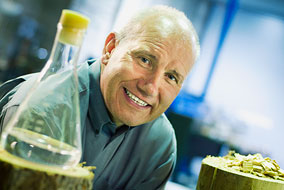
Forestry Dean Jack Saddler forecasts a seismic charge in agricultural and forest industries - photo by Darin Dueck

The size of the Mountain pine beetle (MPB) blight in Canada is in direct proportion to the number of trees found there. It is believed by many scientists that there is a connection between global warming and the spread of the infestation.

In an article published today by the University of British Columbia (UBC) the magnitude of the problem is pegged at about 1 Billion cubic meters of lodgepole in British Columbia by 2013. "An outbreak of this size is unprecedented in recorded history." That piece of information begs the following question - what is the total for all forests in North America?

In this article, UBC professor Jack Saddler projects that "if only 25 per cent of the MPB-killed wood was converted to ethanol, it could supply between five and ten years worth of BC’s gasoline requirements." Of even greater value of such an enterprise is the mitigation of the risk of having so much standing deadwood in our forests. How much particulate matter and CO2 will be released from fires consuming just some these trees? What impact would such fires have on industry, tourism, and population centers throughout the world?

Here are some excerpts from Professor Saddler's article...

------------------
Back to the Future: Substituting Wood for Oil with the “Forest Biorefinery”
By Jack Saddler, Professor of Forest Products Biotechnology and Dean
and Warren Mabee, Research Associate, Dept. of Wood Science, Faculty of Forestry

Over the past few years, the University of British Columbia (UBC) has been fortunate in obtaining federal and provincial support to establish a world class Clean Energy Research Centre based in the Faculty of Applied Science, while the Faculty of Forestry has received about $2.5 million to establish a Process Development Unit (PDU) to assess the potential of wood-based biofuels and chemicals. Our group also acts as the Task Leaders for the International Energy Agency's (IEA) network, coordinating the technical and policy issues influencing the global commercialization of liquid biofuels from biomass.

The ongoing Mountain pine beetle (MPB) outbreak (is) projected to cumulatively impact almost 1 billion cubic metres of lodgepole pine in the province of British Columbia by 2013. An outbreak of this size is unprecedented in recorded history. There is an accumulating surplus of standing deadwood in our forests, which increases the danger of catastrophic fires and reduces the merchantable volume of the working forest. While we will try to recover as much of the beetle-killed wood as possible in the short term for structural applications, we know that wood impacted by MPB loses its value as timber over time, and so wood that has been standing dead for extended periods cannot be processed into lumber, pulp or other advanced wood products. In the longer term, development of bioenergy applications may provide us with a cost-effective product that justifies harvesting and replanting activities. For example, if only 25 per cent of the MPB-killed wood was converted to ethanol, it could supply between five and ten years worth of BC’s gasoline requirements.

For the global forest industry, moving away from fossil fuels is an economic necessity, as volatility associated with fossil fuels has resulted in high energy costs for the industry in recent years. There is a need to extract additional values from our forest resource, and a need to accept ecosystem realities in forest industry practices. Biofuels and bioenergy, which are inherently carbon-neutral and work within the carbon cycle, represent a new model of business which all types of industry could follow.

A number of technological platforms for biofuel production exist and each should be explored to compare their effectiveness and their ability to produce value-added co-products. In all cases, the use of wood for biofuel production should be linked to bioenergy and bioproduct generation, creating a 'biorefinery' with multiple outputs. The biorefinery concept provides maximum economic and environmental returns by efficiently utilizing all components of the wood.

The size of the biofuel and bioenergy opportunity in Canada is huge and biorefinery technologies can and will bring about major changes to the sustainable energy future for our nation. These technologies have the potential to add long-term, sustainable jobs in rural, urban, and aboriginal communities. What is needed now is continued collaboration to create technical platforms for effective and sustainable use of bioenergy, and a strong political will for putting these platforms to work.


technorati , , , , , , ,

April 19, 2007

Thinning trees to save ecology

640,000 acres.

That's larger than the state of Rhode Island and is, unfortunately, the current extent of the pine beetle infestation in Colorado as of February, 2007. There is no way to halt it and it will only get worse. The impact on the state's wildlife (not to mention the effect on tourism and the state's economy) is hard to imagine. Similar outbreaks risk forest fires of horrendous proportions in the San Bernardino mountains in Southern California and the much larger infestations in British Columbia.

Growing replacement trees will have to await the removal of dead ones to save wildlife. Finding an economically practical solution may require swift governmental action to spur private development of new solutions.

This ecological emergency requires forestry triage on a massive scale. The Rocky Mountain News carried the original story that led to this entry in the online BCO newsletter of the Environmental and Energy Study Institute.

----------------
Colorado Seeks Market for Wood Waste from Forest Thinning

As ethanol-from-wood biomass plants open in Georgia, the state of Colorado questions the choice of location. Colorado has been suffering from a pine beetle outbreak for the past four years with 42 percent of Colorado's lodgepole pines infected. One of the largest factors for the outbreak, and one that if addressed could help mitigate the problem, is the accumulation of biomass in Colorado's forests and tree overcrowding. The lowest bid to thin one acre of forests in Summit Count, CO is $1600.

Gary Severson, executive director for the Northwest Colorado Council of Governments, said "It's so expensive because there's no market for the wood. And at that price, there's simply not enough public money to thin the forests. The only way to do this is to find some way to add value to this material. With small-diameter lodgepole pine, there aren't a lot of options."

When Range Fuels was asked about its location choice of Georgia for its cellulosic ethanol plant, CEO Mitch Mandich explained that it was the difference between the trees as plantation crops and the already developed timber infrastructure Georgia has to offer. Georgia rain and soil conditions allow trees to grow to ten inch diameters within ten years, much different from Colorado's position. Lynn Young, a retired U.S. Forest Service public information director, explained, "It's too dry here, the soil's not deep and the trees are small - usually 6 inches to 8 inches in diameter."

Severson added - "What it's going to take is involvement of the private sector. What can we as government do? Cut red tape. Provide some incentives to make things possible, so people say 'Hey, I can make a buck at this.' Then the problem begins to solve itself. Until then, economic disconnect is the big problem."


technorati , , ,

September 15, 2008

Raven Biofuels allies with Price BIOstock

Price BIOstock and Raven Biofuels announced the signing of a strategic alliance that will help them usher in the new era of biofuel biorefinery deployments. Raven expects to build several acid hydrolysis bio-refineries over the next five years. Each biorefinery is being designed to produce an initial capacity of more than 10 million gallons per year (10 MPGY) of ethanol and high value furfural chemicals.

I work as a Marketing Consultant for Price BIOstock. This project is the product of the sales efforts of Ken Day, Price BIOstock Canada Vice President.

What I especially like about the alliance is the emphasis on the use of waste construction wood and Mountain Pine Beetle infested wood to make biofuels. From the Raven Biofuels website:

Our first project is in Washington state and uses construction wood waste for feedstock. Our second project will be in British Columbia Canada and we expect to use pine beetle infested wood for feedstock. This feedstock is readily available and unusable for other applications.

Salvaging waste wood helps mitigate the impact of its decay that would otherwise add greenhouse gas emissions to our already saturated carbon cycle.

Here is the text of their joint press release, found on the CNN Money online report.

---------------
Raven Biofuels Forges Strategic Alliance With Biomass Feedstock Experts at Price BIOstock

September 15, 2008: 07:00 AM EST

Raven Biofuels International Corporation (OTCBB: RVBF) ("Raven" or the "Company") is pleased to announce a strategic alliance with Price BIOstock Services, a division of Arkansas-headquartered The Price Companies, Inc. ("Price Companies") (www.pricebiostock.com), with the stated intent towards the development of definitive agreements on a project by project basis.

With over 40 years of operating history and $450,000,000 in fixed assets the Price Companies is one of the largest and most experienced wood processing companies in the U.S. offering 19 facilities nationwide under contract for many of the most respected manufacturing companies in America -- including International Paper, Rayonier, Weyerhaeuser, New Page, and Georgia Pacific.

Through their many association memberships and industry-wide relationships, Price recognized that the future of biofuels production will significantly exploit cellulosic biomass and has subsequently developed customized solutions for a broad range of dry biomass feedstock including wood, paper, municipal solid waste (MSW), tires, C&D (construction and demolition waste), and agricultural waste. Currently, Price operates 19 Bio-Mass (Wood Pulp Chip) state-of-the-art facilities that produce 14.6 million tons of pulp chips and 2.5 million tons of hog fuel annually. The BIOstock division offers an expanded set of services for managing biomass feedstock materials including consulting, procurement, systems design/engineering, and facilities management.

John Sams, Raven's President and Chief Operating Officer, commented, "The Price Companies are a long established and well managed organization. With the establishment of their BIOstock division they can provide innovative solutions specifically tailored to the needs of biofuels companies like Raven. Feedstock procurement and management is critical to efficiently operating our proposed refineries. Additionally, I feel that Price brings a lot to the table beyond their core offering and could ultimately accelerate Raven's growth strategy."

About Raven Biofuels International Corporation (OTCBB: RVBF)

Raven Biofuels is a developing global renewable energy company focused on producing ethanol from waste or biomass (cellulosic ethanol). Raven plans to build commercial scale refineries using a proprietary 2 stage dilute acid hydrolysis process to convert forestry and agricultural waste to transportation grade ethanol. The production of cellulosic ethanol could play a major role in national energy independence as it has in Brazil. Ethanol made from waste is a viable clean fuel that can play a part in reducing emissions that cause global warming and reducing independence on foreign oil. For more information visit: www.ravenbiofuelsinternational.com.

Contact:
Bakerview Investor Relations Inc.
1-888-525-7823 (RVBF)

----------------
technorati ,

August 20, 2007

Restoration Forestry and 5 Myths about Wildfires


While conducting some research on the catastrophic "megafires" that have been plaguing the U.S. in recent years and their relationship with forest tree density, I ran across a terrific website that offers free downloadable and printable educational materials appropriate for all ages. It is operated by "The Forest Foundation which was created in 1994 to inform the public, specifically Californians, about the relationship between the environment and human needs."

The Forest Foundation is elevating key points in the forest management debate and building valuable relationships with government officials, educators, and community leaders. We bring forest science to today's students and tomorrow's leaders, and develop on-the-ground solutions to improve forest health throughout the state.

Education must be the agent of change that saves California's forests. More than 90 percent of Californians now live in urban settings, meaning most kids growing up here have little or no experience in the state's forests, rangelands, or farms. The next generation will be essentially disconnected from the natural resources they take for granted every day.

One of the concepts that their site successfully gets across is the counterproductive results of modern fire-suppression and restricted timber harvesting. Our forests are much denser than they were natively. Around Lake Tahoe - which has recently suffered a wildfire that destroyed over 250 homes - the forests are four times denser than they were 150 years ago. Beetle infestations from forest density further endangers tree health, wildlife diversity, and provides even more fuel for wildfires.

Timber harvesting on California's public lands is down about 90% since 1990. Yet demand for timber is up and will continue to rise with population increases. I believe it is hypocritical for Californians to enact "tree-hugger" policies that necessitate outsourcing wood harvesting and processing outside the state - particularly since it is counter-productive to the proper stewardship of our public forests. Our forests have become time-bombs in our midst that will cloud our skies with decades worth of particulate matter and greenhouse gases as they burn, rot, and decay.

Here are two sections from a well-researched, downloadable brochure that details techniques for solving the wildfire crisis through restoration forestry.

----------------
Protecting Communities and Saving Forests
by Thomas M. Bonnicksen, Ph.D

What To Do with the Excess Fuel

There is no doubt that California’s forests are plagued with excess fuels. What remains to be seen is how those fuels are dealt with. We could simply leave it there and watch it burn, we could remove some of it in prescribed burns or we can harvest it and put it to good use.

Clean energy
California’s ongoing energy crunch, goals of deriving more energy from renewable sources, and efforts to reduce greenhouse gas emissions in the state to 1990 levels by 2020 highlight another possible use for excess forest growth: biomass energy.

Biomass energy is produced by burning organic material and converting the heat to electricity or even converting the biomass to fuel for cars. Because trees can be replanted, forest biomass represents a largely untapped source of renewable energy.

Utilizing biomass energy has several advantages, especially when seen in the context of global climate change, greenhouse gas emissions and reducing the wildfire threat. Burning fossil fuels to generate energy releases tremendous amounts of carbon dioxide and other greenhouse gases into the atmosphere. Burning biomass to produce energy does not. In fact, biomass energy has a “net zero” carbon impact on the atmosphere.

The more energy we derive from renewable sources like biomass, the less need we have to burn fossil fuels that spew greenhouse gases into the air. Furthermore, the more excess fuels we burn to generate electricity, the less we have to watch burn in catastrophic wildfires.

----------------
5 Myths about Forests and Wildfires

It is important to distinguish between fact and fiction regarding certain myths that may advance agendas but block ecologically sound forest management. Those myths include:

Myth #1: We have to live with catastrophic wildfire. No, we don’t. Managing our forests to reduce fuel loads can make them safe again. Catastrophic wildfire was not a frequent occurrence in California’s historic forests; it need not be frequent today.

Myth #2: Fire is natural and good. There is a world of difference between the low-intensity fires that shaped California’s landscape for thousands of years and the mega-fires that now devastate thousands of acres at a time. Low-level fires cleared the forest floor of debris and regenerated forests. But we have suppressed natural fire for more than 100 years. Wildfires can now feast on unnatural fuel loads, decimate wildlife, sterilize soils and erase forests from the landscape for centuries.

Myth #3: Today’s forests are natural forests. Research and photographic evidence show that California’s modern forests are vastly different from historic forests. Today’s forests are far thicker than their historic predecessors, densely packed with up to 10 times as many trees. Forests have become dangerously overgrown, much to the detriment of wildlife and biodiversity.

Myth #4: Escalating firefighting costs are inevitable. It’s true that average firefighting costs have increased by more than $100 million per year since the early 1990s, but the trend does not have to continue. Spending a fraction of what we spend on fighting fires to manage forests so there are fewer dangerous fires in the first place could save taxpayers millions.

Myth #5: Commercial logging denudes hillsides and kills wildlife. Private forestland owners have proven that modern forest management can provide habitat for diverse wildlife and sustain forests for generations. The most productive forestland in California is privately owned, and research confirms that wildlife and fisheries from salmon and owls to deer and songbirds flourish on managed lands.

technorati , , ,

March 31, 2007

March 2007 Digest

Bridging the Gap to Biofuels


When it comes to energy, we are all stakeholders – whether we are producers, refiners, developers, educators, policymakers, marketers, regulators, environmentalists, distributors, farmers, foresters, or simply commuters... we are all consumers with a vested interest in future development of renewable energy in concert with environmental sustainability.

Even though there is a growing global recognition that something must be done to reduce dependence on fossil fuels and mitigate carbon emissions, the potential for endless debate over the means to these ends is threatened by delays. We need to act now.

The success of any mission to achieve 25x’25 or Twenty in Ten is more dependent on our willingness to communicate and work together than it is on our technical achievements. Why? I am convinced it will take collaboration between all stakeholders to develop and deploy these emerging technologies.

Having attended three important conferences this month, perhaps the most important lesson I can share is one for “bridging the gap” that I learned at 25x’25. When negotiating all parties must take an attitude of “Yes, if...” rather than “No, because...”

For example, “Will you agree...?”:
• “Yes, if you will guarantee...
• “Yes, if you can convince...
• “Yes, if you can match...
• “Yes, if you will commit...

Without the proper spirit of collaboration no compact between stakeholders will be sustainable – even if the technology is.

BIOstock Blog--------------
Will dead trees revive forest industries?
Why ethanol from wood makes sense
The Canadian action plan against the Mountain Pine Beetle
25x'25 Summit pressures U.S. Congress to act
Environmentalists and industrialists meet at the BioEnergy Wiki

BIOconversion Blog--------------
Multi-prong approach enhances energy security
ACORE wins BIG in Vegas
So. California Air Quality (AQMD) looks at Cellulosic Ethanol
BIO World Congress is bio-energized by cellulosic ethanol

BIOoutput Blog--------------
Using fungi to produce ethanol & biodegradeable material

BIOwaste Blog--------------
Producing hydrogen from wastewater and MSW
Fortune looks at waste source reduction

Each month we provide a similar breakdown of article titles from our favorite "companion" site - Biopact Blog. This list is kept current and is accessible in the right hand column of each of the three blogs.

Please forward a link to this digest to anyone you know who would be interested in keeping track of change that will affect us all. They can add their name to the mailing list on the BioConversion Blog.

January 31, 2007

January 2007 Digest

The Renewable Industrial Revolution

After more than 150 years, the Industrial Revolution is overdue for a major retooling. No longer can we heedlessly combust biomass and fossil resources without consideration for the carbon emissions and potential energy that "floats out the smokestack." But what can possibly replace the status quo paradigm that we have based so much of our energy, industry, transportation, and lifestyle liberties upon?

This BIO "BlogRing" - BIOstock Blog, BIOconversion Blog, BIOoutput Blog, and the new BIOwaste Blog - is intended to help identify the multi-faceted pieces of emerging biomass technologies. - is intended to help identify the multi-faceted pieces of emerging biomass technologies. Like a Rubik's cube, the parts are inextricably linked together, but currently in disarray. By addressing each facet independently, challenging issues will become clear. By shifting perspective, new collaborative solutions can be synthesized. Not just one solution but many, because the ultimate solution for any market will depend upon the resources, ecology, and stakeholders of that market.

Here are their most significant developments of January 2007, organized by blog...

BIOstock Blog--------------
Utilizing Pine Beetle Wood Waste as BIOstock
Japanese wood-to-ethanol facility uses Arkenol process
CHINA: Choosing wood over corn for biofuels production
Low heat gasification converts woody biostock to energy
25x'25 Vision of BIOstock Supply
Food vs. Fuel: Over-reliance on Corn Raises Ag Prices
Celunol produces Ethanol from Wood using Bacteria
BIOethanol converted from pulping liquor
Food vs. Fuel? U.S. Farmers Can Produce Both
Black Liquor Gasification Technology Attracts Volvo Investment

BIOconversion Blog--------------
Biomass: Year-in-Review
Biomass Power Generation using Gasification
ALT Energy Stocks: The Future of Ethanol
FLORIDA: Cultivating a Bioconversion Industry
Low heat gasification technique to convert biostock to energy
Europe's "New Industrial Revolution"
Celunol launches commercial-scale cellulosic ethanol plant in Japan
Cellulose Ethanol Market Potential Report
ACORE: President Bush on Renewable Energy in 2007
Apollo Alliance pursues 'green-collar' jobs
Ethanol and Net Energy - EROI
The Renewable Path to Energy Security

BIOoutput Blog-----------------
FAQ: BIOoutput Blog
"Living with Ed" Begley, Jr. in Studio City
CALIFORNIA: Governor Targets Fuel Emissions
Electric cars - a boost for biofuels?
CHINA: Pollution threatens 2008 Olympics
BioButanol from Cellulosic Bioconversion
From Food to Fuel to Fashion

NEW! BIOwaste Blog-----------------
FAQ: BIOwaste Blog
Spinning “Gold” Out of Trash
Southern California Emerging Waste Technologies Forum
The Benefits of Conversion Technologies
Recycling’s “China Syndrome”
Plasma Gasification and Incineration Compared
CANADA: Municipal Solid Waste Disposal Options
CHINA: Pollution threatens 2008 Olympics
Using Algae to Recycle Flue Gas into Biofuels
U.S. D.O.E.: Strategies for Reducing Greenhouse Gases
CALIFORNIA: Air Resources Board tackles Global Warming
Impact of Global Growth on Carbon Emissions
Enforcing California's Greenhouse Gas Emissions Limits
BIOwaste Energy as Explained on the Energy Kid's Page
Expanded Recycling - a Key to Cutting Fossil Fuels and Global Warming
Mayors seek $4B to fight Energy & Environmental Challenges
MIT/PNNL Plasma Arc Waste-to-ethanol Solution

Each month we provide a similar breakdown of article titles from our favorite "companion" site - Biopact Blog. This list is kept current and is accessible in the right hand column of each of the three blogs.

Please forward a link to this digest to anyone you know who would be interested in keeping track of change that will affect us all. They can add their name to the mailing list on the BioConversion Blog.


technorati , , , , , ,

September 29, 2007

Woody Biomass: Fuel for Wildfires


This article contains the text and some images from the first half of a speech I presented at the Energy from Biomass and Waste conference in Pittsburgh, PA on September 27. It leads into the second half of the presentation titled Woody Biomass: Feedstock for BioEnergy which describes the existing and emerging technologies that can utilize woody biomass for the production of bioenergy - heat, steam, electricity, and biofuels. Many of the statistics and photos come from an excellent Forest Foundation publication titled Protecting Communities and Saving Forests.

-----------------
Woody Biomass: Fuel for Wildfires

I believe that the conversion of biomass to energy represents not only a sustainable, clean alternative to fossil fuel energy but that implementing these emerging technologies can help us solve environmental and ecological challenges of the new millennium.

This presentation will focus on just one environmental challenge - wildfires in the continental U.S. - and how a robust woody biomass conversion industry can provide tools to lessen the threat to our forests.

There are over 10 million private forest owners in the U.S. Although you could say that the country experienced “deforestation” during its early development, the acreage of forests have not diminished at all during the last 100 years. Forests have provided fuel and created great industries for furniture, construction, and paper - industries that sequester carbon.

Unfortunately, these industries that are now stagnating and, in some cases, staggering under the multiple pressures of cheap imports, crusades against forest use, and timberland sell-offs due to skyrocketing real estate prices.

Added to these pressures is the appropriation of more lands to public ownership shifting responsibility to management by the USDA Forest Service.

Some groups seek to preserve forests, biodiversity, and wildlife habitats by severely limiting access by the forest product industries and, through litigation, micromanaging the public forest services charged with insuring forest health.
I contend that it is simply not economically feasible or sustainable for public agencies to take proper care of forests under these conditions.

Forest health has suffered greatly from wildfires and bug infestations.

Wildfires and Greenhouse Gas Emissions
We all know that healthy forests are capable of sequestering vast amounts of greenhouse gases which is a leading cause of global warming.
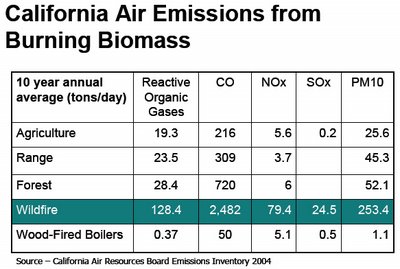
But we are just starting to recognize that forests can emit vast amounts of GHG through burning and decaying. Here are some numbers pulled together by the California Air Resources Board comparing the average emissions of major geographic sectors. Notice that wildfire emissions dwarf the volume from the other sources combined!

Satellite photographs taken during the last four years of wildfire’s devastating impacts on public lands provide clear evidence of the extent of this travesty.

In Congressional testimony Senator Pete Domenici of New Mexico testified that when the Hayman Fire burned in Colorado in 2002, NASA scientists estimated that the fire was emitting more carbon dioxide in one day than all the vehicles in the United States emitted in a week. It lasted 14 days.

Since 2002 mega-fires have gotten worse.

In 2003 the San Diego Cedar Fire (click to enlarge) was the largest in California history lasting 8 days and consuming an area half the size of Rhode Island. Here is a satellite photo of the emissions - so dense that air traffic control towers in L.A. and San Diego were closed for a period of time.


Simultaneously, a fire was burning in the San Bernardino Mountains, just east of L.A. It lasted two weeks and destroyed more than 1,000 other homes. Fortunately it stopped before reaching resort towns near Lake Arrowhead and Big Bear, shown in the upper right corner. If it had it would have decimated evergreen trees that were already sick, dead, or dying from bark beetle infestations - which, incidentally, is what happened in Big Bear two weeks ago. The lakeside community of Fawnskin had to be evacuated by the 15,000 acre fire. The smoke plume from this fire reached far north into Nevada.

Here is what a burned forest looks like (click to enlarge) - charred remains stripped of its leaves and pine needles and in active decay. According to the Forest Foundation the impact of wildfires does not end with the smoke. During decay trees emit about 300% more greenhouse gases than what was emitted during the fire.

Most of the charred remains need to be removed and the lands replanted. Unfortunately, “Nearly four years after fires burned more than 133,000 acres of national forest land in California, less than one percent of those acres have been replanted.”

Just Monday, Senator Craig of Idaho gave testimony in Congress stating that over $2 Billion has been spent this year fighting forest fires while less than $600 million has been spent on preventing them.

Indeed, 2007 has seen a startling upsurge in mega-fires. The Angora Fire, a 3,100 acre blaze in South Lake Tahoe, was responsible for emitting the equivalent of 143,000 cars for an entire year. A blaze 15 times that size devastated Montana.

On July 4th a fire broke out in the Santa Barbara mountains. A week later in Yosemite a satellite photo series was posted throughout the park warning hikers of the health impacts caused by the fire 180 miles away. Driving south through Bakersfield the sun was blotted out by the smoke. The fire lasted another two weeks.

The point is that MORE greenhouse gases are emitted each year from wildfires than we are likely to save in a decade of reduced vehicle greenhouse gas emissions. We can do much better.

Wildfire Impact on Wildlife
They say the road to hell - in this case wildfires - is paved with good intentions. Activists mount crusades and file litigation to protect endangered species which frustrate attempts to fix forest health problems that lead to wildfires.

It is impossible to estimate the impact of wildfires on wildlife but even if the species escape, it leads to overcrowding in surrounding ecologies. But not even mobile animals are immune from the quick moving fires. Like the victims of Pompei most animals die from asphyxiation. Fires can boil streams which kill the fish. The U.S. Fish and Wildlife Department reports that Georgia’s largest fire ever that started in the Okefenokee Swamp this year was also the most expensive ever for the agency.

The problem of forest density
According to Texas A&M professor Dr. Tom Bonnicksen, a founder of the Forest Foundation, the problem is one of forest density. Our forests have 4 to 10 times as many trees per acre as they used to have. People used to be able to gallop through forests - now it is hard to walk through them or fight fires within them.

Excess forest biomass in the form of small diameter trees, and underbrush create a kindling “ladder of fuel” that helps surface fires spiral up to the crowns of trees. Once there, a fire storm can evolve whipped by winds to spread rapidly in all directions.

Public agencies waste precious funds to fight the wildfires - the symptoms of unhealthy forests - rather than invest it in efforts to restore and manage forest health through thinning. When asked what the biggest hurdle is to deploying thinning programs that are important to restoring forest health, field Forest Service planners say "infrastructure." Without forest product industries to convert the woody biomass to carbon sequestering products and bioenergy, there is no where to store the collected woody biomass and no economically sustainable way to help pay for the program.

To restore forests to a healthy condition, Dr. Bonnicksen recommends a three step, economically sustainable solution that involves private industry who would restore and maintain forest stewardship as part of their operating overhead.
1. First they would harvest decaying biomass
2. Then reforest to a historic model specific to the forest, and
3. Third mechanically thin vulnerable forests of woody biomass as part of their stewardship.

The USDA Forest Service could provide oversight of the program.

-----------------
The followup presentation is titled Woody Biomass: Feedstock for BioEnergy

----------------
technorati , ,

August 22, 2011

Increased global forest density necessitates more forest management

Environmental Research Web published a report last month based on U.S. and European research concluding that global "Forest Density is Increasing." This substantiates the argument that Indirect Land Use Change is a speculative theory because increased forest density can mitigate the impacts of deforestation - particularly in large forests like Brazil's. If we can sustainably grow and manage forests that have increased density or develop best practices that improve the health and yield of forests (just as we can with food and energy crops) then minor variations in the use of acres becomes a meaningless concern.

Unfortunately, many in the North American environmental community will conclude that the study results prove something else. They believe that, by obstructing forest industry development and enforcing a more laissez-faire attitude toward forests, that forests will cure themselves of the "exploitive invasion" by the forest products industry.

Almost everyone agrees that that an end to active fire suppression decades ago in North America has resulted in more forest density. However, the challenge and responsibility of maintaining forest health is more important now than ever before. Is it safe to have unmanaged forests with 400-600 trees per acre when, properly thinned, it is much healthier and fire resistant at 100?

What is the value of a carbon sink if it (and its diverse habitats) can be lost to megafires and beetle kill? These disasters have grown substantially since 2000 in North America - in acreage and intensity. One can believe that "natural conditions" will fix forests but if that same person believes that 39% more carbon in the atmosphere compared to the pre-Industrial era compromises natural conditions then a laissez-faire attitude toward forest health is pure negligence.

Increased density of our forests makes it imperative that we exercise more forest management. The academics (UC/Berkeley), agencies (USDA/Forest Service and the Woody Biomass Utilization Group), and associations I belong to (TAPPI, SAF, ACORE) all tell me that the key to improving forest management is building more "infrastructure." They define infrastructure to mean forest products facilities, including biopower plants and biorefineries, that can convert forest thinnings into products, power, and fuels.

These products that have the added carbon cycle benefit of reducing greenhouse gases from combusting coal and oil distillates. More infrastructure will also provide important disaster response alternatives for managing forest salvage from hurricanes, tornadoes, floods, and droughts - all anticipated to rise with global climate change.

I wrote about a 2008 study of 4 wildfires in California and the carbon consequences of active vs. inactive forest management as carried out by private vs. federal managers (see Links between California Wildfires and GHG emissions). The data analysis from this study raises some important questions relevant to our perception of the best way to manage forests before and after high density fuelwood accumulation.

----------------

technorati , , ,

November 22, 2006

Forest Industry: Bio-Solutions to Climate Change

Is there an environmentally safe role for wood industry byproducts and waste to play in providing sustainable bio-solutions to climate change? Can we really live on less paper, pulp, and lumber? Are substitutes likely to be better environmentally - with equal or less impact on carbon sequestration? What is the responsible thing to do with tree trimmings, black liquor, and bark beetle-infested trees?

Does "saving forests" include thinning them to prevent forest fires - a horrific source of toxic carbon emissions and particulate matter (see below)?

These are some of the questions that are being asked at Forestry Industry meetings like the International Seminar on Energy and Forest Products Industry (30-31 October) held in Rome.

The forest products industry is a major consumer of energy, using 6 percent of total industrial energy use in 2003. But the industry also produces energy, as well as other by-products that can be used for energy generation. It is the only sector that already generates approximately 50 percent of its own energy needs, the majority from renewable carbon-neutral biomass. Energy costs, energy supply and climate change are amongst the core issues impacting on the future of the forest products industry.

Wulf Killmann, Director of Forest Products and Economics at Food and Agriculture Organization (FAO), said that the potential of the forestry industry to help solve energy and climate change needs to be tapped. "Governments have a key role to play in encouraging industries to use cleaner and more efficient energy technologies and in promoting bio-energy."

Here are excerpts from a recent article published by Forest Newswatch:

--------------------
Can the forest products industry be part of a bio-solution to climate change?
Forest Newswatch (subscription)
Friday, 03 November 2006

The global forest products industry can play a significant role in combating climate change by optimizing the use of raw material, increasing efficiency, producing bio-energy and expanding into bio-refinery products while developing the competitiveness of the sector.

This was the conclusion of the International Seminar on Energy and Forest Products Industry (30-31 October), in which intergovernmental and private sector organisations of the global forest product industry joined forces. Participants stressed that well integrated and carefully balanced energy and forest policies around the globe set the stage for these developments. Governments, industry, institutions and society at large each have a role to play and should work together.

"The forest products industry can be part of the solution for climate change if committed to technological changes and energy efficiency," said Neil Hirst, Director of Energy Technology of the International Energy Agency (IEA). "It has the exceptional ability to become a net supplier of a range of energy products and it could, in combination with carbon capture and storage, become an important actor in removing carbon dioxide from the atmosphere."

"Wood and paper products are uniquely renewable and recyclable products that help reducing greenhouse gas emissions by absorbing carbon dioxide from the atmosphere," said Teresa Presas, Chair of the International Council of Forest and Paper Associations (ICFPA). The industry is committed to innovative energy solutions that meet the challenge of climate change, increase efficiency, reduce reliance on fossil fuel and expand the use of renewable energy sources. The industry believes that fibre from sustainable managed forests makes a positive contribution to the world's future energy supply.

"To achieve this", Presas said, "the industry needs enabling policies that support research and innovation, promote demonstration projects and improve the investment climate, specifically in this sector. Moreover there needs to be a level playing field between energy and non-energy uses of wood, considering that all this has to take place within the boundaries of sustainable forest management."

The World Wide Fund for Nature (WWF) would be glad to see the global forest product industry taking a stronger role in the energy and climate change mitigation field, but also sets some requirements.

"WWF considers that sustainable bioenergy has to be part of the global strategy to reduce greenhouse gas emissions, among other measures aiming to reduce the ecological footprint. Credible certification of bioenergy feedstocks with a focus on social and environmental issues - including greenhouse gas calculations - and land use planning are part of the solution to ensure the sustainability of development", said Duncan Pollard, Director of the WWF Forests for Life Programme.


technorati , , , , , , , ,