Showing posts sorted by relevance for query bonnicksen. Sort by date Show all posts

April 25, 2008

Links between California Wildfires and GHG emissions

"Reducing wildfires maybe the single most important action we can take in the short-term to reduce greenhouse gas emissions and fight global warming." - Dr. Tom Bonnicksen

Dr. Tom Bonnicksen, a professor at Texas A&M and author of "America's Ancient Forests: from the Ice Age to the Age of Discovery" is a staunch advocate for restoring our forests to a healthier condition. That shouldn't make him controversial but it does because he advocates what many environmental groups consider "heretical" means to achieve this objective - removing excess biomass through forest thinning, salvaging of dead and dying trees, and reforestation on a massive scale. Recognizing such restorative steps will require the building of temporary roads and the re-introduction of forest product industries to buy the wood, he has drawn criticism from environmental groups, including coordinated attempts to question his academic credentials.


Above is a historic chart produced by the National Interagency Fire Center that plots the disturbing rise in wildfire acreage nationwide in the last 50 years. This doesn't register the growth of intensity of fires which are believed to be at unprecedented ferocity producing even more GHG. The trend line shows the legacy of the last ten years when litigious obstruction by environmental groups of planned USDA Forest Service projects has been the most vigorous - delaying remedial public forest programs.

To circulate his interpretation to a broader audience, Dr. Bonnicksen published a very professional 52-page booklet titled "Protecting Communities and Saving Forests: Solving the Wildfire Crisis through Restoration Forestry." It should be required reading for all environmental policy makers in California because it clearly states how the state has arrived at a condition of ever increasing wildfires and suggests sensible actions to mitigate the problem.

Taking his research a step further, Dr. Bonnicksen has just released a new study entitled "Greenhouse Gas Emissions From Four California Wildfires: Opportunities to Prevent and Reverse Environmental and Climate Impacts" which draws the connection between GHG and forest fires. Without restorative action, fires will get worse and greenhouse gas emissions will increase. With action, not only will the growth of forest fires and bug infestations likely be held in check, but more carbon will be sequestered, correcting the imbalance created by the original fires.

A key to understanding the urgency for remedial action is recognition that GHG doesn't just come from the combustion and smoke of the original fire - that only accounts for 25% of the emissions. The other 75% comes during the period of decay of the affected forest. According to his research of four representative fires, initial combustion plus eventual decay emissions represent the equivalent of adding 7 million cars to California's roadways for 1 year!

The study also paints a revealing picture of the difference in GHG impact between responsive action by private timberland owners versus the publicly-obstructed remedies proposed by the federal government. Because of fierce anticipated public opposition, the Forest Service has no know plans to plant trees on burned areas of the Tahoe area Angora fire - consequently 0% of the total CO2 emitted will eventually be recovered from plantings. Contrast this with the Fountain Fire where 100% of the privately owned burned land was replanted. The study estimates that 99.2% of the original lost C02 will be recovered.

Here is an abstract written by The Forest Foundation on their website where free copies of the study is available for download:

-----------------------
Wildfires, Forests and Climate Change
California wildfires release millions of tons of greenhouse gases into the atmosphere every year. Conversely, sustainable forest management removes greenhouse gases from the air, stores carbon in wood products and regenerates landscapes in a perpetual cycle of carbon sequestration. The Forest Foundation developed the Forest Carbon and Emission Model (FCEM) to help clarify the relationships between wildfires, forest management and greenhouse gas emissions.

Greenhouse Gas Emissions From Four California Wildfires: Opportunities to Prevent and Reverse Environmental and Climate Impacts

In the report above, the FCEM presents details of the greenhouse gas emissions associated with four California wildfires. It estimates the total emissions from combustion and decay, provides comparisons to autos and other emission sources, and notes the potential value of reforestation to recapture gases released from wildfire. This report considers the Angora, Moonlight, Star and Fountain fires.

Forest Foundation Study Finds Four Wildfires Send 38 Million Tons Of Harmful Gases Into Air, Equivalent Of 7 Million Cars On The Road For One Year In California

The Forest Carbon and Emission Model Overview and Technical Information

The FCEM report above considers site characteristics like vegetation type, density, mortality, acres burned, and other factors to estimate emission totals. The FCEM Overview and Technical Information report explains the inputs and methodologies used to drive the model.

----------------
technorati , , ,

September 29, 2007

Woody Biomass: Fuel for Wildfires


This article contains the text and some images from the first half of a speech I presented at the Energy from Biomass and Waste conference in Pittsburgh, PA on September 27. It leads into the second half of the presentation titled Woody Biomass: Feedstock for BioEnergy which describes the existing and emerging technologies that can utilize woody biomass for the production of bioenergy - heat, steam, electricity, and biofuels. Many of the statistics and photos come from an excellent Forest Foundation publication titled Protecting Communities and Saving Forests.

-----------------
Woody Biomass: Fuel for Wildfires

I believe that the conversion of biomass to energy represents not only a sustainable, clean alternative to fossil fuel energy but that implementing these emerging technologies can help us solve environmental and ecological challenges of the new millennium.

This presentation will focus on just one environmental challenge - wildfires in the continental U.S. - and how a robust woody biomass conversion industry can provide tools to lessen the threat to our forests.

There are over 10 million private forest owners in the U.S. Although you could say that the country experienced “deforestation” during its early development, the acreage of forests have not diminished at all during the last 100 years. Forests have provided fuel and created great industries for furniture, construction, and paper - industries that sequester carbon.

Unfortunately, these industries that are now stagnating and, in some cases, staggering under the multiple pressures of cheap imports, crusades against forest use, and timberland sell-offs due to skyrocketing real estate prices.

Added to these pressures is the appropriation of more lands to public ownership shifting responsibility to management by the USDA Forest Service.

Some groups seek to preserve forests, biodiversity, and wildlife habitats by severely limiting access by the forest product industries and, through litigation, micromanaging the public forest services charged with insuring forest health.
I contend that it is simply not economically feasible or sustainable for public agencies to take proper care of forests under these conditions.

Forest health has suffered greatly from wildfires and bug infestations.

Wildfires and Greenhouse Gas Emissions
We all know that healthy forests are capable of sequestering vast amounts of greenhouse gases which is a leading cause of global warming.

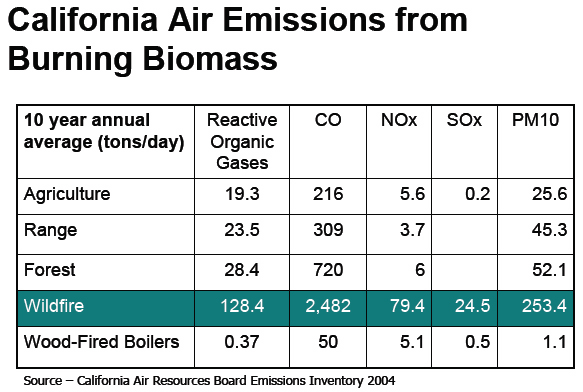
But we are just starting to recognize that forests can emit vast amounts of GHG through burning and decaying. Here are some numbers pulled together by the California Air Resources Board comparing the average emissions of major geographic sectors. Notice that wildfire emissions dwarf the volume from the other sources combined!

Satellite photographs taken during the last four years of wildfire’s devastating impacts on public lands provide clear evidence of the extent of this travesty.

In Congressional testimony Senator Pete Domenici of New Mexico testified that when the Hayman Fire burned in Colorado in 2002, NASA scientists estimated that the fire was emitting more carbon dioxide in one day than all the vehicles in the United States emitted in a week. It lasted 14 days.

Since 2002 mega-fires have gotten worse.

In 2003 the San Diego Cedar Fire (click to enlarge) was the largest in California history lasting 8 days and consuming an area half the size of Rhode Island. Here is a satellite photo of the emissions - so dense that air traffic control towers in L.A. and San Diego were closed for a period of time.


Simultaneously, a fire was burning in the San Bernardino Mountains, just east of L.A. It lasted two weeks and destroyed more than 1,000 other homes. Fortunately it stopped before reaching resort towns near Lake Arrowhead and Big Bear, shown in the upper right corner. If it had it would have decimated evergreen trees that were already sick, dead, or dying from bark beetle infestations - which, incidentally, is what happened in Big Bear two weeks ago. The lakeside community of Fawnskin had to be evacuated by the 15,000 acre fire. The smoke plume from this fire reached far north into Nevada.

Here is what a burned forest looks like (click to enlarge) - charred remains stripped of its leaves and pine needles and in active decay. According to the Forest Foundation the impact of wildfires does not end with the smoke. During decay trees emit about 300% more greenhouse gases than what was emitted during the fire.

Most of the charred remains need to be removed and the lands replanted. Unfortunately, “Nearly four years after fires burned more than 133,000 acres of national forest land in California, less than one percent of those acres have been replanted.”

Just Monday, Senator Craig of Idaho gave testimony in Congress stating that over $2 Billion has been spent this year fighting forest fires while less than $600 million has been spent on preventing them.

Indeed, 2007 has seen a startling upsurge in mega-fires. The Angora Fire, a 3,100 acre blaze in South Lake Tahoe, was responsible for emitting the equivalent of 143,000 cars for an entire year. A blaze 15 times that size devastated Montana.

On July 4th a fire broke out in the Santa Barbara mountains. A week later in Yosemite a satellite photo series was posted throughout the park warning hikers of the health impacts caused by the fire 180 miles away. Driving south through Bakersfield the sun was blotted out by the smoke. The fire lasted another two weeks.

The point is that MORE greenhouse gases are emitted each year from wildfires than we are likely to save in a decade of reduced vehicle greenhouse gas emissions. We can do much better.

Wildfire Impact on Wildlife
They say the road to hell - in this case wildfires - is paved with good intentions. Activists mount crusades and file litigation to protect endangered species which frustrate attempts to fix forest health problems that lead to wildfires.

It is impossible to estimate the impact of wildfires on wildlife but even if the species escape, it leads to overcrowding in surrounding ecologies. But not even mobile animals are immune from the quick moving fires. Like the victims of Pompei most animals die from asphyxiation. Fires can boil streams which kill the fish. The U.S. Fish and Wildlife Department reports that Georgia’s largest fire ever that started in the Okefenokee Swamp this year was also the most expensive ever for the agency.

The problem of forest density
According to Texas A&M professor Dr. Tom Bonnicksen, a founder of the Forest Foundation, the problem is one of forest density. Our forests have 4 to 10 times as many trees per acre as they used to have. People used to be able to gallop through forests - now it is hard to walk through them or fight fires within them.

Excess forest biomass in the form of small diameter trees, and underbrush create a kindling “ladder of fuel” that helps surface fires spiral up to the crowns of trees. Once there, a fire storm can evolve whipped by winds to spread rapidly in all directions.

Public agencies waste precious funds to fight the wildfires - the symptoms of unhealthy forests - rather than invest it in efforts to restore and manage forest health through thinning. When asked what the biggest hurdle is to deploying thinning programs that are important to restoring forest health, field Forest Service planners say "infrastructure." Without forest product industries to convert the woody biomass to carbon sequestering products and bioenergy, there is no where to store the collected woody biomass and no economically sustainable way to help pay for the program.

To restore forests to a healthy condition, Dr. Bonnicksen recommends a three step, economically sustainable solution that involves private industry who would restore and maintain forest stewardship as part of their operating overhead.
1. First they would harvest decaying biomass
2. Then reforest to a historic model specific to the forest, and
3. Third mechanically thin vulnerable forests of woody biomass as part of their stewardship.

The USDA Forest Service could provide oversight of the program.

-----------------
The followup presentation is titled Woody Biomass: Feedstock for BioEnergy

----------------
technorati , ,

August 20, 2007

Restoration Forestry and 5 Myths about Wildfires


While conducting some research on the catastrophic "megafires" that have been plaguing the U.S. in recent years and their relationship with forest tree density, I ran across a terrific website that offers free downloadable and printable educational materials appropriate for all ages. It is operated by "The Forest Foundation which was created in 1994 to inform the public, specifically Californians, about the relationship between the environment and human needs."

The Forest Foundation is elevating key points in the forest management debate and building valuable relationships with government officials, educators, and community leaders. We bring forest science to today's students and tomorrow's leaders, and develop on-the-ground solutions to improve forest health throughout the state.

Education must be the agent of change that saves California's forests. More than 90 percent of Californians now live in urban settings, meaning most kids growing up here have little or no experience in the state's forests, rangelands, or farms. The next generation will be essentially disconnected from the natural resources they take for granted every day.

One of the concepts that their site successfully gets across is the counterproductive results of modern fire-suppression and restricted timber harvesting. Our forests are much denser than they were natively. Around Lake Tahoe - which has recently suffered a wildfire that destroyed over 250 homes - the forests are four times denser than they were 150 years ago. Beetle infestations from forest density further endangers tree health, wildlife diversity, and provides even more fuel for wildfires.

Timber harvesting on California's public lands is down about 90% since 1990. Yet demand for timber is up and will continue to rise with population increases. I believe it is hypocritical for Californians to enact "tree-hugger" policies that necessitate outsourcing wood harvesting and processing outside the state - particularly since it is counter-productive to the proper stewardship of our public forests. Our forests have become time-bombs in our midst that will cloud our skies with decades worth of particulate matter and greenhouse gases as they burn, rot, and decay.

Here are two sections from a well-researched, downloadable brochure that details techniques for solving the wildfire crisis through restoration forestry.

----------------
Protecting Communities and Saving Forests
by Thomas M. Bonnicksen, Ph.D

What To Do with the Excess Fuel

There is no doubt that California’s forests are plagued with excess fuels. What remains to be seen is how those fuels are dealt with. We could simply leave it there and watch it burn, we could remove some of it in prescribed burns or we can harvest it and put it to good use.

Clean energy
California’s ongoing energy crunch, goals of deriving more energy from renewable sources, and efforts to reduce greenhouse gas emissions in the state to 1990 levels by 2020 highlight another possible use for excess forest growth: biomass energy.

Biomass energy is produced by burning organic material and converting the heat to electricity or even converting the biomass to fuel for cars. Because trees can be replanted, forest biomass represents a largely untapped source of renewable energy.

Utilizing biomass energy has several advantages, especially when seen in the context of global climate change, greenhouse gas emissions and reducing the wildfire threat. Burning fossil fuels to generate energy releases tremendous amounts of carbon dioxide and other greenhouse gases into the atmosphere. Burning biomass to produce energy does not. In fact, biomass energy has a “net zero” carbon impact on the atmosphere.

The more energy we derive from renewable sources like biomass, the less need we have to burn fossil fuels that spew greenhouse gases into the air. Furthermore, the more excess fuels we burn to generate electricity, the less we have to watch burn in catastrophic wildfires.

----------------
5 Myths about Forests and Wildfires

It is important to distinguish between fact and fiction regarding certain myths that may advance agendas but block ecologically sound forest management. Those myths include:

Myth #1: We have to live with catastrophic wildfire. No, we don’t. Managing our forests to reduce fuel loads can make them safe again. Catastrophic wildfire was not a frequent occurrence in California’s historic forests; it need not be frequent today.

Myth #2: Fire is natural and good. There is a world of difference between the low-intensity fires that shaped California’s landscape for thousands of years and the mega-fires that now devastate thousands of acres at a time. Low-level fires cleared the forest floor of debris and regenerated forests. But we have suppressed natural fire for more than 100 years. Wildfires can now feast on unnatural fuel loads, decimate wildlife, sterilize soils and erase forests from the landscape for centuries.

Myth #3: Today’s forests are natural forests. Research and photographic evidence show that California’s modern forests are vastly different from historic forests. Today’s forests are far thicker than their historic predecessors, densely packed with up to 10 times as many trees. Forests have become dangerously overgrown, much to the detriment of wildlife and biodiversity.

Myth #4: Escalating firefighting costs are inevitable. It’s true that average firefighting costs have increased by more than $100 million per year since the early 1990s, but the trend does not have to continue. Spending a fraction of what we spend on fighting fires to manage forests so there are fewer dangerous fires in the first place could save taxpayers millions.

Myth #5: Commercial logging denudes hillsides and kills wildlife. Private forestland owners have proven that modern forest management can provide habitat for diverse wildlife and sustain forests for generations. The most productive forestland in California is privately owned, and research confirms that wildlife and fisheries from salmon and owls to deer and songbirds flourish on managed lands.

technorati , , ,

November 17, 2007

Hurricane Katrina's greenhouse gas legacy


Hurricane Katrina's legacy is not just the flooding of New Orleans and the destruction of coastal Mississippi. It is also responsible for damaging five million acres of forests - an area the size of the state of Massachusetts. For comparison, the destructive power the 1980 eruption of Mt. St. Helens wiped out 150,000 acres of forests (less than 4% of the forest destruction reach of Katrina).

In a front page article of the Los Angeles Times, Thomas Maugh II and Karen Kaplan reported on new research results by Tulane's Dr. Jeffrey Q. Chambers that has appeared in Science magazine. By using spectral analysis comparisons of before (2003) and after (2006) imagery of the region made by NASA's Landsat V satellite (click to enlarge image above), Chambers and his research team has made a number of alarming findings about the carbon footprint of this very destructive hurricane.

What is the greenhouse gas consequence of all that wasted biomass rotting and decaying?

Left in place without removal, the carbon of the trees will continue to decay for decades. Roughly 50% of the content of trees is carbon. The emissions from decay will contain methane and carbon dioxide. According to Dr. Chambers' analysis, 367 million tons of carbon dioxide will be emitted - which is about the same amount as is absorbed by all U.S. forests in a year. It is also a total that exceeds the combined emissions of national forest fires for an entire year.

What is the time frame for removal?

As it decays, the woody biomass becomes harder to access and harder to remove. Even with modern equipment, it is easier to assess, plan, and harvest standing trees than those lying on the ground at some progression of decay. Besides the remaining obstruction of hurricane-damaged logging roads in the area, foliage regrowth has already begun which makes logging access more difficult.

Should the drought conditions of the South persist, the dead biomass represents a significant fire threat which would add significant amounts of new greenhouse gas and particulate matter emissions to the atmosphere and further complicate restoration.

What will the new forests look like if left to natural regeneration?

According to the Times article, "Chambers and his colleagues said the deforested land, once covered with native species such as longleaf pine, oak and cypress, is being taken over by invasive species that are change the ecology of the area. One of the most prolific, the Chinese tallow, oozes a milky, toxic sap that creates an inhospitable environment for insects, birds and small animals."

How can we pay for forest restoration?

According to Dr. Thomas Bonnicksen of The Forest Foundation, the a privately financed restoration of the forests is straightforward. "Sell the logs to sawmills to be turned into wood products, and use the revenue generated to pay for removing the slash left behind and replanting the forest. Replant native trees in a patchy mosaic so the forest develops naturally. This includes leaving enough snags and logs for wildlife habitat, and returning a few years after planting to remove competing brush so trees grow quickly and are protected against future wildfires."

Who would administer the forest restoration program?

There is a federal committee called the Woody Biomass Utilization Group that includes forestry, energy, and wildlife experts from several departments of government - the Departments of Energy, Agriculture/Forest Service, and Interior. They also have a subgroup studying Disaster Debris that works with FEMA and Homeland Security in an effort to establish and coordinate federal remedial response to environmental disasters like Katrina, floods, tornadoes, and megafires throughout the country.

When asked what the biggest hurdle was to the implementation of harvesting and reforestation programs, Ron Vineyard of the Forest Service responded "infrastructure." By that he meant that there needs to be more sawmills, power plants, forest products companies, and biorefineries who can take possession of the woody biomass harvested from the disaster zones. The carbon would be sequestered in forest products like lumber, paper, and biochar while carbon-neutral bioproducts like ethanol, alcohols, chemicals, and bioplastics could be cleanly produced to reduce the use of carbon-positive petroleum byproducts.

Unfortunately, many of companies of the pre-existing infrastructure have been damaged from the hurricane, too, and the timberland owners of the region are likely to sell their lands to developers rather than pay to reforest their lost inventories. That will not make environmentalist groups happy who recognize the need to keep our forests large and healthy as carbon sinks to mitigate global warming.

Government action is needed now

There is no possible way that the federal agencies - who are already coping with fire-fighting, humanitarian rescue efforts, and capital restitution from each year's mounting ecological catastrophes - can pay for the scope of immediate remedial action needed. Political leadership and coordination with utilities and private industry is required - and the nation will be stronger for it.

Now is the time for federal, state, and local governments to pass policies that reduce regulatory hurdles and create incentives to utilities and private industry to establish new infrastructure. Passage of bioenergy friendly amendments to the stagnating Energy and Farm Bills would be a very timely response demonstrating Congress' recognition of the long-term consequences of the problem while supporting green business and career opportunities for their constituencies.

Emerging technology companies can convert the woody biomass much more cleanly than their predecessors. This will create the economic means to address the gargantuan and urgent task of harvesting and replanting Katrina's catastrophic biomass legacy.

technorati , , ,

August 27, 2007

California wildlife threatened by mega fires

The Forest Foundation has made a field guide available to help forest enthusiasts appreciate and identify the variety of wildlife that populate various geographical portions of California's 15 million acres of private forestlands. The guide categorizes the wildlife by forest type - generally the age and type of vegetation - with geographic state maps that display where these species are located.

There is also an identification guide that depicts the prevalent types of trees that grow on California forestlands. Not only are the shape profiles provided, but also the leaf and needle designs.

In the first ten pages of the guide are several essays by an esteemed slate of forestry experts. Many point out the severe risks to wildlife and wildlife diversity that are posed by the poor health of our forests. The main causes? Excessive forest tree density (four to ten times historic norms) leading to wildfires and bug infestations. Here are some excerpts:

----------------
A Guide to California's Wildlife on Private Forestlands

Enhancing Biodiversity by John Stuart Ph.D

On California’s private forestland, foresters strive to create a mosaic of forest types to support diverse wildlife – just like patches of old and young, dense and open forests that historically covered the West were shaped by seasonal lightning fires and fires set by Native Americans. Harvesting and replanting are carefully planned because everybody needs a home.

California's Historic Forests and Wildlife by Thomas Bonnicksen, Ph.D
Overcrowded forests can fuel catastrophic wildfires and have detrimental effects on wildlife. The plants and animals that need sunny openings get crowded out and are disappearing. Streams are drying up as thickets of trees use all the water. Insect infestation and tree mortality are reaching epic proportions. Catastrophic fire can alter wildlife habitat for centuries.

Habitat in Decline by George Gruell
Wildlife habitat in unmanaged forest ecosystems is collapsing across the West. Overly dense forests block sunlight and intercept precipitation that once reached the forest floor. That begins the collapse. Herbaceous plants and flowering shrubs, denied moisture, sunlight and nutrients, die out and get replaced by litter and coniferous debris. When you lose the grasses and shrubs, you lose critical habitat and wildlife populations suffer. The cumulative effect of hands-off forest management has been less biodiversity and more catastrophic fire. We must actively manage the landscape if we are to sustain the biodiversity we claim to cherish.

Forestry Education Must Prevail by Douglas Pitrio
Some people equate caring for forests with leaving them alone. Doing so ignores the dangerous fuel accumulations that now plague our forests and fails to consider that today’s overgrown forest conditions negatively affect biodiversity. It also dooms California to a cycle of severe fires, deadly mudslides, and devastated communities.

There is no doubt that many of California’s public forests are overcrowded, nor that overcrowding can lead to horrific forest health and fire hazards. Conditions similar to those in Southern California’s forests before they succumbed to beetles and flames in 2003 are increasingly appearing throughout the Sierra Nevada and Lake Tahoe Basin.

Leaving forests alone doesn’t work. Southern California’s firestorm makes clear what professional foresters have known for years: forests need management to be safe and productive.

technorati , ,