Showing posts with label forestry. Show all posts

August 22, 2011

Increased global forest density necessitates more forest management

Environmental Research Web published a report last month based on U.S. and European research concluding that global "Forest Density is Increasing." This substantiates the argument that Indirect Land Use Change is a speculative theory because increased forest density can mitigate the impacts of deforestation - particularly in large forests like Brazil's. If we can sustainably grow and manage forests that have increased density or develop best practices that improve the health and yield of forests (just as we can with food and energy crops) then minor variations in the use of acres becomes a meaningless concern.

Unfortunately, many in the North American environmental community will conclude that the study results prove something else. They believe that, by obstructing forest industry development and enforcing a more laissez-faire attitude toward forests, that forests will cure themselves of the "exploitive invasion" by the forest products industry.

Almost everyone agrees that that an end to active fire suppression decades ago in North America has resulted in more forest density. However, the challenge and responsibility of maintaining forest health is more important now than ever before. Is it safe to have unmanaged forests with 400-600 trees per acre when, properly thinned, it is much healthier and fire resistant at 100?

What is the value of a carbon sink if it (and its diverse habitats) can be lost to megafires and beetle kill? These disasters have grown substantially since 2000 in North America - in acreage and intensity. One can believe that "natural conditions" will fix forests but if that same person believes that 39% more carbon in the atmosphere compared to the pre-Industrial era compromises natural conditions then a laissez-faire attitude toward forest health is pure negligence.

Increased density of our forests makes it imperative that we exercise more forest management. The academics (UC/Berkeley), agencies (USDA/Forest Service and the Woody Biomass Utilization Group), and associations I belong to (TAPPI, SAF, ACORE) all tell me that the key to improving forest management is building more "infrastructure." They define infrastructure to mean forest products facilities, including biopower plants and biorefineries, that can convert forest thinnings into products, power, and fuels.

These products that have the added carbon cycle benefit of reducing greenhouse gases from combusting coal and oil distillates. More infrastructure will also provide important disaster response alternatives for managing forest salvage from hurricanes, tornadoes, floods, and droughts - all anticipated to rise with global climate change.

I wrote about a 2008 study of 4 wildfires in California and the carbon consequences of active vs. inactive forest management as carried out by private vs. federal managers (see Links between California Wildfires and GHG emissions). The data analysis from this study raises some important questions relevant to our perception of the best way to manage forests before and after high density fuelwood accumulation.

----------------

technorati , , ,

May 27, 2011

Open Letter Defending REAP and BCAP


Yesterday the House Agriculture Appropriations Subcommittee voted to eliminate USDA BCAP and REAP funding - this in the name of frugality. Biomass Magazine's Lisa Gibson has written an excellent article that accurately depicts the situation. I encourage readers to contact their House Congressional Representatives immediately to express their desire to keep these programs intact.

Cutting these biomass production initiatives are very likely just the opening salvo in an attack by the new House majority Republicans to gut alternative fuel and climate change programs. Surprising, really, since the states most likely to be hurt by these cuts are traditional Republican rural strongholds. The outcome of these cuts would be even less market entry of technologies providing choices at the pump and power outlets, shrinking markets for agricultural and forest industry producers, and declining of products that can provide America with greater energy self-reliance.

Here's an open letter to my Congressman on the possibility that the House Appropriations Committee will progress with plans to cut REAP and BCAP funding:

I want to express in the most vigorous way possible my alarm that the House Appropriations Subcommittee has recommended the elimination of two USDA programs (REAP and BCAP) that are critical to the future national and energy security of the nation.

I am deeply involved with bioenergy issues throughout the U.S. because of my firm belief in the need to insure that next generations of Americans have the choice of alternative fuels at the pump. Fossil fuels are not only not renewable but are getting dirtier, more expensive, and unsustainable (economically, environmentally, and socially) all the time.

REAP and BCAP are small investments that will help propel the development of new energy projects that cannot be off-shored. At the same time they will enable rural communities to remain economically self-reliant at a time when too many of our resources are being underfinanced for proper management or, worse, plowed under to make room for urban sprawl.

I implore you to take a leading role in fighting this attack on renewable energy development on the false perception that it will "save money." That is penny-wise and "pound-fuelish" to the extreme.
----------------
technorati , ,

April 14, 2009

25x'25: Agriculture and Forestry in a Reduced Carbon Economy

The 25x'25 Alliance held their National Summit March 31-April 2 in Arlington, VA. The theme this year was "Agriculture and Forestry in a Reduced Carbon Economy" which is significant because of the relatively equal footing given to forestry in an organization that has, up to this point, reflect a more agricultural emphasis. Last year the organization's National Steering Committee chartered a special Carbon Work Group to analyze this issue, file a report, and make its recommendations.

To date, a carbon “primer” has been developed by the 25x'25 Carbon Work Group and circulated in draft form among its agricultural and forestry partners and renewable energy stakeholders. That input was incorporated into a carbon discussion guide, an evolving collection of recommendations regarding climate change policy, its implementation, and what must happen for the agriculture and forestry sectors to deliver maximum greenhouse gas emissions reductions.

Here is a link to the draft version of Agriculture and Forestry in a Reduced Carbon Economy: Solutions from the Land There is a shorter Executive Summary that facilitates accessing the longer document which was completed just in time for the Summit to encourage distribution and comments of the draft.

The Work Group facilitators ask that you please send your comments to Jeffrey Frost and Ernie Shea.

The Work Group has also developed a Question and Answer guide to support information education outreach work with interested stakeholders and has also consolidated a list of key documents and resources.
Click here to see a new video about Agriculture and Forestry in a Reduced Carbon Economy.

----------------
technorati , ,

March 9, 2009

EESI: Briefings on Woody Biomass and Renewable Energy

July 6, 2009 - After two years development, EESI has just released a new policy paper titled Sustainable Forest Biomass: Promoting Renewable Energy and Forest Stewardship . EESI convened a discussion series bringing together scientists, community groups, foresters, environmental advocates, federal agencies, and other experts to explore the opportunities and problems associated with greater use of woody biomass for energy.

The paper summarizes the most important issues surrounding the current use of woody biomass as a renewable energy resource, and identifies policy solutions that will promote sustainable harvesting of woody biomass resources as part of a larger effort to steward our nation's forests for a diversity of values, products, and ecosystem services. The American Clean Energy and Security Act of 2009 (ACES, H.R. 2454), recently passed by the House of Representatives, contains a number of provisions relating to bioenergy.

The renewable energy paradigm shift will not happen without clear communication and education of policymakers at the highest level of Congress. One of the most influential agencies designed for this purpose is the EESI - whose Executive Director Carol Werner and staff are top notch accumulators and presenters of relevant information about these emerging industries and the policies needed to enable their development:

The Environmental and Energy Study Institute (EESI) is a non-profit organization established in 1984 by a bipartisan, bicameral group of members of Congress to provide timely information and develop innovative policy solutions that set us on a cleaner, more secure and sustainable energy path.

EESI accomplishes these objectives in three ways: 1) Policymaker Education, 2) Networking & Coalition Building and 3) Policy Development.

A glimpse of their home page reveals that the breadth of their focus is staggering.

Below are abstracts from two stories that were emailed to me today about a briefing that was conducted March 4th in Washington, DC.

------------------
Forest Biomass and Its Role in a National Renewable Electricity Standard

On March 4, EESI held a briefing at the Capitol Visitor Center about the role that woody biomass from forest management can play in helping to meet a national Renewable Electricity Standard (RES).

Briefing Highlights
• Biomass, described by speaker Bob Cleaves as the "most poorly understood resource in the U.S.," is a low carbon source of renewable energy available in every region of the country. It is a readily available fuel source that can increase America's energy independence and largely reduce carbon emissions in the short-term, relative to fossil fuels.
• It will be very difficult for some states to meet a national renewable energy standard if forest biomass is not included in state or regional energy portfolios. In the Southeast, for example, biomass represents about two-thirds of the region's near-term potential for expanding renewable energy. "Biopower is our competitive advantage in the Southeast," said speaker John Bonitz.
• A very inclusive definition of forest biomass must be included in a national RES which permits greater use of forest feedstocks from both public and private land. Strict rules and oversight on biomass harvesting and environment concerns will ensure a sustainable biomass industry.
• A national RES, with a broad and inclusive definition of forest biomass, will provide tremendous economic benefits. It will boost rural economies, reduce our reliance on imported fuels, make the grid more reliable, foster greater energy security, and create jobs. Use of biomass for energy will not compete with the pulp and paper industry to a significant extent, and therefore will not threaten existing manufacturing.
• Biomass can provide renewable, reliable baseload power. Furthermore, it is a low-cost, easily implemented baseload generation source, particularly when used in cofiring applications (where biomass replaces a portion of fossil fuels, usually coal). Biomass can also replace all fossil fuel at an existing power plant (known as repowering), but this requires far more expensive and extensive modifications compared to cofiring and will not occur without policy drivers and incentives.

Click here for more information from the forest biomass briefing, including a video and presentations from the speakers.

---------------
Issue Brief: Biomass Cofiring: A Transition to a Low-Carbon Future

Biomass cofiring refers to the simultaneous combustion of a biomass fuel and a base fuel to produce energy, usually electrical power. The most common base fuel is coal. The most common sources of biomass fuel include low-value wood from forestry activities, crop residues, construction debris, municipal waste, storm debris, and dedicated energy crops, such as switchgrass, willow, and hybrid poplar. Most biomass feedstocks must undergo significant processing before they can be utilized for cofiring. The shape, size, and moisture-content of feedstock particles need to be adjusted to meet specifications.

Once the feedstocks are prepared, cofiring is a relatively simple process. A mixture of coal and biomass (typically containing less than 20 percent biomass by energy content) is fed into a modified coal-burning power plant to produce energy. Cofiring systems can be broadly classified as blended delivery systems, in which the two fuels are blended prior to injection, or separate feed systems, in which they are injected into the system separately. The former requires less modification to the power plant, although modifications are generally simple for both approaches. Additional modifications to the fuel-handling, processing, and storage systems may be necessary.

The entire issue brief is available here.
1112 16th Street, NW, Suite 300, Washington, DC 20036-4819
(202) 628-1400

----------------
technorati , ,

March 8, 2009

A New Social Contract for Forestry

Here is an article that I didn't write but it offers an approach to solving the communications problem that currently stymies the deployment of forest management programs. I have written several articles about the sad state of affairs of the environmental litigation process in this blog. If you wish to participate in a dialog on this subject or contact the author, David Atkins, then visit this Timber Buy/Sell article.

Disclaimer: The opinions expressed here are those of an individual and do not necessarily reflect the policies or opinions of his employer.

-----------------
A New Social Contract for Forestry –
Climate Change, Energy Independence a Path to a Sustainable World


Forestry has been in the cross hairs of environmentalists for 40+ years in the United States. This “Forty Year Civil War” has revolved primarily around federal forest lands. In spite of this, I think forestry has a very bright future, provided we complete a new social contract.

This “civil war” originated in the 1960s when the controversies around clearcutting and terracing on the Monongahela and Bitterroot National Forests exploded onto the national political scene. The old social contract that came out of the Progressive Era of Teddy Roosevelt has been rejected. At that time, the “experts” were given the authority to implement land management decisions on behalf of society. This model of top down decision-making crossed a broad spectrum of society, from health care to education.

The environmental protection laws passed in the early to mid-1970s, such as the National Environmental Policy Act and the National Forest Management Act, attempted to define a more responsive decision-making process by inviting the public to give input before the experts made their decisions. However, the laws still held the experts solely responsible for making Solomon-like judgments on behalf of society at large.

Unfortunately, what we now have is a system for fighting decisions, through appeals and litigation, but not for resolving the disputes by finding common ground resulting in an acceptable decision to implement. The system is a ‘winner takes all’ approach wherein courts are asked to decide who is “right” and who is “wrong.”

The reality is a whole array of approaches to managing forests exist, not just a binary choice of right vs. wrong. For any particular living, dynamic forest ecosystem, there are an ever-evolving set of choices to be made between a multitude of resource considerations and societal values.

It is clear from the current litigation-stalled processes that citizens are not content to simply share their opinions. Rather, they want to BE the decision-making body, in consultation with the experts. This requires a new social contract for both the decision-making and disputes-resolution processes regarding public land management decisions in the U.S.

Over the past fifteen years a new boot-strapped social contract of “collaborative decisions” has grown in various parts of the country at the grass roots, community level. The inability to implement actions on the ground motivated people in a few places to re-examine the old battle lines. They achieved agreements by focusing on common ground. This new system is based on sustainable management; the requirement to blend environmental, economic and social needs and desires, now and in the long-term.

This new approach is hampered by the existing decision-making and litigious disputes-resolution process. Small minorities can over-ride the work of the community collaborative effort; the process can be dragged out for years and then end up in court for additional years. This is a powerful disincentive for open collaborative behavior.

I am bullish on Forestry’s future for two reasons: 1) the repeated examples of successful collaboration demonstrate this process can work; 2) there to two national/international issues, Energy Independence and Climate Change, that will greatly benefit from proactive, collaborative forestry practices. In a carbon constrained world and as a country that is a net importer of oil and gas, environmentalists and forest managers have a huge opportunity for discovering common ground. Forests as natural solar collectors with wooden batteries and their ability to capture and store carbon are an important contributor to a new sustainable world. Wood can conserve energy by substituting it for energy intensive materials like steel, concrete and aluminum. Wood can provide thermal energy, electricity and liquid fuels that can be carbon neutral. The solid wood can sequester C for decades to centuries. The need for collective, collaborative, adaptive management timely decision-making and disputes resolving processes has never been more critical or urgent.

This new social contract needs to be based on the following principles:
• power between the parties needs to be fair and equitable involving appointed and elected representatives of all interested parties;
• dispute-resolution needs to be timely and relatively low cost involving mediation rather than litigation;
• it needs to re-enforce collaborative behaviors and discourage confrontational behaviors by disincentivizing litigation;
• Sustainability - balancing social, environmental and economic desires, needs to be foundational

Such a contract assures all the participants that their perspective is legitimate; it eliminates the binary choice of right vs. wrong, it is timely and protects people’s right to challenge decisions.

I suggest we need legislation that captures the tremendous lessons learned from the boot-strapped grassroots processes that have grown out of many locations around the country, codify them in a system that provides access equity, timeliness, and representation in the decisions, and apply this system throughout the nation. We need to move past the old divisions and rancor, and recognize that the need to address climate change and energy independence requires a new social contract that provides structure for a new time.

For an expanded discussion, click here.

David C. Atkins
Forester and Forest Ecologist
Missoula, Montana
February 22, 2009

----------------
technorati <, ,

October 25, 2008

Analysis of Woody Biomass Case Studies

After every thinning operation of forest management (see the before/after picture above) there is an accumulation of woody biomass (see below).
Woody biomass is the lowest-value material removed from the forest, usually logging slash, small-diameter trees, tops, limbs, or trees that can not be sold as timber. However, in the emerging renewable energy paradigm shift, this biomass has suddenly acquired added value as a potential feedstock for conversion to biofuels and biopower. So there is a pull of demand for this feedstock that did not exist before. Couple that with the push to reduce the impacts of global warming, accumulations of woody biomass in the forests are seen as a two-prong threat. First, they dry out to become combustible fuelwood to spark wildfires and second, as they rot they emit greenhouse gases.

So the collection, impacts, and the logistics involved in removal of these piles is a new subject of research and debate. Numerous case studies have been collected that examine the impacts of woody biomass on forest fires (both left standing in the forest and left piled after forest management).

I reported on the case studies accumulated and referenced online by the Joint Fire Science Program. A new report has been issued by the Forest Guild titled
Synthesis of Knowledge from Woody Biomass Removal Case Studies that provides an analysis of the case studies focusing on seven main themes that emerged from collecting and comparing them: objectives, collaboration, ecology, fire, economics, implementation, and regional differences.

Its final conclusions are that all aspects of biomass removals from forests are evolving - expanding markets, harvest technology, restoration of fire-adapted eco-systems, collaborative partnerships, contractor experience, and guidelines for best management practices. Funding challenges for science and implementation of new forest management remain. However -

"Rising oil prices, carbon concerns, wildfire hazard reduction requirements, and interest in renewable fuels may help expand markets and thereby expand the number of forests where biomass removals are profitable."


Profits are important, in the absence of other sources of funding, to make evolution of woody biomass management environmentally as well as economically sustainable.

----------------
technorati ,

September 15, 2008

Raven Biofuels allies with Price BIOstock

Price BIOstock and Raven Biofuels announced the signing of a strategic alliance that will help them usher in the new era of biofuel biorefinery deployments. Raven expects to build several acid hydrolysis bio-refineries over the next five years. Each biorefinery is being designed to produce an initial capacity of more than 10 million gallons per year (10 MPGY) of ethanol and high value furfural chemicals.

I work as a Marketing Consultant for Price BIOstock. This project is the product of the sales efforts of Ken Day, Price BIOstock Canada Vice President.

What I especially like about the alliance is the emphasis on the use of waste construction wood and Mountain Pine Beetle infested wood to make biofuels. From the Raven Biofuels website:

Our first project is in Washington state and uses construction wood waste for feedstock. Our second project will be in British Columbia Canada and we expect to use pine beetle infested wood for feedstock. This feedstock is readily available and unusable for other applications.

Salvaging waste wood helps mitigate the impact of its decay that would otherwise add greenhouse gas emissions to our already saturated carbon cycle.

Here is the text of their joint press release, found on the CNN Money online report.

---------------
Raven Biofuels Forges Strategic Alliance With Biomass Feedstock Experts at Price BIOstock

September 15, 2008: 07:00 AM EST

Raven Biofuels International Corporation (OTCBB: RVBF) ("Raven" or the "Company") is pleased to announce a strategic alliance with Price BIOstock Services, a division of Arkansas-headquartered The Price Companies, Inc. ("Price Companies") (www.pricebiostock.com), with the stated intent towards the development of definitive agreements on a project by project basis.

With over 40 years of operating history and $450,000,000 in fixed assets the Price Companies is one of the largest and most experienced wood processing companies in the U.S. offering 19 facilities nationwide under contract for many of the most respected manufacturing companies in America -- including International Paper, Rayonier, Weyerhaeuser, New Page, and Georgia Pacific.

Through their many association memberships and industry-wide relationships, Price recognized that the future of biofuels production will significantly exploit cellulosic biomass and has subsequently developed customized solutions for a broad range of dry biomass feedstock including wood, paper, municipal solid waste (MSW), tires, C&D (construction and demolition waste), and agricultural waste. Currently, Price operates 19 Bio-Mass (Wood Pulp Chip) state-of-the-art facilities that produce 14.6 million tons of pulp chips and 2.5 million tons of hog fuel annually. The BIOstock division offers an expanded set of services for managing biomass feedstock materials including consulting, procurement, systems design/engineering, and facilities management.

John Sams, Raven's President and Chief Operating Officer, commented, "The Price Companies are a long established and well managed organization. With the establishment of their BIOstock division they can provide innovative solutions specifically tailored to the needs of biofuels companies like Raven. Feedstock procurement and management is critical to efficiently operating our proposed refineries. Additionally, I feel that Price brings a lot to the table beyond their core offering and could ultimately accelerate Raven's growth strategy."

About Raven Biofuels International Corporation (OTCBB: RVBF)

Raven Biofuels is a developing global renewable energy company focused on producing ethanol from waste or biomass (cellulosic ethanol). Raven plans to build commercial scale refineries using a proprietary 2 stage dilute acid hydrolysis process to convert forestry and agricultural waste to transportation grade ethanol. The production of cellulosic ethanol could play a major role in national energy independence as it has in Brazil. Ethanol made from waste is a viable clean fuel that can play a part in reducing emissions that cause global warming and reducing independence on foreign oil. For more information visit: www.ravenbiofuelsinternational.com.

Contact:
Bakerview Investor Relations Inc.
1-888-525-7823 (RVBF)

----------------
technorati ,

July 24, 2008

Redefining "renewable biomass" in EISA

As we strive to find sustainable alternatives to the demonstrably unsustainable fossil fuel paradigm the definition of "renewable biomass" is critically important. It is not just biofuels, biopower, or bioproducts that are (or are not) environmentally sustainable. Sustainability is a function, too, of the feedstock - and it may vary by region. Corn grown in the midwest might be sustainable while corn grown in California might not be for any number of reasons - water, pests, climate, topography, or soil to name a few. And that doesn't begin to address the question of economic sustainability which is determined by a host of other factors like capital availability, markets, infrastructure, ownership, manpower, and subsidies.

Bruce Dale of Michigan State University said at the 2008 California Biomass Collaborative "All biomass is local. And, as Tip O'Neil used to famously assert 'All politics is local.' So the obvious syllogism is that 'All biomass is political!'"

Funny if it wasn't so true.

Which is why it makes no sense for a federal definition of "renewable biomass" to be exclusionary (which is the way that it is as currently defined in the EISA law). It should be as inclusive as possible - allowing local considerations to determine what is environmentally and economically sustainable.

I think this is the inferred conclusion of an excellent "renewable biomass" testimony made today by Environmental and Energy Study Institute Senior Advisor Jetta Wong in her presentation at a hearing of the U.S. House of Representatives Committee on Agriculture Subcommittee on Conservation, Credit, Energy, and Research.

Here are some key points that she made in her summary and conclusion.

Summary:
On December 19, 2007 the President and Congress took a huge step forward in trying to mitigate climate change and reduce our country’s reliance on fossil fuels by enacting the Energy Independence and Security Act (EISA, P.L. 110-140). EISA substantially increases the Renewable Fuel Standard (RFS), calling for the production by 2022 of 36 billion gallons of renewable fuel with specific targets for greenhouse gas reductions. Within the 36 billion gallon mandate, 21 billion gallons must come from advanced biofuels, which means renewable fuel other than ethanol derived from corn starch. Additionally, there is a carve-out within the advanced fuels mandate that 16 billion gallons of cellulosic biofuel be derived from ‘renewable biomass.’

This is an aggressive and ambitious RFS. It is laudable, but it stirs up a lot of difficult issues regarding the sustainability of biofuels. One of the biggest factors in determining if a biofuel is sustainable is the choice of feedstocks used to produce the renewable fuel. Unfortunately, the definition of ‘renewable biomass’ included in the law deems several feedstocks ineligible, including thinning materials and woody residues from federal forests, some woody feedstocks from private forests, and a wide array of feedstocks from municipal solid waste.

Key Points :
• Renewable fuels are important to our climate and energy security strategy. They are reducing our dependence on foreign oil, reducing the cost of gasoline at the pump, and if produced sustainably, reducing greenhouse gas emissions.
• Renewable fuel facilities provide a market for low-value material produced through forest management practices.
• Abundant sources of woody biomass in the west can increase the distribution of liquid transportation fuels across the country. This will help to meet the large fuel markets of the west while further securing our energy supply.
• Mill residue and other woody materials create complications (in terms of collection) and should be carefully considered during implementation.
• Municipal solid waste is a low-value feedstock that several companies are investigating. Confusing or varying definitions included in public law create risk, limit innovation, and ultimately reduce the use of a feedstock currently considered a problem.
• Production of renewable fuels from low-value materials, such as woody biomass and municipal solid waste, reduces the pressure to develop feedstocks on sensitive land.
• A variety of stakeholders overwhelmingly support a broadening of feedstocks that could be eligible for the RFS. Specifically, low-value woody biomass sustainably harvested from both federal and private lands should be included.

Cellulosic biofuels can be produced from a highly diverse array of feedstocks, allowing every region of the country to be a potential producer of this fuel. (Cellulose is found in all plant matter.) As a result, support for cellulosic biofuels has brought together a broad array of constituents including environmentalists, farmers, national security experts, industry, and religious leaders. Unquestionably, the production of renewable fuels needs to be done in a way that sequesters carbon and enhances natural resources, including soils, water supply and native habitats. Production of renewable feedstocks should not be deemed to be in competition with the goals of sustainable agriculture or forestry. In fact, there are opportunities for renewable fuel and energy production to aid conservation efforts and environmental sustainability beyond those associated conventional agriculture, forestry or fossil fuel production and consumption.

Conclusion:
The wisest course of action would be to focus on feedstocks that do not compete for land resources, such as low-value forest residues and other waste materials. The RFS is a very aggressive mandate, but it is not an impossible one, as long as we do not exclude any of those feedstocks that can be produced sustainably and that meet important environmental and greenhouse gas emissions reductions. With conversion technologies still in development, we must keep our options open and strive to produce renewable fuels that meet objective and appropriate standards of sustainability. Fortunately, our nation possesses abundant and readily available feedstocks that satisfy this criterion.

----------------
technorati , ,

June 27, 2008

California's Target for Forest Carbon Reduction

The California Air Resources Board is responsible for implementing the state's AB32 Global Warming Solutions Act. It's first step is to provide a Climate Change Draft Scoping Plan that outlines the reduction goals for achieving a reduction in statewide greenhouse gas emissions to 1990 levels by 2020.

One of the goals is the reduction of 5 million tons/year of CO2 from forests using sustainable management practices. It is no secret that California can profit from better management of both its private and public forest lands. But as documented in studies from the California Forest Foundation, wildfires in America are at an all-time high and trending higher. Unless aggressive changes take place, like implementing forest management programs funded by the federal 2003 Healthy Forest Restoration Act, greenhouse gases may well outpace the reductions stipulated in the plan.

Here is the specific text in the Scoping Plan that stipulate the Sustainable Forest portion.

---------------------------
Sustainable Forests

Preserve forest sequestration and encourage the use of forest biomass for sustainable energy generation.

The 2020 target for California’s forest lands is to achieve a 5 MMTCO2E reduction through sustainable management practices, including reducing the risk of catastrophic wildfire, and the avoidance or mitigation of land-use changes that reduce carbon storage. California’s Board of Forestry and Fire Protection has the regulatory authority to implement the Forest Practice Act to provide for sustainable management practices and, at a minimum, to maintain current carbon sequestration levels. The federal government must do the same for lands under its jurisdiction in California. California forests are now a net carbon sink. The 2020 target would provide a mechanism to help ensure that this carbon stock is not diminished over time. The 5 MMTCO2E emission reduction target is set equal to the current estimate of the net emission reduction from California forests. As technical data improve, the target can be recalibrated to reflect new information.

California’s forests will play an even greater role in reducing carbon emissions for the 2050 greenhouse gas reduction goals. Forests are unique in that planting trees today will maximize their sequestration capacity in 20 to 50 years. As a result, near-term investments in activities such as planting trees will help us reach our 2020 target, but will play a greater role in reaching our 2050 goals.

Monitoring carbon sequestered on forest lands will be necessary to implement the target. The Board of Forestry and Fire Protection, working with the Resources Agency, the Air Resources Board, and the Department of Forestry and Fire Protection would be tasked with developing a monitoring program, improving greenhouse gas inventories, and determining what actions are needed to meet the 2020 target for the Forest sector. Future climate impacts will exacerbate existing wildfire and pest problems in the Forest sector. These problems will create new uncertainties in reducing emissions and maintaining sequestration levels over the long-term requiring more creative strategies for adapting to these changes. In the short term, focusing on sustainable management practices and land-use issues is a practical approach for moving forward.

Future land use decisions will play a role in reaching our greenhouse gas emission reduction goals for all sectors. Loss of forest land to development increases greenhouse gas emissions because less carbon is sequestered. Avoiding or mitigating such conversions will support efforts to meet the 2020 goal. When significant changes occur, the California Environmental Quality Act is a mechanism providing for assessment and mitigation of greenhouse gas emissions.

Biomass fuels will also play a role in the expansion of renewable energy sources but will be accounted for in the Energy sector. Similarly, no reductions are yet attributed to future fuels management strategies, but that accounting will be done following implementation. Public investments to purchase and preserve forests and woodlands would also provide reductions that will be accounted for as projects are funded. Urban forest projects can provide the dual benefit of carbon sequestration and shading to reduce air conditioning load. The Forest sector is already a source of voluntary reductions that would not otherwise occur. ARB has already adopted a methodology to quantify reductions from forest projects, and will be considering additional quantification methodologies later this year. Table 11 summarizes the emission reductions from the forest measure.


----------------

technorati , , , ,

April 25, 2008

Links between California Wildfires and GHG emissions

"Reducing wildfires maybe the single most important action we can take in the short-term to reduce greenhouse gas emissions and fight global warming." - Dr. Tom Bonnicksen

Dr. Tom Bonnicksen, a professor at Texas A&M and author of "America's Ancient Forests: from the Ice Age to the Age of Discovery" is a staunch advocate for restoring our forests to a healthier condition. That shouldn't make him controversial but it does because he advocates what many environmental groups consider "heretical" means to achieve this objective - removing excess biomass through forest thinning, salvaging of dead and dying trees, and reforestation on a massive scale. Recognizing such restorative steps will require the building of temporary roads and the re-introduction of forest product industries to buy the wood, he has drawn criticism from environmental groups, including coordinated attempts to question his academic credentials.


Above is a historic chart produced by the National Interagency Fire Center that plots the disturbing rise in wildfire acreage nationwide in the last 50 years. This doesn't register the growth of intensity of fires which are believed to be at unprecedented ferocity producing even more GHG. The trend line shows the legacy of the last ten years when litigious obstruction by environmental groups of planned USDA Forest Service projects has been the most vigorous - delaying remedial public forest programs.

To circulate his interpretation to a broader audience, Dr. Bonnicksen published a very professional 52-page booklet titled "Protecting Communities and Saving Forests: Solving the Wildfire Crisis through Restoration Forestry." It should be required reading for all environmental policy makers in California because it clearly states how the state has arrived at a condition of ever increasing wildfires and suggests sensible actions to mitigate the problem.

Taking his research a step further, Dr. Bonnicksen has just released a new study entitled "Greenhouse Gas Emissions From Four California Wildfires: Opportunities to Prevent and Reverse Environmental and Climate Impacts" which draws the connection between GHG and forest fires. Without restorative action, fires will get worse and greenhouse gas emissions will increase. With action, not only will the growth of forest fires and bug infestations likely be held in check, but more carbon will be sequestered, correcting the imbalance created by the original fires.

A key to understanding the urgency for remedial action is recognition that GHG doesn't just come from the combustion and smoke of the original fire - that only accounts for 25% of the emissions. The other 75% comes during the period of decay of the affected forest. According to his research of four representative fires, initial combustion plus eventual decay emissions represent the equivalent of adding 7 million cars to California's roadways for 1 year!

The study also paints a revealing picture of the difference in GHG impact between responsive action by private timberland owners versus the publicly-obstructed remedies proposed by the federal government. Because of fierce anticipated public opposition, the Forest Service has no know plans to plant trees on burned areas of the Tahoe area Angora fire - consequently 0% of the total CO2 emitted will eventually be recovered from plantings. Contrast this with the Fountain Fire where 100% of the privately owned burned land was replanted. The study estimates that 99.2% of the original lost C02 will be recovered.

Here is an abstract written by The Forest Foundation on their website where free copies of the study is available for download:

-----------------------
Wildfires, Forests and Climate Change
California wildfires release millions of tons of greenhouse gases into the atmosphere every year. Conversely, sustainable forest management removes greenhouse gases from the air, stores carbon in wood products and regenerates landscapes in a perpetual cycle of carbon sequestration. The Forest Foundation developed the Forest Carbon and Emission Model (FCEM) to help clarify the relationships between wildfires, forest management and greenhouse gas emissions.

Greenhouse Gas Emissions From Four California Wildfires: Opportunities to Prevent and Reverse Environmental and Climate Impacts

In the report above, the FCEM presents details of the greenhouse gas emissions associated with four California wildfires. It estimates the total emissions from combustion and decay, provides comparisons to autos and other emission sources, and notes the potential value of reforestation to recapture gases released from wildfire. This report considers the Angora, Moonlight, Star and Fountain fires.

Forest Foundation Study Finds Four Wildfires Send 38 Million Tons Of Harmful Gases Into Air, Equivalent Of 7 Million Cars On The Road For One Year In California

The Forest Carbon and Emission Model Overview and Technical Information

The FCEM report above considers site characteristics like vegetation type, density, mortality, acres burned, and other factors to estimate emission totals. The FCEM Overview and Technical Information report explains the inputs and methodologies used to drive the model.

----------------
technorati , , ,

November 17, 2007

Hurricane Katrina's greenhouse gas legacy


Hurricane Katrina's legacy is not just the flooding of New Orleans and the destruction of coastal Mississippi. It is also responsible for damaging five million acres of forests - an area the size of the state of Massachusetts. For comparison, the destructive power the 1980 eruption of Mt. St. Helens wiped out 150,000 acres of forests (less than 4% of the forest destruction reach of Katrina).

In a front page article of the Los Angeles Times, Thomas Maugh II and Karen Kaplan reported on new research results by Tulane's Dr. Jeffrey Q. Chambers that has appeared in Science magazine. By using spectral analysis comparisons of before (2003) and after (2006) imagery of the region made by NASA's Landsat V satellite (click to enlarge image above), Chambers and his research team has made a number of alarming findings about the carbon footprint of this very destructive hurricane.

What is the greenhouse gas consequence of all that wasted biomass rotting and decaying?

Left in place without removal, the carbon of the trees will continue to decay for decades. Roughly 50% of the content of trees is carbon. The emissions from decay will contain methane and carbon dioxide. According to Dr. Chambers' analysis, 367 million tons of carbon dioxide will be emitted - which is about the same amount as is absorbed by all U.S. forests in a year. It is also a total that exceeds the combined emissions of national forest fires for an entire year.

What is the time frame for removal?

As it decays, the woody biomass becomes harder to access and harder to remove. Even with modern equipment, it is easier to assess, plan, and harvest standing trees than those lying on the ground at some progression of decay. Besides the remaining obstruction of hurricane-damaged logging roads in the area, foliage regrowth has already begun which makes logging access more difficult.

Should the drought conditions of the South persist, the dead biomass represents a significant fire threat which would add significant amounts of new greenhouse gas and particulate matter emissions to the atmosphere and further complicate restoration.

What will the new forests look like if left to natural regeneration?

According to the Times article, "Chambers and his colleagues said the deforested land, once covered with native species such as longleaf pine, oak and cypress, is being taken over by invasive species that are change the ecology of the area. One of the most prolific, the Chinese tallow, oozes a milky, toxic sap that creates an inhospitable environment for insects, birds and small animals."

How can we pay for forest restoration?

According to Dr. Thomas Bonnicksen of The Forest Foundation, the a privately financed restoration of the forests is straightforward. "Sell the logs to sawmills to be turned into wood products, and use the revenue generated to pay for removing the slash left behind and replanting the forest. Replant native trees in a patchy mosaic so the forest develops naturally. This includes leaving enough snags and logs for wildlife habitat, and returning a few years after planting to remove competing brush so trees grow quickly and are protected against future wildfires."

Who would administer the forest restoration program?

There is a federal committee called the Woody Biomass Utilization Group that includes forestry, energy, and wildlife experts from several departments of government - the Departments of Energy, Agriculture/Forest Service, and Interior. They also have a subgroup studying Disaster Debris that works with FEMA and Homeland Security in an effort to establish and coordinate federal remedial response to environmental disasters like Katrina, floods, tornadoes, and megafires throughout the country.

When asked what the biggest hurdle was to the implementation of harvesting and reforestation programs, Ron Vineyard of the Forest Service responded "infrastructure." By that he meant that there needs to be more sawmills, power plants, forest products companies, and biorefineries who can take possession of the woody biomass harvested from the disaster zones. The carbon would be sequestered in forest products like lumber, paper, and biochar while carbon-neutral bioproducts like ethanol, alcohols, chemicals, and bioplastics could be cleanly produced to reduce the use of carbon-positive petroleum byproducts.

Unfortunately, many of companies of the pre-existing infrastructure have been damaged from the hurricane, too, and the timberland owners of the region are likely to sell their lands to developers rather than pay to reforest their lost inventories. That will not make environmentalist groups happy who recognize the need to keep our forests large and healthy as carbon sinks to mitigate global warming.

Government action is needed now

There is no possible way that the federal agencies - who are already coping with fire-fighting, humanitarian rescue efforts, and capital restitution from each year's mounting ecological catastrophes - can pay for the scope of immediate remedial action needed. Political leadership and coordination with utilities and private industry is required - and the nation will be stronger for it.

Now is the time for federal, state, and local governments to pass policies that reduce regulatory hurdles and create incentives to utilities and private industry to establish new infrastructure. Passage of bioenergy friendly amendments to the stagnating Energy and Farm Bills would be a very timely response demonstrating Congress' recognition of the long-term consequences of the problem while supporting green business and career opportunities for their constituencies.

Emerging technology companies can convert the woody biomass much more cleanly than their predecessors. This will create the economic means to address the gargantuan and urgent task of harvesting and replanting Katrina's catastrophic biomass legacy.

technorati , , ,

October 19, 2007

Watch 60 Minutes - Warming Climate Fuels Mega-fires

I recommend that my readers watch a story on CBS 60 Minutes this Sunday, October 21st. You can read it first at Expert: Warming Climate Fuels Mega-Fires - including my online comment. Like so many investigative stories on television, they create a significant amount of viewer outrage without offering solutions.

I am glad they are pointing out that "Seven of the 10 busiest fire seasons have been since 1999." What they don't point out is that 50% of the Forest Service budget has been allocated to fighting forest fires and obstructive litigation rather than deploying proven prevention measures.

Forests are now 4-10 times denser than their historic norm (when they were open enough for a horse to gallop through). Now dense underbrush and small diameter trees hamper walking and fire-fighting. That, coupled with warmer, dryer conditions, is what is causing these fires.

I witnessed a persuasive presentation at a workshop sponsored by UC/Berkeley and the USDA/Forest Service last month that thinning forests works. Through a series of photographs Ron Vineyard of the Eagle Lake Ranger District of the Lassen National Forest showed how the 2002 Cone Fire in Northern California extinguished itself within about 20 yards of its entry into the mechanically thinned zone. Their studies place the cost of suppressing a fire in an unthinned forest at $1,726/acre. The cost of mechanically thinning a forest with an underburn is approximately $204 per acre. An ounce of prevention is, indeed, worth a pound of cure.

With the benefits of thinning so obvious I asked him what the biggest hurdle was for the Forest Service. He said "Infrastructure." He explained that there wasn't sufficient private industry demand for the fuelwood to make publicly financed thinning operations economically sustainable.

Currently the forest products industry is not robust enough to fill the breach. But there is significant promise that new tech biorefineries will be able to cleanly convert woody biomass (fuelwood and underbrush) into cellulosic ethanol.

For now, I would like to see environmental groups restrain themselves from attacking Forest Service fire prevention programs they plan to deploy. If they care about global warming they should recognize that mega-fires now spew more greenhouse gas emissions per year than all the auto emissions of the U.S. combined.

I will be attending the Society of American Foresters National Convention in Portland, Oregon October 23-24 and presenting my speech Woody Biomass: Fuel for Wildfires or Feedstock for Bioenergy? October 25th at the Residual Wood Conference in Vancouver, BC.

technorati , , ,

October 5, 2007

Ending Obstructive Environmental Lawsuits

An oft heard frustration of the USDA Forestry Service is the frequency of challenges mounted in opposition to their planned forest management programs. In June of last year, the Society of American Foresters published a comprehensive study of the legal challenges filed in federal court from 1989-2002 - all 729 of them!

Dr. Robert Malmsheimer, lead researcher and Associate Professor of Forest Policy and Law at State University of New York's College of Environmental Science and Forestry (SUNY ESF) expressed the good news/bad news verdict of the study:

“The Forest Service enjoys an excellent success rate – winning 57% of all cases and 73% of the cases decided by a judge or panel of judges – especially when one considers that the Forest Service is the defendant in all of these cases and the plaintiffs get to choose the basis and venues for their lawsuits.

“It’s interesting to note however, that the Forest Service settles more than one in every six cases – almost as many land management cases as it loses. Clearly both the Forest Service and litigants view settlements as an important dispute-resolution tool.”

The study’s authors also note that plaintiffs win less than one of every four cases. This suggests that plaintiffs may receive indirect benefits from litigation, such as publicity, delay of action, and the chance of establishing new legal precedents. These benefits may be as important to some litigants as the direct benefits of winning lawsuits.

Delays are costly to the environment. Forest Service programs are designed to either prevent a health problem for a forest or remediate an unhealthful condition that could result in fires, decay, or infestations. It has been determined that a decaying forest emits 300% more greenhouse gases than a fire ravaging the same tree. The Forest Foundation reports that "Nearly four years after fires burned more than 133,000 acres of national forest land in California, less than one percent of those acres have been replanted.” As Forest Service resources are squandered fighting litigation and forest fires, is it any wonder that more remedial programs are shelved until more resources are available?

On the bright side, Michael Moore of The Missoulian reports that environmentalists and government leaders have found a way to reach consensus on forest programs without resorting to legal redress. See excerpts below:

----------------------
Forest Parties Reach Consensus on Restoration Principles
by MICHAEL MOORE of the Missoulian, September 28, 2007

For months, a diverse group of conservationists, timber industry officials, forest users and government leaders met in an effort designed to stem the tide of lawsuits filed against forest restoration projects.

Finally, on Thursday, the group announced a set of 13 principles that might guide future restoration work on the Bitterroot and Lolo national forests.

And because those principles are the result of a time-consuming consensus process, the hope is that restoration projects will move ahead more quickly, be less likely to spawn litigation and, most important, be good for the ecosystems they're designed to restore.

The effort started in the frustrating wake of a post-fire restoration project in the southern Bitterroot Valley. The project became embroiled in litigation, and prompted many on both sides of the debate to wonder if there wasn't a better way to approach such projects.

Not long after that, a group of about 35 gathered at the Lubrecht Experimental Forest for a meeting that eventually evolved into the Montana Forest Restoration Working Group.

The group drew representatives from industry and the conservation community, but also from forest user groups like snowmobilers, horsemen and outfitters.

Over the next months, they worked to find what they characterized as a zone of agreement, a place where everyone could accept what a successful restoration project ought to look like.

The zone eventually grew into a preamble and set of principles. That preamble notes the importance of scientifically sound, ecologically appropriate restoration work, but it also factors in the importance such work can have on surrounding rural communities.

The principles include:

- Restore functioning ecosystems by enhancing ecological processes.
- Re-establish fire as a natural process on the landscape.
- Consider social constraints and seek public support for reintroducing fire.
- Engage community members and interested parties in the restoration process.
- Improve terrestrial and aquatic habitat and connectivity.
- Establish and maintain a safe road and trail system that is ecologically sustainable.
- Integrate restoration with socioeconomic well-being.

Now that the principles are in place, the committee will begin work on two pilot projects on the Lolo National Forest and one on the Bitterroot. Those projects are still under consideration and were not announced on Thursday.

On a project-to-project basis, committee membership will vary depending on where the project is, with an eye toward bringing stakeholders and those with the most knowledge of the area to the table, Ekey said.

Pyramid's Gordy Sanders said the end result should be a restoration process that works for both the land and communities.

The Full Restoration Guidelnes Can be viewed and Down loaded at www.montanarestoration.org.

------------------

Finally, in a recent article in the NY Times titled As Logging Fades, Rich Carve Up Open Land in West environmentalist see another ominous threat that is a consequence of the demise of the forest products industry - the rise of timberland sales to real estate developers.
In ways that would have been unthinkable only a few years ago, environmentalists and representatives of the timber industry are reaching across the table, drafting plans that would get loggers back into the national forests in exchange for agreements that would set aside certain areas for protection.

Both groups are feeling under siege: timber executives because of the decline in logging, and environmentalists because of the explosion of growth on the margins of the public lands.

technorati , ,

September 29, 2007

Woody Biomass: Fuel for Wildfires


This article contains the text and some images from the first half of a speech I presented at the Energy from Biomass and Waste conference in Pittsburgh, PA on September 27. It leads into the second half of the presentation titled Woody Biomass: Feedstock for BioEnergy which describes the existing and emerging technologies that can utilize woody biomass for the production of bioenergy - heat, steam, electricity, and biofuels. Many of the statistics and photos come from an excellent Forest Foundation publication titled Protecting Communities and Saving Forests.

-----------------
Woody Biomass: Fuel for Wildfires

I believe that the conversion of biomass to energy represents not only a sustainable, clean alternative to fossil fuel energy but that implementing these emerging technologies can help us solve environmental and ecological challenges of the new millennium.

This presentation will focus on just one environmental challenge - wildfires in the continental U.S. - and how a robust woody biomass conversion industry can provide tools to lessen the threat to our forests.

There are over 10 million private forest owners in the U.S. Although you could say that the country experienced “deforestation” during its early development, the acreage of forests have not diminished at all during the last 100 years. Forests have provided fuel and created great industries for furniture, construction, and paper - industries that sequester carbon.

Unfortunately, these industries that are now stagnating and, in some cases, staggering under the multiple pressures of cheap imports, crusades against forest use, and timberland sell-offs due to skyrocketing real estate prices.

Added to these pressures is the appropriation of more lands to public ownership shifting responsibility to management by the USDA Forest Service.

Some groups seek to preserve forests, biodiversity, and wildlife habitats by severely limiting access by the forest product industries and, through litigation, micromanaging the public forest services charged with insuring forest health.
I contend that it is simply not economically feasible or sustainable for public agencies to take proper care of forests under these conditions.

Forest health has suffered greatly from wildfires and bug infestations.

Wildfires and Greenhouse Gas Emissions
We all know that healthy forests are capable of sequestering vast amounts of greenhouse gases which is a leading cause of global warming.
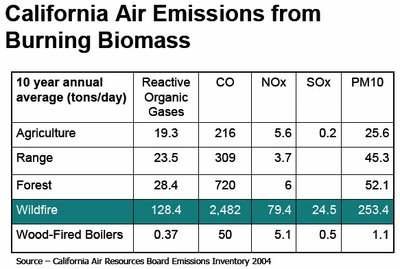
But we are just starting to recognize that forests can emit vast amounts of GHG through burning and decaying. Here are some numbers pulled together by the California Air Resources Board comparing the average emissions of major geographic sectors. Notice that wildfire emissions dwarf the volume from the other sources combined!

Satellite photographs taken during the last four years of wildfire’s devastating impacts on public lands provide clear evidence of the extent of this travesty.

In Congressional testimony Senator Pete Domenici of New Mexico testified that when the Hayman Fire burned in Colorado in 2002, NASA scientists estimated that the fire was emitting more carbon dioxide in one day than all the vehicles in the United States emitted in a week. It lasted 14 days.

Since 2002 mega-fires have gotten worse.

In 2003 the San Diego Cedar Fire (click to enlarge) was the largest in California history lasting 8 days and consuming an area half the size of Rhode Island. Here is a satellite photo of the emissions - so dense that air traffic control towers in L.A. and San Diego were closed for a period of time.


Simultaneously, a fire was burning in the San Bernardino Mountains, just east of L.A. It lasted two weeks and destroyed more than 1,000 other homes. Fortunately it stopped before reaching resort towns near Lake Arrowhead and Big Bear, shown in the upper right corner. If it had it would have decimated evergreen trees that were already sick, dead, or dying from bark beetle infestations - which, incidentally, is what happened in Big Bear two weeks ago. The lakeside community of Fawnskin had to be evacuated by the 15,000 acre fire. The smoke plume from this fire reached far north into Nevada.

Here is what a burned forest looks like (click to enlarge) - charred remains stripped of its leaves and pine needles and in active decay. According to the Forest Foundation the impact of wildfires does not end with the smoke. During decay trees emit about 300% more greenhouse gases than what was emitted during the fire.

Most of the charred remains need to be removed and the lands replanted. Unfortunately, “Nearly four years after fires burned more than 133,000 acres of national forest land in California, less than one percent of those acres have been replanted.”

Just Monday, Senator Craig of Idaho gave testimony in Congress stating that over $2 Billion has been spent this year fighting forest fires while less than $600 million has been spent on preventing them.

Indeed, 2007 has seen a startling upsurge in mega-fires. The Angora Fire, a 3,100 acre blaze in South Lake Tahoe, was responsible for emitting the equivalent of 143,000 cars for an entire year. A blaze 15 times that size devastated Montana.

On July 4th a fire broke out in the Santa Barbara mountains. A week later in Yosemite a satellite photo series was posted throughout the park warning hikers of the health impacts caused by the fire 180 miles away. Driving south through Bakersfield the sun was blotted out by the smoke. The fire lasted another two weeks.

The point is that MORE greenhouse gases are emitted each year from wildfires than we are likely to save in a decade of reduced vehicle greenhouse gas emissions. We can do much better.

Wildfire Impact on Wildlife
They say the road to hell - in this case wildfires - is paved with good intentions. Activists mount crusades and file litigation to protect endangered species which frustrate attempts to fix forest health problems that lead to wildfires.

It is impossible to estimate the impact of wildfires on wildlife but even if the species escape, it leads to overcrowding in surrounding ecologies. But not even mobile animals are immune from the quick moving fires. Like the victims of Pompei most animals die from asphyxiation. Fires can boil streams which kill the fish. The U.S. Fish and Wildlife Department reports that Georgia’s largest fire ever that started in the Okefenokee Swamp this year was also the most expensive ever for the agency.

The problem of forest density
According to Texas A&M professor Dr. Tom Bonnicksen, a founder of the Forest Foundation, the problem is one of forest density. Our forests have 4 to 10 times as many trees per acre as they used to have. People used to be able to gallop through forests - now it is hard to walk through them or fight fires within them.

Excess forest biomass in the form of small diameter trees, and underbrush create a kindling “ladder of fuel” that helps surface fires spiral up to the crowns of trees. Once there, a fire storm can evolve whipped by winds to spread rapidly in all directions.

Public agencies waste precious funds to fight the wildfires - the symptoms of unhealthy forests - rather than invest it in efforts to restore and manage forest health through thinning. When asked what the biggest hurdle is to deploying thinning programs that are important to restoring forest health, field Forest Service planners say "infrastructure." Without forest product industries to convert the woody biomass to carbon sequestering products and bioenergy, there is no where to store the collected woody biomass and no economically sustainable way to help pay for the program.

To restore forests to a healthy condition, Dr. Bonnicksen recommends a three step, economically sustainable solution that involves private industry who would restore and maintain forest stewardship as part of their operating overhead.
1. First they would harvest decaying biomass
2. Then reforest to a historic model specific to the forest, and
3. Third mechanically thin vulnerable forests of woody biomass as part of their stewardship.

The USDA Forest Service could provide oversight of the program.

-----------------
The followup presentation is titled Woody Biomass: Feedstock for BioEnergy

----------------
technorati , ,

August 27, 2007

California wildlife threatened by mega fires

The Forest Foundation has made a field guide available to help forest enthusiasts appreciate and identify the variety of wildlife that populate various geographical portions of California's 15 million acres of private forestlands. The guide categorizes the wildlife by forest type - generally the age and type of vegetation - with geographic state maps that display where these species are located.

There is also an identification guide that depicts the prevalent types of trees that grow on California forestlands. Not only are the shape profiles provided, but also the leaf and needle designs.

In the first ten pages of the guide are several essays by an esteemed slate of forestry experts. Many point out the severe risks to wildlife and wildlife diversity that are posed by the poor health of our forests. The main causes? Excessive forest tree density (four to ten times historic norms) leading to wildfires and bug infestations. Here are some excerpts:

----------------
A Guide to California's Wildlife on Private Forestlands

Enhancing Biodiversity by John Stuart Ph.D

On California’s private forestland, foresters strive to create a mosaic of forest types to support diverse wildlife – just like patches of old and young, dense and open forests that historically covered the West were shaped by seasonal lightning fires and fires set by Native Americans. Harvesting and replanting are carefully planned because everybody needs a home.

California's Historic Forests and Wildlife by Thomas Bonnicksen, Ph.D
Overcrowded forests can fuel catastrophic wildfires and have detrimental effects on wildlife. The plants and animals that need sunny openings get crowded out and are disappearing. Streams are drying up as thickets of trees use all the water. Insect infestation and tree mortality are reaching epic proportions. Catastrophic fire can alter wildlife habitat for centuries.

Habitat in Decline by George Gruell
Wildlife habitat in unmanaged forest ecosystems is collapsing across the West. Overly dense forests block sunlight and intercept precipitation that once reached the forest floor. That begins the collapse. Herbaceous plants and flowering shrubs, denied moisture, sunlight and nutrients, die out and get replaced by litter and coniferous debris. When you lose the grasses and shrubs, you lose critical habitat and wildlife populations suffer. The cumulative effect of hands-off forest management has been less biodiversity and more catastrophic fire. We must actively manage the landscape if we are to sustain the biodiversity we claim to cherish.

Forestry Education Must Prevail by Douglas Pitrio
Some people equate caring for forests with leaving them alone. Doing so ignores the dangerous fuel accumulations that now plague our forests and fails to consider that today’s overgrown forest conditions negatively affect biodiversity. It also dooms California to a cycle of severe fires, deadly mudslides, and devastated communities.

There is no doubt that many of California’s public forests are overcrowded, nor that overcrowding can lead to horrific forest health and fire hazards. Conditions similar to those in Southern California’s forests before they succumbed to beetles and flames in 2003 are increasingly appearing throughout the Sierra Nevada and Lake Tahoe Basin.

Leaving forests alone doesn’t work. Southern California’s firestorm makes clear what professional foresters have known for years: forests need management to be safe and productive.

technorati , ,