Showing posts with label emissions. Show all posts

May 18, 2011

Carbon Accounting and the Titanic Analogy


In a Forest Business Network article May 15th, it was reported that:

The National Alliance of Forest Owners (NAFO) told the U.S. Environmental Protection Agency (EPA) today that they support the proposed rule to defer the regulation of greenhouse gas (GHG) emissions from biomass for three years while the agency studies the science and policy of regulating biomass energy the same as fossil fuels.

I join NAFO in supporting this rule to defer, too, because carbon accounting has become an incredibly controversial issue between the bioenergy industry and those who seek to obstruct its emergence as an alternative to fossil fuel. Finding clarity on this issue appears to be a losing battle in Massachusetts but there is no reason for the federal EPA to compound their mistake of confusing fossil with biogenic carbon emissions.

I would like to offer an analogy that I think puts in proper perspective the difference between carbon accounting of biogenic feedstock sources (biostock) with those of fossil origin.

GHG emissions was not an issue during pre-Industrial times because the carbon cycle – which includes plowing and tilling of land and harvesting of timber – was closed loop. Whatever the fluctuations, the carbon content of the atmosphere stayed relatively constant.

The advent of the Industrial Age was characterized by the need for denser fuels. Cheap sources of dense fuels were found in subterranean geologic formations in the form of fossil fuels (carbon sequestered as coal and oil). The carbon cycle was violated (open looped) with carbon that had been sequestered for millions of years. Hence the carbon cycle gained input that had been successfuly sequestered. It is estimated that, as of 2009, the carbon content in the atmosphere is a full 39% greater than the pre-industrial levels. The rate of change is increasing (see breakdown of sources in the chart below). That increase from fossil carbon reintroduction to the atmosphere is what should be considered carbon positive.

Carbon accounting that measures biogenic emissions (wood and biomass) and compares it with fossil atmospheric impacts is like comparing the arrangement of deck chairs (biogenic) to the fatal impact of the iceberg (subsurface fossil) on the Titanic.

Fossil carbon is carbon positive and without mitigation, a climate and health threat that is within the authority of the EPA to regulate. Biogenic sources are carbon neutral and should be exempt from EPA comparative accounting.

I welcome comments that support or challenge this analogy.

----------------

technorati , , , ,

July 1, 2009

Advanced Wood Combustion: Rekindling Wood Energy in America


Opened in February 2009, the new biomass power plant at Vermont's Middlebury College is expected to burn 20,000 tons of wood chips each year to provide heat and electricity for the campus.

The plant uses an "advanced wood combustion" system. Such plants hold great potential to save energy, cut costs, and even fight global warming, a March 2009 study says.

Photograph by Brett Simison, courtesy Middlebury College


Daniel Richter is professor of soils and forest ecology at Duke University and Director of Graduate Studies for Duke’s interdepartmental University Program in Ecology. His research investigates forest sustainability, biogeochemistry, interactions of soil and forests with the wider environment, and global soil change.

Below are excerpts from an article he wrote recently for Renewable Energy World.com about advanced wood combustion (AWC) and its promise for helping understand the intertwining of the carbon cycle and combustion - and how we can efficiently tap that energy for fuels, power, steam, and heat.

------------------
Rekindling Wood Energy in America - Renewable Energy World

One of the largest sources of renewable energy available today is one of the oldest, that is direct combustion of wood. Recent European developments in advanced wood combustion (AWC, defined as automated, high-efficiency wood-fired energy systems with strict air pollution control) have wood supplying thermal and electrical energy cleanly and reliably to thousands of communities in Europe and increasingly in North America. AWC minimizes air pollutants including fossil greenhouse gases.

AWC is so clean and safe that AWC systems are commonly deployed in the midst of picture-perfect European towns and villages. Because AWC systems can be developed in community-sized increments of 0.1 to 20 MWth, they can be managed to meet community needs and not overwhelm the productivity of local woodsheds.

Wood in the United States is several-fold less expensive per unit of energy compared with natural gas or heating oil ($2 to 5 per GJ vs $7 to 10 per GJ for recent USA prices of natural gas and heating oil). If properly deployed, AWC systems can not only affordably supply clean and renewable energy, AWC can add value to the forest itself, promote community development, and support local employment and rural and municipal economies. AWC can complement other renewable energy resources as well.

It is now time for AWC and renewable thermal energy sources to take center stage in North American energy deliberations. Not only can wood safely and affordably supply energy, but wood can teach us much about energy in general, energy-use efficiency, and sustainability itself.

No one renewable will solve our energy crisis, not solar, not wind, not wood. But recent multi-agency estimates indicate that AWC can sustainably supply at least 5% of the nation’s currently inefficient energy consumption without impacting forests that are protected for environmental, social, or economic reasons. This is more energy that that stored in our Strategic Petroleum Reserve, more than what all American hydro-power plants produce in a year, and slightly more than half of the electric energy produced annually by the entire nuclear industry.

Wood is abundant but is far too valuable to inefficiently burn. Resource policy questions should turn on how to encourage wood-energy efficiency, community development and sustainability, and how to avoid extracting wood from the forest like coal from a mine.

June 1, 2009

NACD's Woody Biomass Desk Guide and Toolkit

It seems like every bioenergy and conservation conference I go to drives toward the same conclusion... "What we need is education, education, education." Of course, determining which messages should be communicated is key - which is why the credibility of the authors is paramount. Who is writing the content and what is their motivation?

Whenever I come across material that I think is credible and approachable from a lay audience's perspective, I upload links to them through this Bioenergy BlogRing. Some of the guides I have written about in the past include:
• 25x'25 - Agriculture and Forestry in a Reduced Carbon Economy
• USDA Forest Service - Woody Biomass Utilization Desk Guide
• Southern Forest Research Partnership, Inc. - Sustainable Forestry for Bioenergy and Bio-based Products Training Curriculum Notebook
• California Forest Foundation - Protecting Communities and Saving Forests

Fred Deneke of 25x'25 just sent me a treasure trove of information about Woody Biomass amassed by the National Association of Conservation Districts (NACD).

Conservation Districts were born out of necessity in the 1930s Dust Bowl when America's topsoil rapidly eroded. They are local units of government established under state law to carry out natural resource management programs at the local level.

NACD is the nonprofit organization that represents America’s 3,000 conservation districts and the 17,000 men and women who serve on their governing boards. It was founded in 1946 on the philosophy that conservation decisions should be made at the local level with technical and funding assistance from federal, state and local governments and the private sector.

The association's programs and activities aim to advance the resource conservation cause of local districts and the millions of cooperating landowners and land managers they serve.

The desk guide is intended to be used for public outreach in support of biomass industry planning and development. It includes educational content, handouts, introductory Powerpoint presentations, case studies, FAQs, and a glossary of terms.

Here is how the authors describe the guide...

-------------------
Woody Biomass Desk Guide and Toolkit

Communities today are challenged to develop effective strategies that support forest ecosystem health, mitigate the effects of climate change, satisfy growing energy needs, and provide local economic opportunities. For some communities, woody biomass may be a viable option for meeting these needs and deserves serious consideration. Forests in the United States represent an important potential energy and biobased product resource.

NACD, in collaboration with federal, state, and local partners is working to raise awareness about the potential for woody biomass as a primary feedstock for such products.

This Woody Biomass Desk Guide and Toolkit provides an overview of woody biomass production and utilization in the U.S., tips of how to provide effective outreach for your clientele, and educational handouts to share with your audiences. The purpose of this guide is to equip natural resource professionals and outreach specialists with the information and tools needed to increase awareness of the use of woody biomass for energy in the U.S.

Desk Guide and Toolkit Chapter Topics

Introduction and Table of Contents (1MB PDF)
Chapter 1 - Setting the Stage (836KB PDF)
Chapter 2 - What is Biomass? (2.5MB PDF)
Chapter 3 - Products and Possibilities (1.7MB PDF)
Chapter 4 - Implications of Producing and Using Woody Biomass (1.5MB PDF)
Chapter 5 - Incentives to Produce and Use Woody Biomass (1.3MB PDF)
Chapter 6 - Do-It-Yourself Supply Curve: Tools to Help You Get Involved in an Entrepreneurial Biomass Project (13.8MB PDF)
Chapter 7 - Outreach and Education (492KB PDF)
Chapter 8 - Case Studies (2.15MB PDF)

Handouts
In addition to the reference sections, most of the chapters also contain handouts. These outline important points, strategies, and information that may be useful for landowners, the public, local leaders, or other audiences.
Handout 1 - Electricity Production: Comparing Wood and Fossil Fuel Feedstocks (2MB PDF)
Handout 2 - Woody Biomass Basics (2.25MB PDF)
Handout 3 - Agricultural Biomass (1.5MB PDF)
Handout 4 - Implications of Using Woody Biomass for Energy and Other Products (1.15MB PDF)
Handout 5 - State and Local Policies and Incentives to Produce and Use Woody Biomass (1.5MB PDF)
Handout 6 - Financing a Bioenergy Project (1.15MB PDF)
Handout 7 - Common Concerns (1.15MB PDF)

NACD has two more Desk Guides in the works that will be out shortly. One will be on Community Wildfire Planning (Pre, During, & Post) and the third on Woody Disaster Debris Disposal.

----------------
technorati , , ,

April 17, 2009

New Report Challenges Searchinger ILUC Study

Coinciding with the National 25x'25 Summit earlier this month the alliance has just inaugurated their own blog full of news, reports, and commentary relevant to the mission of the organization - to get 25 percent of our energy from renewable resources like wind, solar, and biofuels by the year 2025.

A blog article published yesterday titled "New Report Challenges Searchinger ILUC Study" provides information about the work of two Australian researchers which criticizes the methods and assumptions employed by Tim Searchinger and others in the controversial study titled "Use of U.S. Croplands for Biofuels Increases Greenhouse Gases through Emissions from Land Use Change", which was published in February, 2008.

Below are my comments to the article.


There are two paradigm shifts at play here.

The obvious one is the international effort to shift the production of liquid fuels from fossil, carbon positive, feedstock to renewable, carbon neutral or negative feedstock. The Catch-22 for renewables is its current unavoidable reliance on its predecessor for energy, transport, and fertilizers. Consequently, many of the factors that impact the carbon footprint of cultivated feedstocks like corn are a result of the very lack of alternatives that renewables are designed to provide. The corn ethanol industry in particular is already at work replacing every carbon input imaginable to improve its balance sheet but it will take time.

The second paradigm shift is the unprecedented global definition of acceptable technologies and markets before they have had a chance to incubate regionally. What innovations would we have sacrificed had we pre-regulated to this extent in the past? Nuclear bombs - which saved millions of lives by changing hot world wars into cold ones? Personal computers and the internet - which democratized worldwide communication and learning to an unparalleled extent?

Anticipating ill effects before feedstocks and products are developed is a risky business that threatens to kill research, development, and deployment - and rapidly shrinking investment. Are we to cede all future RD&D to deep pocketed corporations who have a vested interest in controlling threats to their markets? Can politically motivated legislators objectively thread the delicate needle of market definition and regulation?

The indirect land use conclusions arrived at in Searchinger’s paper are highly speculative and are better at looking backward than forward while new technologies and feedstocks alternatives are being developed. The prominence that such one-side speculation has been given in the public media is troubling.

The idea that low carbon fuel standards include factors based on speculation is prone to gross misuse and manipulation. By hamstringing technology and market development with such standards we virtually insure unfair perpetuation of the status quo - an industry that clearly would not have passed such scrutiny had similar lifecycle analysis models been applied one hundred years ago.

----------------
technorati , ,

April 14, 2009

25x'25: Agriculture and Forestry in a Reduced Carbon Economy

The 25x'25 Alliance held their National Summit March 31-April 2 in Arlington, VA. The theme this year was "Agriculture and Forestry in a Reduced Carbon Economy" which is significant because of the relatively equal footing given to forestry in an organization that has, up to this point, reflect a more agricultural emphasis. Last year the organization's National Steering Committee chartered a special Carbon Work Group to analyze this issue, file a report, and make its recommendations.

To date, a carbon “primer” has been developed by the 25x'25 Carbon Work Group and circulated in draft form among its agricultural and forestry partners and renewable energy stakeholders. That input was incorporated into a carbon discussion guide, an evolving collection of recommendations regarding climate change policy, its implementation, and what must happen for the agriculture and forestry sectors to deliver maximum greenhouse gas emissions reductions.

Here is a link to the draft version of Agriculture and Forestry in a Reduced Carbon Economy: Solutions from the Land There is a shorter Executive Summary that facilitates accessing the longer document which was completed just in time for the Summit to encourage distribution and comments of the draft.

The Work Group facilitators ask that you please send your comments to Jeffrey Frost and Ernie Shea.

The Work Group has also developed a Question and Answer guide to support information education outreach work with interested stakeholders and has also consolidated a list of key documents and resources.
Click here to see a new video about Agriculture and Forestry in a Reduced Carbon Economy.

----------------
technorati , ,

August 11, 2008

Authority returned to the Forest Service

I am convinced that one of the hardest jobs in the government is to work in the USDA Forest Service. It is not that it is dangerous work... it's that it must be so frustrating.

Here is an organization entrusted with a gargantuan challenge, with what should be a more than adequate budget, and more responsibility than should be expected of any governmental agency - safeguarding the health of one of our biggest assets, our federal forests. The job should be the most fulfilling in government - "gardeners" of our rich forest legacy and its wildlife. The people I've met are dedicated and top-notch - steeped in decades of education and experience studying the fine machinations of our forest ecology.

So why is it so frustrating? It is because the management lacks any real authority. They cannot control their own much less our forests' destiny.

What is ironic is that the people that challenge them the most - the non-governmental organizations (NGOs) that frequently take them to court - insist on turning more private lands into their care. Do they receive commensurate budgetary increases to manage the additional lands? No. Are the forests going to be taken care of better by a federal bureaucracy than by private timberland owners - no. Why? Well, the private owners had authority to tend to their assets. The Forest Service has very little control over these same lands. It must be great sport taking the FS to court but it certainly isn't resulting in healthier forests based on better science.

Which is why it is heartening to see the Ninth Circuit Court of Appeals come out and unanimously overrule a decision that judges should not be making scientific decisions in lieu of Forest Service expertise. The August 2008 issue of the Society of American Forestry (SAF) reports on this encouraging turnaround.

Incredibly, many court challenges barring forest management projects are based on the specious argument that the Forest Service violates the National Environmental Policy Act (NEPA) because it doesn't "adequately address all of the uncertainties in its proposed treatments." The lower courts often take the view that "the public interest in preserving nature and avoiding irreparable environmental injury outweighs economic concerns." In short, neither money nor time matters if there is any possibility that their actions might be detrimental to some special concern or another. The appeals court's ruling counters that this policy gives the lower court too much authority over scientific matters outside its jurisdiction.

In its July 2 ruling on Lands Council v. McNair (or Lands Council I) the panel wrote that, “In essence, Lands Council asks this court to act as a panel of scientists that instructs the Forest Service how to validate its hypotheses regarding wildlife viability, chooses among scientific studies in determining whether the Forest Service has complied with the underlying Forest Plan, and orders the agency to explain every possible scientific uncertainty. As we will explain, this is not a proper role for a federal appellate court.”"

Such a ruling couldn't come too soon. As explained elsewhere in this blog, our forests suffer from too little forest management stalled interminably by litigation - particularly in view of the unnatural conditions of smoke and greenhouse gas emissions from wildfires which continue to distort the historic profile of our forests.

--------------------
Ninth Circuit: Improper for Judges to Act as Scientists
11-Judge Panel Says Courts Must Defer to Agency Expertise

In a landmark case, an 11-judge panel of the US Circuit Court of Appeals for the Ninth Circuit unanimously ruled last month that courts must defer to US Forest Service expertise when it cannot be shown that the agency acted in scientific uncertainty in complying with the National Environmental Policy Act (NEPA), and that the agency could choose the scientific methods it uses in meeting the requirements of the National Forest Management Act (NFMA).

Undersecretary of Agriculture Mark Rey praised the decision.
“We think this is a fairly significant decision—maybe the most significant Forest Service environmental case of the past two decades,” he said. “The panel was reacting to the Ninth Circuit getting deeper and deeper into a posture of second-guessing agency expertise or its use of expert scientific information. In several instances, the panel reversed what they believed was a drift in Ninth Circuit jurisprudence away from the standards of review used by other circuits.”

Rey added that the panel said that it was not necessary for the Forest Service to prove its methods to a level of scientific certainty.
“The panel said that wildlife viability is not the only consideration that the agency has to take into account and that we are not required to use on-the-ground analysis in all cases,” Rey said. “They said that it is not the court’s role to conduct an assessment of the methodology the Forest Service uses, that the Forest Service has discretion to determine what scientific studies are important, and that we’re not required to address every possible uncertainty in our decisionmaking.”

----------------
technorati , ,

July 3, 2008

CA Draft Scoping Plan comment:
Sustainable Forests

This is one of a series of comments submitted to the California Air Resources Board for their draft version of the California Climate Change Draft Scoping Plan. Other BIOenergy BlogRing comments are linked here:
Challenge the Status Quo
Recycling and Waste
Sustainable Forests

----------------

The ill health of our forests is a statewide catastrophe. We are witnessing deforestation by wildfire, bug infestation, and decay that consumes our forests without adequate reforestation efforts. It is estimated by the California Forest Foundation that we are losing over 30,000 acres of timberlands (an area the size of San Francisco) each year to brushlands.

Nationally, six of the seven worst fire seasons on record have occurred within the last eight years with some fires lasting months and covering hundreds of thousands of acres. Just four wildfires that were recently studied were found to emit the GHG equivalent of adding 7 million cars to our streets for one year.

The smoke and emissions from wildfires are greenhouse gases that we can see, smell, and touch as ash and particulate matter is strewn across the landscape. But this is only the start of the GHG problem. Decay contributes 3 times as much greenhouse gas as the fire itself.

The goal of reducing 5 MMTC02E by 2020 seems woefully inadequate considering the GHG from the combustion of just one wiidfire (2007 Moonlight Fire in Plumas National Forest) which burned 65,000 acres has been documented to have generated 4.9 MMT GHG. Unmanaged treatment would add an additional 15 MMT GHG according to a study by the California Forest Foundation. If wildfire trends continue on their current trajectory, we will have to see much greater reductions to maintain the forest managed GHG sequestration defined in the Scoping Plan.

There are forest management practices that can and should be implemented that would mitigate the greenhouse gas impact of these fires while reducing the ferocity of future fires. These practices are not mentioned in the Scoping Plan and I'll list them here:

1 - We need to thin our most vulnerable forests.

Recent reports of a thousand fires in California spotlight the urgency of the problem - which is neither the lightning that sparks the fires nor the lack of firefighting resources to fight the blazes. The real problem is the density of the number of trees with undergrowth - estimated to be 4-10 times their historic profile - on our largely unmanaged forests.

In 2003, the U.S. Congress passed the 2003 Healthy Forest Restoration Act (HFRA) allocating $750 million dollars in federal funds to thin approximately 20 million acres nationally. Thinned forests contain the spread of wildfires.

Due to resource allocation to fight forest fires, answer environmentalist challenges (729 lawsuits between 1989-2003), and the resultant bureaucratic inertia only 77,000 acres have been thinned.

Thinning forests won't reduce the incidence of fires, but it would significantly reduce their size and GHG consequences.

2 - We need to salvage wood from impacted forests.

Reducing the biomass of dead and dying trees would go far to mitigating the GHG impacts of wildfires since decay contributes three times the GHG as the original fire itself. Large diameter wood could be converted into saw logs and building materials that sequester carbon in energy efficient homes. Scrap wood could be used to cleanly generate green electricity and convert into carbon-neutral biofuels reducing our GHG from fossil fuels.

3 - We need to replant our devastated forests.

From 2001 to 2007, over 143,500 acres of forestland outside wilderness owned by the federal government has not been replanted and has been left to turn into brush.

Following the 1992 Cleveland Fire in the Eldorado National Forest, the U.S. Forest Service replanted some lands, and left some untouched in an experimental ecoplot. Today, trees stand more than 17 feet tall on replanted lands, but brush dominates the untreated ecoplot.

Unlike government-owned lands, private forest landowners quickly remove dead trees and other fuels for additional fires and then replant. It is a part of their enduring legacy for their children.

CARB needs to incorporate these common sense steps into the Scoping Plan otherwise the status quo will prevail. CARB needs to show leadership in fighting bureaucratic inertia caused by public resistance to necessary change in forest management. These problems will worsen in the midst of compounding global warming factors. As the Plan so clearly states "Future climate impacts will exacerbate existing wildfire and pest problems in the Forest sector."

We can ill afford to lose the carbon sequestering forests of our state.

----------------
technorati ,

May 25, 2008

Sustainable Forestry for Bioenergy and Bio-based Products

To many preservationists the term "Sustainable Forestry" is an oxymoron. To them all management of forests is unnatural, and therefore unsustainable. I have two questions for them:

1 - If your garden was infested with bugs, suffering from lack of soil nutrients, invaded by weeds, recently burned, or eroding from water damage, would you intervene by managing it? If yes, then why should forests be treated differently?
2 - Hasn't civilization already changed the character of our natural forests to a point from which they will never return to a "natural" state?

Even the experts of the USDA Forest Service would agree with the second question. Some of the problems that are plaguing our public forest lands are the result of aggressive fire suppression of the mid-1900's that were initiated in response to massive fires of the period. If we want to restore our forests, we need to return them to a profile more closely resembling the 1800's with care to make sure that the restored profile is more sustainable. But it will take management to get there, and management to sustain it in the face of growing population, climate change, and global competition for energy feedstocks.

Forest management is necessary. The expanded interface between wildlands and civilization (called "Wildland Urban Interface") is inevitable and the current high density (number of trees per acre) of undermanaged forests is changing their character. The consequence could be a spiral of forest wildfire and decay causing unprecedented greenhouse gas emissions, leading to more global warming, leading to more greenhouse gas emissions. The magnitude of the problem potential dwarfs emissions from other sources.

The forest industry is ready to lead the way to more sustainable forest management practices. The Southern Forest Research Partnership (SFRP) is a leader in research examining how the use of woody biomass can be expanded to aid the health of our forests while insuring that health is sustainable. SFRP research is available online with digital manuals and powerpoint presentations that can be used to train the public about environmentally sustainable bioenergy production systems.

I met up with Dr. Larry Biles, Interim Director of SFRP, at the 2008 Smallwood conference in Madison, WI who had barely enough time during his presentation to outline the wealth of SFRP information available online. Their 300-page training manual is located the Forest Bioenergy website (under Training Tools). They also have a forest encyclopedia (actually a series of several encyclopedias that focus on specific topics) and he highly recommended both the Forest and Range and Interface South websites that provide useful information for practitioners of forest management.

He gave me a CD of the training materials and I found them to be extremely well written and up-to-date (having been published in September, 2007). They really do "span the gap between knowledge and application."

Of particular interest to me was Module 7: Environmentally Sustainable Bioenergy Production Systems:

This module provides an overview of adaptive forest management along with international agreements and various certification systems. It covers issues related to forest soils, water quality, and biodiversity conservation. Specific issues include soil compaction, streamside management zones, and the management of dead wood.

The final part of this module deals with designing low impact operations. Using tools and information presented previously, the readers learn how to plan a low-impact operation. A summary of the concept of best management practices and links are provided to each state’s specific BMP program. You will learn about the proper application of these practices to conserve and protect the environmental sustainability of the forest while maintaining biomass and timber productivity.

The SFRP and supporting organizations have provided a tremendous service collecting this information and providing straightforward media for its distribution and presentation. The slides are a gold mine for presenters who wish to engage stakeholders in decisions affecting the management of forests.

----------------
technorati , ,

April 25, 2008

Links between California Wildfires and GHG emissions

"Reducing wildfires maybe the single most important action we can take in the short-term to reduce greenhouse gas emissions and fight global warming." - Dr. Tom Bonnicksen

Dr. Tom Bonnicksen, a professor at Texas A&M and author of "America's Ancient Forests: from the Ice Age to the Age of Discovery" is a staunch advocate for restoring our forests to a healthier condition. That shouldn't make him controversial but it does because he advocates what many environmental groups consider "heretical" means to achieve this objective - removing excess biomass through forest thinning, salvaging of dead and dying trees, and reforestation on a massive scale. Recognizing such restorative steps will require the building of temporary roads and the re-introduction of forest product industries to buy the wood, he has drawn criticism from environmental groups, including coordinated attempts to question his academic credentials.


Above is a historic chart produced by the National Interagency Fire Center that plots the disturbing rise in wildfire acreage nationwide in the last 50 years. This doesn't register the growth of intensity of fires which are believed to be at unprecedented ferocity producing even more GHG. The trend line shows the legacy of the last ten years when litigious obstruction by environmental groups of planned USDA Forest Service projects has been the most vigorous - delaying remedial public forest programs.

To circulate his interpretation to a broader audience, Dr. Bonnicksen published a very professional 52-page booklet titled "Protecting Communities and Saving Forests: Solving the Wildfire Crisis through Restoration Forestry." It should be required reading for all environmental policy makers in California because it clearly states how the state has arrived at a condition of ever increasing wildfires and suggests sensible actions to mitigate the problem.

Taking his research a step further, Dr. Bonnicksen has just released a new study entitled "Greenhouse Gas Emissions From Four California Wildfires: Opportunities to Prevent and Reverse Environmental and Climate Impacts" which draws the connection between GHG and forest fires. Without restorative action, fires will get worse and greenhouse gas emissions will increase. With action, not only will the growth of forest fires and bug infestations likely be held in check, but more carbon will be sequestered, correcting the imbalance created by the original fires.

A key to understanding the urgency for remedial action is recognition that GHG doesn't just come from the combustion and smoke of the original fire - that only accounts for 25% of the emissions. The other 75% comes during the period of decay of the affected forest. According to his research of four representative fires, initial combustion plus eventual decay emissions represent the equivalent of adding 7 million cars to California's roadways for 1 year!

The study also paints a revealing picture of the difference in GHG impact between responsive action by private timberland owners versus the publicly-obstructed remedies proposed by the federal government. Because of fierce anticipated public opposition, the Forest Service has no know plans to plant trees on burned areas of the Tahoe area Angora fire - consequently 0% of the total CO2 emitted will eventually be recovered from plantings. Contrast this with the Fountain Fire where 100% of the privately owned burned land was replanted. The study estimates that 99.2% of the original lost C02 will be recovered.

Here is an abstract written by The Forest Foundation on their website where free copies of the study is available for download:

-----------------------
Wildfires, Forests and Climate Change
California wildfires release millions of tons of greenhouse gases into the atmosphere every year. Conversely, sustainable forest management removes greenhouse gases from the air, stores carbon in wood products and regenerates landscapes in a perpetual cycle of carbon sequestration. The Forest Foundation developed the Forest Carbon and Emission Model (FCEM) to help clarify the relationships between wildfires, forest management and greenhouse gas emissions.

Greenhouse Gas Emissions From Four California Wildfires: Opportunities to Prevent and Reverse Environmental and Climate Impacts

In the report above, the FCEM presents details of the greenhouse gas emissions associated with four California wildfires. It estimates the total emissions from combustion and decay, provides comparisons to autos and other emission sources, and notes the potential value of reforestation to recapture gases released from wildfire. This report considers the Angora, Moonlight, Star and Fountain fires.

Forest Foundation Study Finds Four Wildfires Send 38 Million Tons Of Harmful Gases Into Air, Equivalent Of 7 Million Cars On The Road For One Year In California

The Forest Carbon and Emission Model Overview and Technical Information

The FCEM report above considers site characteristics like vegetation type, density, mortality, acres burned, and other factors to estimate emission totals. The FCEM Overview and Technical Information report explains the inputs and methodologies used to drive the model.

----------------
technorati , , ,

November 17, 2007

Hurricane Katrina's greenhouse gas legacy


Hurricane Katrina's legacy is not just the flooding of New Orleans and the destruction of coastal Mississippi. It is also responsible for damaging five million acres of forests - an area the size of the state of Massachusetts. For comparison, the destructive power the 1980 eruption of Mt. St. Helens wiped out 150,000 acres of forests (less than 4% of the forest destruction reach of Katrina).

In a front page article of the Los Angeles Times, Thomas Maugh II and Karen Kaplan reported on new research results by Tulane's Dr. Jeffrey Q. Chambers that has appeared in Science magazine. By using spectral analysis comparisons of before (2003) and after (2006) imagery of the region made by NASA's Landsat V satellite (click to enlarge image above), Chambers and his research team has made a number of alarming findings about the carbon footprint of this very destructive hurricane.

What is the greenhouse gas consequence of all that wasted biomass rotting and decaying?

Left in place without removal, the carbon of the trees will continue to decay for decades. Roughly 50% of the content of trees is carbon. The emissions from decay will contain methane and carbon dioxide. According to Dr. Chambers' analysis, 367 million tons of carbon dioxide will be emitted - which is about the same amount as is absorbed by all U.S. forests in a year. It is also a total that exceeds the combined emissions of national forest fires for an entire year.

What is the time frame for removal?

As it decays, the woody biomass becomes harder to access and harder to remove. Even with modern equipment, it is easier to assess, plan, and harvest standing trees than those lying on the ground at some progression of decay. Besides the remaining obstruction of hurricane-damaged logging roads in the area, foliage regrowth has already begun which makes logging access more difficult.

Should the drought conditions of the South persist, the dead biomass represents a significant fire threat which would add significant amounts of new greenhouse gas and particulate matter emissions to the atmosphere and further complicate restoration.

What will the new forests look like if left to natural regeneration?

According to the Times article, "Chambers and his colleagues said the deforested land, once covered with native species such as longleaf pine, oak and cypress, is being taken over by invasive species that are change the ecology of the area. One of the most prolific, the Chinese tallow, oozes a milky, toxic sap that creates an inhospitable environment for insects, birds and small animals."

How can we pay for forest restoration?

According to Dr. Thomas Bonnicksen of The Forest Foundation, the a privately financed restoration of the forests is straightforward. "Sell the logs to sawmills to be turned into wood products, and use the revenue generated to pay for removing the slash left behind and replanting the forest. Replant native trees in a patchy mosaic so the forest develops naturally. This includes leaving enough snags and logs for wildlife habitat, and returning a few years after planting to remove competing brush so trees grow quickly and are protected against future wildfires."

Who would administer the forest restoration program?

There is a federal committee called the Woody Biomass Utilization Group that includes forestry, energy, and wildlife experts from several departments of government - the Departments of Energy, Agriculture/Forest Service, and Interior. They also have a subgroup studying Disaster Debris that works with FEMA and Homeland Security in an effort to establish and coordinate federal remedial response to environmental disasters like Katrina, floods, tornadoes, and megafires throughout the country.

When asked what the biggest hurdle was to the implementation of harvesting and reforestation programs, Ron Vineyard of the Forest Service responded "infrastructure." By that he meant that there needs to be more sawmills, power plants, forest products companies, and biorefineries who can take possession of the woody biomass harvested from the disaster zones. The carbon would be sequestered in forest products like lumber, paper, and biochar while carbon-neutral bioproducts like ethanol, alcohols, chemicals, and bioplastics could be cleanly produced to reduce the use of carbon-positive petroleum byproducts.

Unfortunately, many of companies of the pre-existing infrastructure have been damaged from the hurricane, too, and the timberland owners of the region are likely to sell their lands to developers rather than pay to reforest their lost inventories. That will not make environmentalist groups happy who recognize the need to keep our forests large and healthy as carbon sinks to mitigate global warming.

Government action is needed now

There is no possible way that the federal agencies - who are already coping with fire-fighting, humanitarian rescue efforts, and capital restitution from each year's mounting ecological catastrophes - can pay for the scope of immediate remedial action needed. Political leadership and coordination with utilities and private industry is required - and the nation will be stronger for it.

Now is the time for federal, state, and local governments to pass policies that reduce regulatory hurdles and create incentives to utilities and private industry to establish new infrastructure. Passage of bioenergy friendly amendments to the stagnating Energy and Farm Bills would be a very timely response demonstrating Congress' recognition of the long-term consequences of the problem while supporting green business and career opportunities for their constituencies.

Emerging technology companies can convert the woody biomass much more cleanly than their predecessors. This will create the economic means to address the gargantuan and urgent task of harvesting and replanting Katrina's catastrophic biomass legacy.

technorati , , ,

October 19, 2007

Watch 60 Minutes - Warming Climate Fuels Mega-fires

I recommend that my readers watch a story on CBS 60 Minutes this Sunday, October 21st. You can read it first at Expert: Warming Climate Fuels Mega-Fires - including my online comment. Like so many investigative stories on television, they create a significant amount of viewer outrage without offering solutions.

I am glad they are pointing out that "Seven of the 10 busiest fire seasons have been since 1999." What they don't point out is that 50% of the Forest Service budget has been allocated to fighting forest fires and obstructive litigation rather than deploying proven prevention measures.

Forests are now 4-10 times denser than their historic norm (when they were open enough for a horse to gallop through). Now dense underbrush and small diameter trees hamper walking and fire-fighting. That, coupled with warmer, dryer conditions, is what is causing these fires.

I witnessed a persuasive presentation at a workshop sponsored by UC/Berkeley and the USDA/Forest Service last month that thinning forests works. Through a series of photographs Ron Vineyard of the Eagle Lake Ranger District of the Lassen National Forest showed how the 2002 Cone Fire in Northern California extinguished itself within about 20 yards of its entry into the mechanically thinned zone. Their studies place the cost of suppressing a fire in an unthinned forest at $1,726/acre. The cost of mechanically thinning a forest with an underburn is approximately $204 per acre. An ounce of prevention is, indeed, worth a pound of cure.

With the benefits of thinning so obvious I asked him what the biggest hurdle was for the Forest Service. He said "Infrastructure." He explained that there wasn't sufficient private industry demand for the fuelwood to make publicly financed thinning operations economically sustainable.

Currently the forest products industry is not robust enough to fill the breach. But there is significant promise that new tech biorefineries will be able to cleanly convert woody biomass (fuelwood and underbrush) into cellulosic ethanol.

For now, I would like to see environmental groups restrain themselves from attacking Forest Service fire prevention programs they plan to deploy. If they care about global warming they should recognize that mega-fires now spew more greenhouse gas emissions per year than all the auto emissions of the U.S. combined.

I will be attending the Society of American Foresters National Convention in Portland, Oregon October 23-24 and presenting my speech Woody Biomass: Fuel for Wildfires or Feedstock for Bioenergy? October 25th at the Residual Wood Conference in Vancouver, BC.

technorati , , ,

October 5, 2007

Senators: "Wildfires are a climate change issue, too."

It is interesting to see the lengths that state and federal governments will go trying to mitigate the emission of greenhouse gases: higher CAFE standards mandating increased mpg for automobiles, renewable portfolio standards that provide incentives for using renewable energy in place of fossil fuels, regulations on air conditioning systems and semi cab designs, etc. But efforts to reduce a profound source of greenhouse gases, seems to fall on deaf ears, presumeably because thinning forests of fire-producing underbrush, small diameter trees, and dead, infected trees is seen as politically incorrect - pitting "environmental" groups and their litigators against the Forest Service assigned with the responsibility of managing public lands.

Two Republican Senators representing western states that have suffered from significant fires and who sit on the Energy and Natural Resources Committee have testified their concern. Says embattled Senator Larry Craig:

Actively managing forests can lead to a 50 to 60 percent reduction in the numbers of acres lost to wildfires each year. Preventing the forests from burning also ensures that we maintain the forests for the consumption of carbon dioxide from other sources.

Senator Pete Domenici made similar points during testimony last July.

In California - site this year of the worst fire season in the state's history - Senator Feinstein recognizes the magnitude of the growing problem and has fought to secure more funding from the USDA Forest Service to address California's needs. However, that is like putting a bandaid on a problem rather than developing an economically sustainable remedy to address the cause of the fires - failure to thin the dense overgrowth of woody biomass. A true partnership is needed between the government and private industry to build and supply forest product industries that can provide funding for biomass removal and proper forest management.

-----------------
Craig: Wild Fires Impacting Our Climate
Hearing misplaces cause and effect

WASHINGTON, D.C. - Idaho Senator Larry Craig called attention today to the impact wildland fires are having on the global environment in a hearing by the Senate Energy and Natural Resources Committee. The hearing examined the "Impacts of Global Climate Change on Wildfire Activity in the U.S."

As a member of the committee, Craig took the opportunity to point out the apparent chicken-egg scenario at play - do wildfires cause climate change, or does climate change cause wildfires?

"Fires in Idaho will emit more than 12 million metric tons of CO2 this year, compared to only 700,000 metric tons from our electricity generation, or 8.6 million metric tons from all of our automobile use," Craig said. "Wild fires in this country this year released the same amount of greenhouse gases as 12 million automobiles. Preventing fires through active management is certainly more feasible and cost effective than asking 12 million people not to drive."

On average, one acre of burning forest releases six tons of CO2. To date, roughly 8.4 million acres have burned in the U.S., meaning that over 50 million tons of CO2 has been released into the atmosphere. That's the equivalent of 12 million vehicles on the road for one year.

Senator Craig, also a member of the appropriations committee, called for a commitment to spending more on preventative forest management policies, noting that "the U.S. spends only $600 million to manage forests and $2 billion to fight fires. If we spent more of our resources on managing and thinning we'd likely not spend so much fighting fires. We'd also be reducing the amount of greenhouse gases from fires, and increasing the amount of CO2 sequestered by healthy trees."

Craig pushed for the active management of our nation's forests to significantly reduce the numbers of acres burned each year, which in turn would prevent significant emissions of carbon dioxide into the atmosphere. Craig said, "Forest fires of the magnitude of this year's fires in Idaho and in other Western States emit massive quantities of carbon dioxide and other greenhouse gases into the atmosphere. Actively managing forests can lead to a 50 to 60 percent reduction in the numbers of acres lost to wildfires each year. Preventing the forests from burning also ensures that we maintain the forests for the consumption of carbon dioxide from other sources."

technorati , , ,

September 29, 2007

Woody Biomass: Fuel for Wildfires


This article contains the text and some images from the first half of a speech I presented at the Energy from Biomass and Waste conference in Pittsburgh, PA on September 27. It leads into the second half of the presentation titled Woody Biomass: Feedstock for BioEnergy which describes the existing and emerging technologies that can utilize woody biomass for the production of bioenergy - heat, steam, electricity, and biofuels. Many of the statistics and photos come from an excellent Forest Foundation publication titled Protecting Communities and Saving Forests.

-----------------
Woody Biomass: Fuel for Wildfires

I believe that the conversion of biomass to energy represents not only a sustainable, clean alternative to fossil fuel energy but that implementing these emerging technologies can help us solve environmental and ecological challenges of the new millennium.

This presentation will focus on just one environmental challenge - wildfires in the continental U.S. - and how a robust woody biomass conversion industry can provide tools to lessen the threat to our forests.

There are over 10 million private forest owners in the U.S. Although you could say that the country experienced “deforestation” during its early development, the acreage of forests have not diminished at all during the last 100 years. Forests have provided fuel and created great industries for furniture, construction, and paper - industries that sequester carbon.

Unfortunately, these industries that are now stagnating and, in some cases, staggering under the multiple pressures of cheap imports, crusades against forest use, and timberland sell-offs due to skyrocketing real estate prices.

Added to these pressures is the appropriation of more lands to public ownership shifting responsibility to management by the USDA Forest Service.

Some groups seek to preserve forests, biodiversity, and wildlife habitats by severely limiting access by the forest product industries and, through litigation, micromanaging the public forest services charged with insuring forest health.
I contend that it is simply not economically feasible or sustainable for public agencies to take proper care of forests under these conditions.

Forest health has suffered greatly from wildfires and bug infestations.

Wildfires and Greenhouse Gas Emissions
We all know that healthy forests are capable of sequestering vast amounts of greenhouse gases which is a leading cause of global warming.

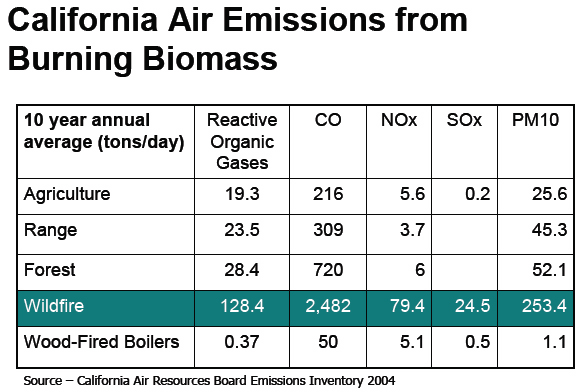
But we are just starting to recognize that forests can emit vast amounts of GHG through burning and decaying. Here are some numbers pulled together by the California Air Resources Board comparing the average emissions of major geographic sectors. Notice that wildfire emissions dwarf the volume from the other sources combined!

Satellite photographs taken during the last four years of wildfire’s devastating impacts on public lands provide clear evidence of the extent of this travesty.

In Congressional testimony Senator Pete Domenici of New Mexico testified that when the Hayman Fire burned in Colorado in 2002, NASA scientists estimated that the fire was emitting more carbon dioxide in one day than all the vehicles in the United States emitted in a week. It lasted 14 days.

Since 2002 mega-fires have gotten worse.

In 2003 the San Diego Cedar Fire (click to enlarge) was the largest in California history lasting 8 days and consuming an area half the size of Rhode Island. Here is a satellite photo of the emissions - so dense that air traffic control towers in L.A. and San Diego were closed for a period of time.


Simultaneously, a fire was burning in the San Bernardino Mountains, just east of L.A. It lasted two weeks and destroyed more than 1,000 other homes. Fortunately it stopped before reaching resort towns near Lake Arrowhead and Big Bear, shown in the upper right corner. If it had it would have decimated evergreen trees that were already sick, dead, or dying from bark beetle infestations - which, incidentally, is what happened in Big Bear two weeks ago. The lakeside community of Fawnskin had to be evacuated by the 15,000 acre fire. The smoke plume from this fire reached far north into Nevada.

Here is what a burned forest looks like (click to enlarge) - charred remains stripped of its leaves and pine needles and in active decay. According to the Forest Foundation the impact of wildfires does not end with the smoke. During decay trees emit about 300% more greenhouse gases than what was emitted during the fire.

Most of the charred remains need to be removed and the lands replanted. Unfortunately, “Nearly four years after fires burned more than 133,000 acres of national forest land in California, less than one percent of those acres have been replanted.”

Just Monday, Senator Craig of Idaho gave testimony in Congress stating that over $2 Billion has been spent this year fighting forest fires while less than $600 million has been spent on preventing them.

Indeed, 2007 has seen a startling upsurge in mega-fires. The Angora Fire, a 3,100 acre blaze in South Lake Tahoe, was responsible for emitting the equivalent of 143,000 cars for an entire year. A blaze 15 times that size devastated Montana.

On July 4th a fire broke out in the Santa Barbara mountains. A week later in Yosemite a satellite photo series was posted throughout the park warning hikers of the health impacts caused by the fire 180 miles away. Driving south through Bakersfield the sun was blotted out by the smoke. The fire lasted another two weeks.

The point is that MORE greenhouse gases are emitted each year from wildfires than we are likely to save in a decade of reduced vehicle greenhouse gas emissions. We can do much better.

Wildfire Impact on Wildlife
They say the road to hell - in this case wildfires - is paved with good intentions. Activists mount crusades and file litigation to protect endangered species which frustrate attempts to fix forest health problems that lead to wildfires.

It is impossible to estimate the impact of wildfires on wildlife but even if the species escape, it leads to overcrowding in surrounding ecologies. But not even mobile animals are immune from the quick moving fires. Like the victims of Pompei most animals die from asphyxiation. Fires can boil streams which kill the fish. The U.S. Fish and Wildlife Department reports that Georgia’s largest fire ever that started in the Okefenokee Swamp this year was also the most expensive ever for the agency.

The problem of forest density
According to Texas A&M professor Dr. Tom Bonnicksen, a founder of the Forest Foundation, the problem is one of forest density. Our forests have 4 to 10 times as many trees per acre as they used to have. People used to be able to gallop through forests - now it is hard to walk through them or fight fires within them.

Excess forest biomass in the form of small diameter trees, and underbrush create a kindling “ladder of fuel” that helps surface fires spiral up to the crowns of trees. Once there, a fire storm can evolve whipped by winds to spread rapidly in all directions.

Public agencies waste precious funds to fight the wildfires - the symptoms of unhealthy forests - rather than invest it in efforts to restore and manage forest health through thinning. When asked what the biggest hurdle is to deploying thinning programs that are important to restoring forest health, field Forest Service planners say "infrastructure." Without forest product industries to convert the woody biomass to carbon sequestering products and bioenergy, there is no where to store the collected woody biomass and no economically sustainable way to help pay for the program.

To restore forests to a healthy condition, Dr. Bonnicksen recommends a three step, economically sustainable solution that involves private industry who would restore and maintain forest stewardship as part of their operating overhead.
1. First they would harvest decaying biomass
2. Then reforest to a historic model specific to the forest, and
3. Third mechanically thin vulnerable forests of woody biomass as part of their stewardship.

The USDA Forest Service could provide oversight of the program.

-----------------
The followup presentation is titled Woody Biomass: Feedstock for BioEnergy

----------------
technorati , ,

August 24, 2007

California's Zaca Fire and Global Warming


Click to enlarge

Here's a question I haven't seen in the press...

What is the impact of public forest wildfires on global warming?

I have seen plenty of inferences that global warming is contributing to the cause of wildfire spread and ferocity but virtually nothing on how the burst of fire temperatures, soot, ash, carbon monoxide, and other toxic emissions impact global warming. No journalists make the connection between the rash of horrific megafires of the last two decades and the precipitous rise in carbon emissions during that same time.

U.S. Senator Pete Domenici recently testified...

When the Hayman Fire burned in Colorado in 2002, NASA scientists estimated that the fire was emitting more carbon dioxide in one day than all the vehicles in the United States emitted in a week.

That fire lasted over a month. The Spring 2007 megafire in Georgia and Northern Florida (the biggest in Georgia history) lasted even longer. The size, length, and ferocity of these fires is not normal - at least not prior to 1980.

Most animal deaths during and after a wildfire are caused by asphyxiation, not the flames themselves. In a sense, the "canary warning" to humans has been given. Now we must act to save not only forest wildlife, but all animals including humans who are in the path of wildfire plumes.

As the huge Zaca fire 9 miles north of bucolic Santa Barbara, California nears completion of its second month of devastation, it is time to ask some environmental questions:

Are we reaping the result of failure to adequately harvest excess forest fuel, reforest past forest acreage, and manage public forests as efficiently as private forests are managed?

Are public perceptions, litigation, and policies designed to protect wildlife diversity having the opposite effect? Stated another way, do efforts to preserve forests actually spell their doom and destroy the habitats of their occupants?

Can the federal and state governments ever be expected to allocate sufficient taxpayer funds to adequately manage the vast public forests under their stewardship?


Here are the latest facts on the Zaca Fire.
--------------------

Basic Information
Incident Type: Wildland Fire
Cause: Human Caused
Date of Origin: 07/04/2007 at 1053 hrs.
Location: 9 miles north of Santa Barbara

Current Situation
Total Personnel: 2,545
Size: 235,601 acres (1/3 the size of Rhode Island)
Percent Contained: 83%
Estimated Containment Date: 09/07/2007 at hrs.
Fuels Involved: Heavy brush containing a high dead component. Some conifer at higher elevations. Live fuel moistures are at 49% which is well below critical levels. A continuous fuel bed lies ahead of the fire.

Growth Potential: Extreme.
Terrain Difficulty: Extreme.
-------------------

I toured California in a motor home between Santa Barbara and Yosemite August 9th through 17. Here are some photos I took in Yosemite August 15th (click to enlarge)...


As I was travelling south August 17th on the 99 FWY near Bakersfield, we caught sight of the smoky plume of the Zaca fire which blotted out the sun at 5pm - actual darkness - (click to enlarge)...


This California roadtrip experience left an indelible impression - not the one I was expecting.

technorati ,

July 8, 2007

Southern utilities lobby against federal RPS legislation

Major Southeastern utilities including the Tennessee Valley Authority, Southern Company, and Duke Energy are lobbying hard against Energy Bill provisions that would establish a federal Renewable Portfolio Standard (RPS). The RPS would mandate that the all U.S. utilities replace 15% of their fossil fuel power generation with renewable alternatives by the year 2020. The utilities are crying foul insisting that their region does not have the same wind and solar power potential of other states and that it is unfair to their consumers to levy extra surcharges for their inability to meet the new standard.

Of course, there are ample woody biomass resources available for conversion to renewable energy (biofuels and electricity) but these assets are, according to the utilities' position, not projected to supply enough electricity to meet RPS goals. In California, its RPS creates high demand resulting in strong investment incentives to develop new renewable generation capacity.

As reported by Carl Levesque of the American Wind Energy Association,in his article featured on Renewable Energy Access titled Slimmed-Down U.S. Energy Bills Raise Major Questions:

High expectations and disappointments have characterized early action on energy legislation. Last month, the U.S. Senate produced an energy bill that includes no tax title -- and, therefore, no production tax credit extension -- and that has no renewable portfolio standard (RPS). In fact, Senate advocates of renewable energy found themselves in a procedural morass that did not even allow for a vote on the RPS issue.

Joe Romm, author of a new book on global water and politics titled Hell and High Water and Climate Progress blogger for the Center for American Progress Action Fund placed the blame on Southern utilities:
In brief, last week the Senate tried to require power companies to generate 15% of their electricity from renewable energy by 2020. That modest renewable portfolio standard (RPS) was killed by the combined efforts of utilities like the Tennessee Valley Authority, Southern Company, and Duke Energy.

Romm cited an article written by Daniel Cusick for Greenwire...

----------------
Who Killed the Senate RPS?

Southern utilities played key roles in the effort to undermine plans in the Senate last week to require power companies to generate at least 15 percent of their electricity from renewable energy.

The fingerprints of the Tennessee Valley Authority and those of the Tennessee Valley Power Providers Association, whose members distribute TVA power to nearly 9 million customers in the South, were all over the successful effort to keep the so-called renewable portfolio standard (RPS) out of the sweeping Senate energy bill.

So too were those of other major Southeastern utilities, including Southern Co. here and Duke Energy Corp. of Charlotte, N.C., both of whom pressed the message to lawmakers that a nationwide renewables mandate would undermine the South’s stable electricity market by forcing utilities to draw more power from wind, biomass, geothermal and other forms of energy.

Their message became a mantra for mostly Republican senators from the South. “Forcing Tennesseans to either build 40-story wind turbines on our pristine mountaintops or to pay billions in penalty taxes to the federal government amounts to a judge giving a defendant the choice to be hanged or shot,” warned Sen. Lamar Alexander (R-Tenn.).

Tennessee’s junior senator, Republican Bob Corker, labeled the RPS proposal as a “transfer of wealth” from the Southeast to other regions of the country where wind and solar power are more viable.

Alabama Sen. Jeff Sessions (R), in a June 14 floor speech, said it would not be feasible for utilities in the South to generate enough power from solar, wind or other renewable power sources to meet the RPS goal. He made his case using data provided by TVA, its power distributors in north Alabama, and the state’s other dominant utility, Southern Co.

“In my home state of Alabama, solar is not effective in our area,” Sessions said. Wind power, too, is a non-starter, he said, because the state lacks sufficient wind to drive large turbines.

“I just don’t like to see us require wind turbines where it is not going to work, or solar panels where it won’t work,” Sessions said.

‘Didn’t seem fair for us’
Proponents of the RPS proposal say the region’s lawmakers missed a prime opportunity to expand the South’s renewable energy base, which they say has far more potential than the utilities and their allies suggest.

“We think that’s very unfortunate,” said Stephen Smith of the Southern Alliance for Clean Energy (SACE), a Knoxville-based advocacy group. “And we are going to let the customers in TVA’s service area know that their energy providers were actively working against clean energy.”


The issue is not dead on Capitol Hill. Senate Majority Leader Harry Reid (D-Nev.) said last week he hopes to revive the proposal, and there could be an effort to add an RPS when the House assembles its energy bill next month.

Spokesmen for TVA in Knoxville insist the government-owned utility took no official position on the renewables measure. But its influence was clear in bleak economic projections it offered to lawmakers opposed to the measure. The authority said a 15 percent RPS would have cost the utility an additional $410 million per year by 2020, and most of that tab would have been passed on to consumers.

TVA spokesman Gil Francis said lawmakers requested the information as they sought to take positions on the renewables measure. “We did not take a formal position,” Francis said, “and we did not send a letter.”

Rather, the heavy lobbying came from the 158 distributors of TVA power who buy wholesale electricity from the utility and resell it under retail sale agreements with municipalities and cooperatives.

Jack Simmons, president and CEO of the Tennessee Valley Public Power Association, which represents TVA’s retail distributors, said his organization believes the RPS plan sponsored by Senate Energy and Natural Resources Committee Chairman Jeff Bingaman (D-N.M.) would impose an untenable mandate upon TVA retailers, forcing them to spend tens of millions of dollars to buy wind and solar power from outside sources.

Specifically, Simmons said, six of the valley’s largest power providers — in areas such as Nashville, Memphis, Knoxville and Chattanooga — have to buy additional renewable power from outside the region at a cost of 2 cents per kilowatt-hour to meet the standard. He and other critics of the proposal likened the mandate to an energy tax on the region’s homeowners and businesses, and a transfer of wealth from the South to other regions.

“Right off the bat, it didn’t seem fair for us to have to pay a 2-cent-per-kilowatt-hour tax when we didn’t have any control over whether we made green power or not,” Simmons said in a telephone interview last week.

Simmons insisted his group is not opposed to greater development of renewable energy resources in the Tennessee Valley. “We were opposing the way the legislation was crafted since it would tax our members without any relief,” he said.

In North and South Carolina, where Duke Energy provides electricity to much of the upstate region, and in portions of Alabama, Georgia, Mississippi and Florida where Southern Co. predominates, the message was much the same.

“A one-size-fits-all approach does not work for us,” said Duke spokesman Tom Williams.

Southern Co. officials said the measure would have driven up annual costs by as much as $745 million by 2020, and much of that increase would have been borne by its 4.32 million customers in Alabama, Florida, Georgia and Mississippi.

“We believe it would be very difficult to comply with a 15 percent RPS from resources here in the Southeast,” said Leonard Haynes, Southern’s executive vice president for supply technologies, renewables and demand side planning.

Call for research
But critics of the utilities’ position, like Smith of SACE, argue the challenges are not insurmountable. Moreover, they say that large power providers in the region will not make a sustained push on expanding renewables unless they are forced by a government mandate.

“The biggest casualty of this debate was the potential for renewables development in the Southeast, and the failure of our utilities to embrace that potential and instead to argue for the status quo,” Smith said.

Smith added that his group and others will work hard to restore a renewables provision through the House, hoping it will be brought back up during the final bill’s conference negotiations.

But George Sterzinger, executive director of the Washington, D.C.,-based Renewable Energy Policy Project, conceded that RPS foes who argued that the South would struggle to meet an RPS mandate have a point. “Using the current set of technologies,” he said, “that’s probably true.”

But, Sterzinger added, even if wind and solar power are not viable in the Southeast, the region has high potential to develop renewable energy resources from biomass such as forest products and switchgrass, a high-yield crop that grows well in the Southern climate.

Southern Co., for example, is already co-firing switchgrass as part of its voluntary “green power” purchase program in Alabama. But the program has failed to draw significant customer interest, in part because of the technological limitations of co-firing with switchgrass, but also because the utility has failed to aggressively market the program (Greenwire, Nov. 2, 2006).

And Southern subsidiary Georgia Power Co. included a biomass provision in its latest filings for additional power supply before the state public service commission.

Sterzinger said utilities wanting to get serious about biomass energy need to invest more heavily in research geared toward burning woody debris and grasses more efficiently, including processes that would gasify biomass materials.

Haynes, the Southern Co. executive, said such R&D efforts are part of the company’s longer-range priorities at its Power Systems Development Facility in Wilsonville, Ala. “Down the road, we think we may have an opportunity to either gasify biomass or introduce biomass along with coal in the gasification process,” he said.

According to Williams, wind power development in western North Carolina is a nonstarter because of restrictions on ridgeline development throughout the Appalachian mountains, which are important to the state’s tourism economy.

“We have potentially very good biomass potential in the Carolinas, but we don’t have the wind potential some others have,” he said.

technorati , , ,