Showing posts sorted by relevance for query litigation. Sort by date Show all posts

March 8, 2009

A New Social Contract for Forestry

Here is an article that I didn't write but it offers an approach to solving the communications problem that currently stymies the deployment of forest management programs. I have written several articles about the sad state of affairs of the environmental litigation process in this blog. If you wish to participate in a dialog on this subject or contact the author, David Atkins, then visit this Timber Buy/Sell article.

Disclaimer: The opinions expressed here are those of an individual and do not necessarily reflect the policies or opinions of his employer.

-----------------
A New Social Contract for Forestry –
Climate Change, Energy Independence a Path to a Sustainable World


Forestry has been in the cross hairs of environmentalists for 40+ years in the United States. This “Forty Year Civil War” has revolved primarily around federal forest lands. In spite of this, I think forestry has a very bright future, provided we complete a new social contract.

This “civil war” originated in the 1960s when the controversies around clearcutting and terracing on the Monongahela and Bitterroot National Forests exploded onto the national political scene. The old social contract that came out of the Progressive Era of Teddy Roosevelt has been rejected. At that time, the “experts” were given the authority to implement land management decisions on behalf of society. This model of top down decision-making crossed a broad spectrum of society, from health care to education.

The environmental protection laws passed in the early to mid-1970s, such as the National Environmental Policy Act and the National Forest Management Act, attempted to define a more responsive decision-making process by inviting the public to give input before the experts made their decisions. However, the laws still held the experts solely responsible for making Solomon-like judgments on behalf of society at large.

Unfortunately, what we now have is a system for fighting decisions, through appeals and litigation, but not for resolving the disputes by finding common ground resulting in an acceptable decision to implement. The system is a ‘winner takes all’ approach wherein courts are asked to decide who is “right” and who is “wrong.”

The reality is a whole array of approaches to managing forests exist, not just a binary choice of right vs. wrong. For any particular living, dynamic forest ecosystem, there are an ever-evolving set of choices to be made between a multitude of resource considerations and societal values.

It is clear from the current litigation-stalled processes that citizens are not content to simply share their opinions. Rather, they want to BE the decision-making body, in consultation with the experts. This requires a new social contract for both the decision-making and disputes-resolution processes regarding public land management decisions in the U.S.

Over the past fifteen years a new boot-strapped social contract of “collaborative decisions” has grown in various parts of the country at the grass roots, community level. The inability to implement actions on the ground motivated people in a few places to re-examine the old battle lines. They achieved agreements by focusing on common ground. This new system is based on sustainable management; the requirement to blend environmental, economic and social needs and desires, now and in the long-term.

This new approach is hampered by the existing decision-making and litigious disputes-resolution process. Small minorities can over-ride the work of the community collaborative effort; the process can be dragged out for years and then end up in court for additional years. This is a powerful disincentive for open collaborative behavior.

I am bullish on Forestry’s future for two reasons: 1) the repeated examples of successful collaboration demonstrate this process can work; 2) there to two national/international issues, Energy Independence and Climate Change, that will greatly benefit from proactive, collaborative forestry practices. In a carbon constrained world and as a country that is a net importer of oil and gas, environmentalists and forest managers have a huge opportunity for discovering common ground. Forests as natural solar collectors with wooden batteries and their ability to capture and store carbon are an important contributor to a new sustainable world. Wood can conserve energy by substituting it for energy intensive materials like steel, concrete and aluminum. Wood can provide thermal energy, electricity and liquid fuels that can be carbon neutral. The solid wood can sequester C for decades to centuries. The need for collective, collaborative, adaptive management timely decision-making and disputes resolving processes has never been more critical or urgent.

This new social contract needs to be based on the following principles:
• power between the parties needs to be fair and equitable involving appointed and elected representatives of all interested parties;
• dispute-resolution needs to be timely and relatively low cost involving mediation rather than litigation;
• it needs to re-enforce collaborative behaviors and discourage confrontational behaviors by disincentivizing litigation;
• Sustainability - balancing social, environmental and economic desires, needs to be foundational

Such a contract assures all the participants that their perspective is legitimate; it eliminates the binary choice of right vs. wrong, it is timely and protects people’s right to challenge decisions.

I suggest we need legislation that captures the tremendous lessons learned from the boot-strapped grassroots processes that have grown out of many locations around the country, codify them in a system that provides access equity, timeliness, and representation in the decisions, and apply this system throughout the nation. We need to move past the old divisions and rancor, and recognize that the need to address climate change and energy independence requires a new social contract that provides structure for a new time.

For an expanded discussion, click here.

David C. Atkins
Forester and Forest Ecologist
Missoula, Montana
February 22, 2009

----------------
technorati <, ,

October 5, 2007

Ending Obstructive Environmental Lawsuits

An oft heard frustration of the USDA Forestry Service is the frequency of challenges mounted in opposition to their planned forest management programs. In June of last year, the Society of American Foresters published a comprehensive study of the legal challenges filed in federal court from 1989-2002 - all 729 of them!

Dr. Robert Malmsheimer, lead researcher and Associate Professor of Forest Policy and Law at State University of New York's College of Environmental Science and Forestry (SUNY ESF) expressed the good news/bad news verdict of the study:

“The Forest Service enjoys an excellent success rate – winning 57% of all cases and 73% of the cases decided by a judge or panel of judges – especially when one considers that the Forest Service is the defendant in all of these cases and the plaintiffs get to choose the basis and venues for their lawsuits.

“It’s interesting to note however, that the Forest Service settles more than one in every six cases – almost as many land management cases as it loses. Clearly both the Forest Service and litigants view settlements as an important dispute-resolution tool.”

The study’s authors also note that plaintiffs win less than one of every four cases. This suggests that plaintiffs may receive indirect benefits from litigation, such as publicity, delay of action, and the chance of establishing new legal precedents. These benefits may be as important to some litigants as the direct benefits of winning lawsuits.

Delays are costly to the environment. Forest Service programs are designed to either prevent a health problem for a forest or remediate an unhealthful condition that could result in fires, decay, or infestations. It has been determined that a decaying forest emits 300% more greenhouse gases than a fire ravaging the same tree. The Forest Foundation reports that "Nearly four years after fires burned more than 133,000 acres of national forest land in California, less than one percent of those acres have been replanted.” As Forest Service resources are squandered fighting litigation and forest fires, is it any wonder that more remedial programs are shelved until more resources are available?

On the bright side, Michael Moore of The Missoulian reports that environmentalists and government leaders have found a way to reach consensus on forest programs without resorting to legal redress. See excerpts below:

----------------------
Forest Parties Reach Consensus on Restoration Principles
by MICHAEL MOORE of the Missoulian, September 28, 2007

For months, a diverse group of conservationists, timber industry officials, forest users and government leaders met in an effort designed to stem the tide of lawsuits filed against forest restoration projects.

Finally, on Thursday, the group announced a set of 13 principles that might guide future restoration work on the Bitterroot and Lolo national forests.

And because those principles are the result of a time-consuming consensus process, the hope is that restoration projects will move ahead more quickly, be less likely to spawn litigation and, most important, be good for the ecosystems they're designed to restore.

The effort started in the frustrating wake of a post-fire restoration project in the southern Bitterroot Valley. The project became embroiled in litigation, and prompted many on both sides of the debate to wonder if there wasn't a better way to approach such projects.

Not long after that, a group of about 35 gathered at the Lubrecht Experimental Forest for a meeting that eventually evolved into the Montana Forest Restoration Working Group.

The group drew representatives from industry and the conservation community, but also from forest user groups like snowmobilers, horsemen and outfitters.

Over the next months, they worked to find what they characterized as a zone of agreement, a place where everyone could accept what a successful restoration project ought to look like.

The zone eventually grew into a preamble and set of principles. That preamble notes the importance of scientifically sound, ecologically appropriate restoration work, but it also factors in the importance such work can have on surrounding rural communities.

The principles include:

- Restore functioning ecosystems by enhancing ecological processes.
- Re-establish fire as a natural process on the landscape.
- Consider social constraints and seek public support for reintroducing fire.
- Engage community members and interested parties in the restoration process.
- Improve terrestrial and aquatic habitat and connectivity.
- Establish and maintain a safe road and trail system that is ecologically sustainable.
- Integrate restoration with socioeconomic well-being.

Now that the principles are in place, the committee will begin work on two pilot projects on the Lolo National Forest and one on the Bitterroot. Those projects are still under consideration and were not announced on Thursday.

On a project-to-project basis, committee membership will vary depending on where the project is, with an eye toward bringing stakeholders and those with the most knowledge of the area to the table, Ekey said.

Pyramid's Gordy Sanders said the end result should be a restoration process that works for both the land and communities.

The Full Restoration Guidelnes Can be viewed and Down loaded at www.montanarestoration.org.

------------------

Finally, in a recent article in the NY Times titled As Logging Fades, Rich Carve Up Open Land in West environmentalist see another ominous threat that is a consequence of the demise of the forest products industry - the rise of timberland sales to real estate developers.
In ways that would have been unthinkable only a few years ago, environmentalists and representatives of the timber industry are reaching across the table, drafting plans that would get loggers back into the national forests in exchange for agreements that would set aside certain areas for protection.

Both groups are feeling under siege: timber executives because of the decline in logging, and environmentalists because of the explosion of growth on the margins of the public lands.

technorati , ,

November 20, 2007

Forest Service and Sierra Club mark trees together

Maybe it's because of the wildfires, maybe the fear of global warming - whatever the reason, here is one example of a reconciliation taking place between two parties that are too often seen "at loggerheads" with each other.

The USDA/Forest Service at Black Butte Ranch in Oregon decided it was time to try a new tack in its attempt to create understanding between stakeholders in the environmental sustainability of forests. By inviting members of the local and environmental community (including the Sierra Club) the Forest Service succeeded in engaging stakeholders in the process of choosing which trees to save and which to harvest to enhance survival and the generation of new old growth forests.

Along similar lines, the American Forest and Paper Association (AF&PA) has just released a document titled Factors that Influence Successful Collaborations Between the Forest Products Industry and Environmental Organizations. It details a dozen geographically diverse projects from the U.S. and Canada. It offers eleven factors that appear to be crucial for the broadbase acceptance of any forest management projects.

There simply isn't time to waste on litigation anymore. Here are some excerpts on a story we need to see more examples of if we expect any headway in preserving the past for the future. Thanks to The Smallwood Utilization Network Forum for citing this and other relevant stories.

------------------------
Field trip helps forge trust among diverse interests
By Kate Ramsayer / The Bulletin
Published: November 16. 2007 5:00AM PST

The 20 or so people — from the U.S. Forest Service, timber industry, conservation groups and some who just live nearby — stood in the ponderosa pine forest next to Black Butte Ranch.

Armed with 11 different colors and patterns of marking tape, they set out with a goal — to flag which trees they would save, with the other ones left to be cut, if they were making the decisions.

One objective point of the Glaze restoration project is to thin trees and do other management treatments to generate new old-growth forests, possibly creating an example for other areas to follow in the process, said Maret Pajutee, district ecologist for the Sisters Ranger District.

But the goal for the day was to have people see how decisions are made about which trees to cut, learn from each other and share ideas, and perhaps build trust between the different groups and the Forest Service, she said.

And putting in time on the ground with different groups at the beginning of the process, she said, could help avoid time-consuming appeals and lawsuits at the end.

The Glaze restoration project was actually first pitched to the Sisters Ranger District by Cal Mukumoto, manager of Warm Springs Biomass, on the timber industry side, and Tim Lillebo, with the conservation group Oregon Wild. While the district originally had other priorities, once Mukumoto and Lillebo built some community support for the project and raised money, the agency got on board. Now, a draft environmental assessment of the project is expected early next year.

“That has never really happened to us before,” said Pajutee. “It’s really an exciting and unique thing that’s happened here.”

With some work that the Forest Service does, the agency has trust from the public, said Bill Anthony, Sisters District ranger. In other areas, however, like salvaging fire-killed trees, there’s a very low level of trust.

But the hope for projects like this, he said, is to move that trust and understanding along.

“What’s unique about this project is the partnership … with the restoration not only being the outcome, but working together, building trust, working through (issues) constructively instead of with litigation,” said Bill Anthony, Sisters District ranger.

The district wants to avoid situations like with the Metolius Basin forest management plan, where some groups collaborated with the agency, but an appeal was still filed against the project.

“By being open, upfront, by being out on the ground with the different interests, that’s how I think this is going to be a success,” Lillebo said. But there will still be concerns, he said, and times when people don’t agree about whether a tree should be cut.

“The goal was to have an example as a potential model,” he said. “Hopefully, we’ll have people say, ‘I can live with that.’”

But the overall goal, he said, is to generate old growth. Lillebo said he used to be totally against all cutting, a response to earlier Forest Service policies of cutting large areas of forests and growing them back just to cut them again as a sort of tree farm.

“People don’t trust what’s happened in the past, when the whole last 40, 50 years has mostly been cutting the big trees down,” he said.

But now, he said, the science is indicating that some forests are so different from their natural state that they need to be managed by people.

“Uh-oh, maybe we were wrong,” he said. “In a lot of cases, you can’t just leave it alone. Let’s protect the big trees, and come up with a system where you grow back this old growth.”

On Thursday, forestry consultant Darin Stringer explained the strategy that the Forest Service is considering to treat the Glaze project area, parts of which edge right up to houses at Black Butte Ranch.

The idea is to create a mosaic across the landscape, of clumps of trees that are of a specific age or size. While that may require taking out a lot of small trees in areas that already have old growth, it will also mean taking some of the medium-sized, commercial-value trees out of stands to let the remaining trees grow bigger.

To show people how this might be done on the ground, the project organizers hosted the tree-tagging experiment. The results won’t actually be used, but it was a way to let people see what goes into the process, Pajutee said.

“You have to look for a lot of things — health, lack of defects,” he said. “If you take this one down, it’ll give this one a better chance.”

Tim Clasen, who lives a few miles south of the area, had come to learn about the Glaze restoration project. He was using his yellow-and-black-striped tape to mark groups of trees, and looking for a good spot to put a clearing that would allow one tree to grow unhindered.

“I really like the idea that they’re trying to coordinate different groups,” he said.

John Morgan, resource manager with Ochoco Lumber Co., said he was tagging the trees with the healthiest, sharpest pointed crowns — the ones that have a better chance of growing big, which adds to the health of the forest but also provides good timber down the road.

If this project is done correctly, it could be a model for future projects, said Miller, who added that she has high hopes that it will be done correctly. She said she had lots of reservations when Lillebo first told her of it, and still has some concerns about things like riparian areas and cutting too much in certain areas.

But if it works, the Glaze restoration project would be something that she could hold up as an example of acceptable ways to do forest management, she said.

“I think it’s kind of exciting,” Miller said, “because you wouldn’t see this five years ago, the Sierra Club and the Forest Service in the forest marking trees.”

Kate Ramsayer can be reached at 617-7811 or kramsayer@bendbulletin.com.

----------------
technorati , ,

September 29, 2007

Woody Biomass: Fuel for Wildfires


This article contains the text and some images from the first half of a speech I presented at the Energy from Biomass and Waste conference in Pittsburgh, PA on September 27. It leads into the second half of the presentation titled Woody Biomass: Feedstock for BioEnergy which describes the existing and emerging technologies that can utilize woody biomass for the production of bioenergy - heat, steam, electricity, and biofuels. Many of the statistics and photos come from an excellent Forest Foundation publication titled Protecting Communities and Saving Forests.

-----------------
Woody Biomass: Fuel for Wildfires

I believe that the conversion of biomass to energy represents not only a sustainable, clean alternative to fossil fuel energy but that implementing these emerging technologies can help us solve environmental and ecological challenges of the new millennium.

This presentation will focus on just one environmental challenge - wildfires in the continental U.S. - and how a robust woody biomass conversion industry can provide tools to lessen the threat to our forests.

There are over 10 million private forest owners in the U.S. Although you could say that the country experienced “deforestation” during its early development, the acreage of forests have not diminished at all during the last 100 years. Forests have provided fuel and created great industries for furniture, construction, and paper - industries that sequester carbon.

Unfortunately, these industries that are now stagnating and, in some cases, staggering under the multiple pressures of cheap imports, crusades against forest use, and timberland sell-offs due to skyrocketing real estate prices.

Added to these pressures is the appropriation of more lands to public ownership shifting responsibility to management by the USDA Forest Service.

Some groups seek to preserve forests, biodiversity, and wildlife habitats by severely limiting access by the forest product industries and, through litigation, micromanaging the public forest services charged with insuring forest health.
I contend that it is simply not economically feasible or sustainable for public agencies to take proper care of forests under these conditions.

Forest health has suffered greatly from wildfires and bug infestations.

Wildfires and Greenhouse Gas Emissions
We all know that healthy forests are capable of sequestering vast amounts of greenhouse gases which is a leading cause of global warming.

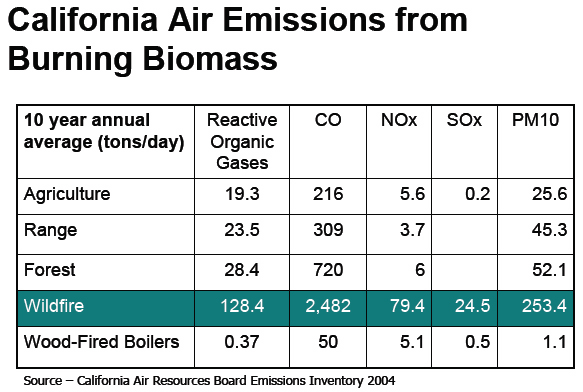
But we are just starting to recognize that forests can emit vast amounts of GHG through burning and decaying. Here are some numbers pulled together by the California Air Resources Board comparing the average emissions of major geographic sectors. Notice that wildfire emissions dwarf the volume from the other sources combined!

Satellite photographs taken during the last four years of wildfire’s devastating impacts on public lands provide clear evidence of the extent of this travesty.

In Congressional testimony Senator Pete Domenici of New Mexico testified that when the Hayman Fire burned in Colorado in 2002, NASA scientists estimated that the fire was emitting more carbon dioxide in one day than all the vehicles in the United States emitted in a week. It lasted 14 days.

Since 2002 mega-fires have gotten worse.

In 2003 the San Diego Cedar Fire (click to enlarge) was the largest in California history lasting 8 days and consuming an area half the size of Rhode Island. Here is a satellite photo of the emissions - so dense that air traffic control towers in L.A. and San Diego were closed for a period of time.


Simultaneously, a fire was burning in the San Bernardino Mountains, just east of L.A. It lasted two weeks and destroyed more than 1,000 other homes. Fortunately it stopped before reaching resort towns near Lake Arrowhead and Big Bear, shown in the upper right corner. If it had it would have decimated evergreen trees that were already sick, dead, or dying from bark beetle infestations - which, incidentally, is what happened in Big Bear two weeks ago. The lakeside community of Fawnskin had to be evacuated by the 15,000 acre fire. The smoke plume from this fire reached far north into Nevada.

Here is what a burned forest looks like (click to enlarge) - charred remains stripped of its leaves and pine needles and in active decay. According to the Forest Foundation the impact of wildfires does not end with the smoke. During decay trees emit about 300% more greenhouse gases than what was emitted during the fire.

Most of the charred remains need to be removed and the lands replanted. Unfortunately, “Nearly four years after fires burned more than 133,000 acres of national forest land in California, less than one percent of those acres have been replanted.”

Just Monday, Senator Craig of Idaho gave testimony in Congress stating that over $2 Billion has been spent this year fighting forest fires while less than $600 million has been spent on preventing them.

Indeed, 2007 has seen a startling upsurge in mega-fires. The Angora Fire, a 3,100 acre blaze in South Lake Tahoe, was responsible for emitting the equivalent of 143,000 cars for an entire year. A blaze 15 times that size devastated Montana.

On July 4th a fire broke out in the Santa Barbara mountains. A week later in Yosemite a satellite photo series was posted throughout the park warning hikers of the health impacts caused by the fire 180 miles away. Driving south through Bakersfield the sun was blotted out by the smoke. The fire lasted another two weeks.

The point is that MORE greenhouse gases are emitted each year from wildfires than we are likely to save in a decade of reduced vehicle greenhouse gas emissions. We can do much better.

Wildfire Impact on Wildlife
They say the road to hell - in this case wildfires - is paved with good intentions. Activists mount crusades and file litigation to protect endangered species which frustrate attempts to fix forest health problems that lead to wildfires.

It is impossible to estimate the impact of wildfires on wildlife but even if the species escape, it leads to overcrowding in surrounding ecologies. But not even mobile animals are immune from the quick moving fires. Like the victims of Pompei most animals die from asphyxiation. Fires can boil streams which kill the fish. The U.S. Fish and Wildlife Department reports that Georgia’s largest fire ever that started in the Okefenokee Swamp this year was also the most expensive ever for the agency.

The problem of forest density
According to Texas A&M professor Dr. Tom Bonnicksen, a founder of the Forest Foundation, the problem is one of forest density. Our forests have 4 to 10 times as many trees per acre as they used to have. People used to be able to gallop through forests - now it is hard to walk through them or fight fires within them.

Excess forest biomass in the form of small diameter trees, and underbrush create a kindling “ladder of fuel” that helps surface fires spiral up to the crowns of trees. Once there, a fire storm can evolve whipped by winds to spread rapidly in all directions.

Public agencies waste precious funds to fight the wildfires - the symptoms of unhealthy forests - rather than invest it in efforts to restore and manage forest health through thinning. When asked what the biggest hurdle is to deploying thinning programs that are important to restoring forest health, field Forest Service planners say "infrastructure." Without forest product industries to convert the woody biomass to carbon sequestering products and bioenergy, there is no where to store the collected woody biomass and no economically sustainable way to help pay for the program.

To restore forests to a healthy condition, Dr. Bonnicksen recommends a three step, economically sustainable solution that involves private industry who would restore and maintain forest stewardship as part of their operating overhead.
1. First they would harvest decaying biomass
2. Then reforest to a historic model specific to the forest, and
3. Third mechanically thin vulnerable forests of woody biomass as part of their stewardship.

The USDA Forest Service could provide oversight of the program.

-----------------
The followup presentation is titled Woody Biomass: Feedstock for BioEnergy

----------------
technorati , ,

May 23, 2008

Engaging Forest Stakeholders through Stewardship Contracting

We have seen too many examples of mainstream media spinning and twisting the discourse between science research, environmental concern, and public opinion. I recently attended a workshop that showed a constructive approach that is taking root in the forests of the Pacific Northwest.

Back in early March I organized two side events at the Washington International Renewable Energy Conference (WIREC) on "Bioenergy and Communications." The humble objective of these panels was to address the challenge of communicating bioenergy information to the public and engaging stakeholders the colossal energy and environmental paradigm shifts that are predicted to occur over the next few decades. The panelists were terrific but the central question remained largely unanswered:

What new ways might exist to engage stakeholders in the constructive development of economically sustainable solutions to environmentally sustainable challenges?

The federal Stewardship Contracting program is a good example of one innovative approach. It is providing a constructive means for bringing diverse stakeholders together to plan and finance forest restoration programs while rebuilding the economic infrastructure of local communities.

Last week the first of four traveling workshops titled Biomass Utilization and Stewardship Contracting was held in Auburn, California. It was hosted by the Sierra Business Council and sponsored by Resource Innovations of the University of Oregon, UC / Berkeley Cooperative Extension, USDA Forest Service (Region 5), the Sierra Nevada Conservancy, and Placer County (site of the recent Angora Fire in Lake Tahoe).

During these two days of presentations attendees witnessed the testimonies of Forest Service managers, community leaders, environmentalists, academicians, consultants, and fire fighters. These experts spoke knowledgeably about the challenges of forest restoration from their unique perspectives. Then examples were given of existing projects that were changing the environmental and economic landscapes of the forests they were designed to restore.

Four stewardship examples from the Pacific Northwest are amply documented in Redefining Stewardship: Public Lands and Rural Communities in the Pacific Northwest - a publication prepared by Ecotrust and Resource Innovations.

Besides meeting some terrific local leaders, what I learned was that patient community discourse is necessary in the formulation of sustainable projects. It is preferable to engage stakeholders up front rather than suffer the delays of reactive litigation to plans that have not been fully vetted by those most vested in the results of forest restoration - the local community.

Similar workshops will be held in Sonora (May 22-23), Bishop (May 28), and Chester (May 30).

----------------
technorati , ,

October 19, 2007

Watch 60 Minutes - Warming Climate Fuels Mega-fires

I recommend that my readers watch a story on CBS 60 Minutes this Sunday, October 21st. You can read it first at Expert: Warming Climate Fuels Mega-Fires - including my online comment. Like so many investigative stories on television, they create a significant amount of viewer outrage without offering solutions.

I am glad they are pointing out that "Seven of the 10 busiest fire seasons have been since 1999." What they don't point out is that 50% of the Forest Service budget has been allocated to fighting forest fires and obstructive litigation rather than deploying proven prevention measures.

Forests are now 4-10 times denser than their historic norm (when they were open enough for a horse to gallop through). Now dense underbrush and small diameter trees hamper walking and fire-fighting. That, coupled with warmer, dryer conditions, is what is causing these fires.

I witnessed a persuasive presentation at a workshop sponsored by UC/Berkeley and the USDA/Forest Service last month that thinning forests works. Through a series of photographs Ron Vineyard of the Eagle Lake Ranger District of the Lassen National Forest showed how the 2002 Cone Fire in Northern California extinguished itself within about 20 yards of its entry into the mechanically thinned zone. Their studies place the cost of suppressing a fire in an unthinned forest at $1,726/acre. The cost of mechanically thinning a forest with an underburn is approximately $204 per acre. An ounce of prevention is, indeed, worth a pound of cure.

With the benefits of thinning so obvious I asked him what the biggest hurdle was for the Forest Service. He said "Infrastructure." He explained that there wasn't sufficient private industry demand for the fuelwood to make publicly financed thinning operations economically sustainable.

Currently the forest products industry is not robust enough to fill the breach. But there is significant promise that new tech biorefineries will be able to cleanly convert woody biomass (fuelwood and underbrush) into cellulosic ethanol.

For now, I would like to see environmental groups restrain themselves from attacking Forest Service fire prevention programs they plan to deploy. If they care about global warming they should recognize that mega-fires now spew more greenhouse gas emissions per year than all the auto emissions of the U.S. combined.

I will be attending the Society of American Foresters National Convention in Portland, Oregon October 23-24 and presenting my speech Woody Biomass: Fuel for Wildfires or Feedstock for Bioenergy? October 25th at the Residual Wood Conference in Vancouver, BC.

technorati , , ,

August 11, 2008

Authority returned to the Forest Service

I am convinced that one of the hardest jobs in the government is to work in the USDA Forest Service. It is not that it is dangerous work... it's that it must be so frustrating.

Here is an organization entrusted with a gargantuan challenge, with what should be a more than adequate budget, and more responsibility than should be expected of any governmental agency - safeguarding the health of one of our biggest assets, our federal forests. The job should be the most fulfilling in government - "gardeners" of our rich forest legacy and its wildlife. The people I've met are dedicated and top-notch - steeped in decades of education and experience studying the fine machinations of our forest ecology.

So why is it so frustrating? It is because the management lacks any real authority. They cannot control their own much less our forests' destiny.

What is ironic is that the people that challenge them the most - the non-governmental organizations (NGOs) that frequently take them to court - insist on turning more private lands into their care. Do they receive commensurate budgetary increases to manage the additional lands? No. Are the forests going to be taken care of better by a federal bureaucracy than by private timberland owners - no. Why? Well, the private owners had authority to tend to their assets. The Forest Service has very little control over these same lands. It must be great sport taking the FS to court but it certainly isn't resulting in healthier forests based on better science.

Which is why it is heartening to see the Ninth Circuit Court of Appeals come out and unanimously overrule a decision that judges should not be making scientific decisions in lieu of Forest Service expertise. The August 2008 issue of the Society of American Forestry (SAF) reports on this encouraging turnaround.

Incredibly, many court challenges barring forest management projects are based on the specious argument that the Forest Service violates the National Environmental Policy Act (NEPA) because it doesn't "adequately address all of the uncertainties in its proposed treatments." The lower courts often take the view that "the public interest in preserving nature and avoiding irreparable environmental injury outweighs economic concerns." In short, neither money nor time matters if there is any possibility that their actions might be detrimental to some special concern or another. The appeals court's ruling counters that this policy gives the lower court too much authority over scientific matters outside its jurisdiction.

In its July 2 ruling on Lands Council v. McNair (or Lands Council I) the panel wrote that, “In essence, Lands Council asks this court to act as a panel of scientists that instructs the Forest Service how to validate its hypotheses regarding wildlife viability, chooses among scientific studies in determining whether the Forest Service has complied with the underlying Forest Plan, and orders the agency to explain every possible scientific uncertainty. As we will explain, this is not a proper role for a federal appellate court.”"

Such a ruling couldn't come too soon. As explained elsewhere in this blog, our forests suffer from too little forest management stalled interminably by litigation - particularly in view of the unnatural conditions of smoke and greenhouse gas emissions from wildfires which continue to distort the historic profile of our forests.

--------------------
Ninth Circuit: Improper for Judges to Act as Scientists
11-Judge Panel Says Courts Must Defer to Agency Expertise

In a landmark case, an 11-judge panel of the US Circuit Court of Appeals for the Ninth Circuit unanimously ruled last month that courts must defer to US Forest Service expertise when it cannot be shown that the agency acted in scientific uncertainty in complying with the National Environmental Policy Act (NEPA), and that the agency could choose the scientific methods it uses in meeting the requirements of the National Forest Management Act (NFMA).

Undersecretary of Agriculture Mark Rey praised the decision.
“We think this is a fairly significant decision—maybe the most significant Forest Service environmental case of the past two decades,” he said. “The panel was reacting to the Ninth Circuit getting deeper and deeper into a posture of second-guessing agency expertise or its use of expert scientific information. In several instances, the panel reversed what they believed was a drift in Ninth Circuit jurisprudence away from the standards of review used by other circuits.”

Rey added that the panel said that it was not necessary for the Forest Service to prove its methods to a level of scientific certainty.
“The panel said that wildlife viability is not the only consideration that the agency has to take into account and that we are not required to use on-the-ground analysis in all cases,” Rey said. “They said that it is not the court’s role to conduct an assessment of the methodology the Forest Service uses, that the Forest Service has discretion to determine what scientific studies are important, and that we’re not required to address every possible uncertainty in our decisionmaking.”

----------------
technorati , ,

August 24, 2007

California's Zaca Fire and Global Warming


Click to enlarge

Here's a question I haven't seen in the press...

What is the impact of public forest wildfires on global warming?

I have seen plenty of inferences that global warming is contributing to the cause of wildfire spread and ferocity but virtually nothing on how the burst of fire temperatures, soot, ash, carbon monoxide, and other toxic emissions impact global warming. No journalists make the connection between the rash of horrific megafires of the last two decades and the precipitous rise in carbon emissions during that same time.

U.S. Senator Pete Domenici recently testified...

When the Hayman Fire burned in Colorado in 2002, NASA scientists estimated that the fire was emitting more carbon dioxide in one day than all the vehicles in the United States emitted in a week.

That fire lasted over a month. The Spring 2007 megafire in Georgia and Northern Florida (the biggest in Georgia history) lasted even longer. The size, length, and ferocity of these fires is not normal - at least not prior to 1980.

Most animal deaths during and after a wildfire are caused by asphyxiation, not the flames themselves. In a sense, the "canary warning" to humans has been given. Now we must act to save not only forest wildlife, but all animals including humans who are in the path of wildfire plumes.

As the huge Zaca fire 9 miles north of bucolic Santa Barbara, California nears completion of its second month of devastation, it is time to ask some environmental questions:

Are we reaping the result of failure to adequately harvest excess forest fuel, reforest past forest acreage, and manage public forests as efficiently as private forests are managed?

Are public perceptions, litigation, and policies designed to protect wildlife diversity having the opposite effect? Stated another way, do efforts to preserve forests actually spell their doom and destroy the habitats of their occupants?

Can the federal and state governments ever be expected to allocate sufficient taxpayer funds to adequately manage the vast public forests under their stewardship?


Here are the latest facts on the Zaca Fire.
--------------------

Basic Information
Incident Type: Wildland Fire
Cause: Human Caused
Date of Origin: 07/04/2007 at 1053 hrs.
Location: 9 miles north of Santa Barbara

Current Situation
Total Personnel: 2,545
Size: 235,601 acres (1/3 the size of Rhode Island)
Percent Contained: 83%
Estimated Containment Date: 09/07/2007 at hrs.
Fuels Involved: Heavy brush containing a high dead component. Some conifer at higher elevations. Live fuel moistures are at 49% which is well below critical levels. A continuous fuel bed lies ahead of the fire.

Growth Potential: Extreme.
Terrain Difficulty: Extreme.
-------------------

I toured California in a motor home between Santa Barbara and Yosemite August 9th through 17. Here are some photos I took in Yosemite August 15th (click to enlarge)...


As I was travelling south August 17th on the 99 FWY near Bakersfield, we caught sight of the smoky plume of the Zaca fire which blotted out the sun at 5pm - actual darkness - (click to enlarge)...


This California roadtrip experience left an indelible impression - not the one I was expecting.

technorati ,

January 14, 2008

Senator Wyden: Thinning Forests to Save Them

Well, at least someone in the Senate has it right. Thinning forests is not only "not all bad" but absolutely necessary if we hope to return forest to their historic condition - their condition prior to the relocation of native americans, the rampant logging, the counter-productive suppression of forest fires, obstructive environmentalist litigation, and real estate overdevelopment of wildlands. Without thinning, there will be insufficient funding of this important work which will help reduce forest fires, their greenhouse gas emissions, and their rapacious impact on wildlife habitats.

Below is a press release reporting on Senator Ron Wyden's (D-Oregon) explanation of the need for thinning legislation. On January 9, 2008, a story by Jeff Barnard appeared in on the AP news wire about Wyden's plans to introduce legislation in support of measures to expedite the deployment of national forest logging projects.

---------------------------
Wyden Says Pacific Northwest Forests in Trouble, Thinning Will Help Increase Forest Health, Reduce Fires, Increase Jobs
Tuesday, January 8, 2008

Medford, Or -- Thinning the Pacific Northwest’s troubled federal forests will increase forest health, decrease the chances of catastrophic forest fires and create more timber industry jobs for Oregonians, Senator Ron Wyden said today.

“Thinning creates a healthier forest, a healthier economy and a healthier environment,” Wyden said during opening remarks at a roundtable discussion on how to improve federal forests in the Pacific Northwest. “Trees going up in smoke do nothing for the quality of our communities, our air or our families. As chair of the Public Lands and Forest Subcommittee, I am committed to finding a solution that protects our treasures while meeting our needs for healthy forests and providing timber for our mills.”

The roundtable discussion included representatives of federal forestry agencies, timber, recreation organizations, conservation groups and others. The roundtable in Medford and another earlier this week in Bend were are a follow up to a Public Lands and Forest Subcommittee hearing in Washington, D.C. last month.

“It’s outrageous, even by federal government standards, that over half of the Forest Service budget is spent on fighting fires while tens of millions of acres of choked, second growth forests go un-managed, waiting to burn,” said Wyden. “Government inaction, endless appeals, and poorly allocated resources have put communities, jobs and forests at risk like never before. If we are willing to work together toward bipartisan, sensible solutions, we can restore our forests, reduce the risk of catastrophic fire, protect old growth and ensure good, family-wage jobs for decades to come.”

Wyden noted that The Healthy Forests Restoration Act (HFRA) authorized up to $760 million in new money to complete hazardous fuel reduction work on 20 million acres of federal forest land, but that only 77,000 acres had been treated.

“At that rate, it would take the Bush Administration more than 250 years to complete the Act’s mandate,” Wyden said. “I, for one, am not willing to wait that long.

----------------
technorati , , ,